The 'industrial cathedral' that helped shape a town

 Trevor Frecknell
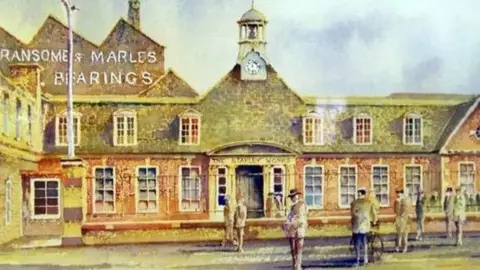
It is an "industrial cathedral" that has survived some of the most tumultuous events of the 20th Century.
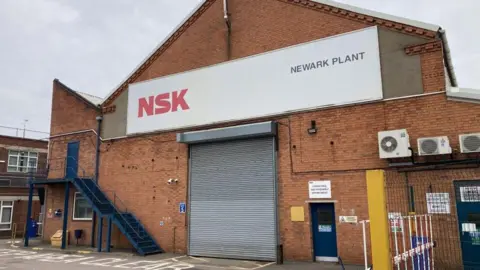
But 125 years of manufacturing could soon come to an end at the precision bearings factory in Newark, after owner NSK Ltd announced plans to halt production at its Northern Road site.
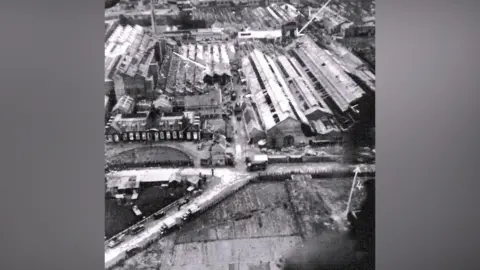
The sprawling facility, which became a target for the Luftwaffe during World War Two, has been among the defining institutions of the Nottinghamshire town, with production moving away from woodworking, on to weapons and then to cars and aircraft.
David Fargher, who runs a website on Newark's history, said: "Like the collieries, it was an industrial cathedral which shaped the communities around it."
Allen Ransome moved from London and set up the company, initially producing wooden items, in 1900.
But it was the pioneering bearings designed by employee Henry Marles in 1906 that set the company on its ultimate course.
Demand for these components surged during World War One, with the Newark site producing more than 50,000 every month by 1917.
As the business grew, so did its place in the life of Newark.
Fargher said: "It's played such an important role in the town. It's the last vestige of the industrial heyday of Newark.
"For the last 125 years, it has operated as a kind of university for Newark because it has seen people going from apprenticeships to master skilled engineers.
"And there was such a big community aspect to it - it wasn't just a factory.
"There were social clubs, sports teams and the world famous Ransome band."
The Ransome Brass Band was formed in November 1937 and made more than 500 BBC radio broadcasts, often direct from the works canteen.
"[The loss] is going to hurt, it's going to hurt Newark's identity," said Fargher.
 Shaun Noble
Such was its reputation for precision that when war came again, it was relied on to produce parts for the machines that fought on land, sea and air.
"It was the front line of the home front," said Fargher.
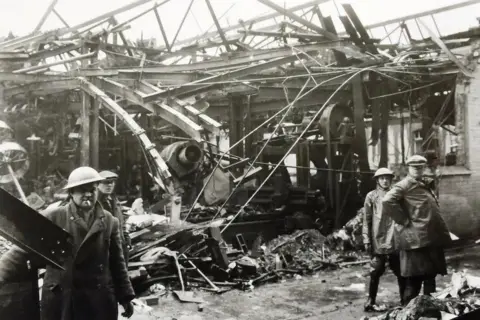
"But this brought dangers and Newark's darkest day, on 7 March 1941, when the Luftwaffe bombed the factory, killing 41 people and left 165 badly wounded."
Another indication of its importance was the fact the factory was back in full operation just three weeks later.
 Trevor Frecknall
The war also inspired the establishment of two of the site's more unique features - its own hospital and fire brigade.
The fire brigade survived for many years after, with volunteers equipped and trained to Home Office standard.
The hospital was bricked up soon after the war but was explored in 2000 as part of centenary celebrations.
Fargher said: "During the war it was producing bearings for Spitfires, Hurricanes and then Lancaster bombers.
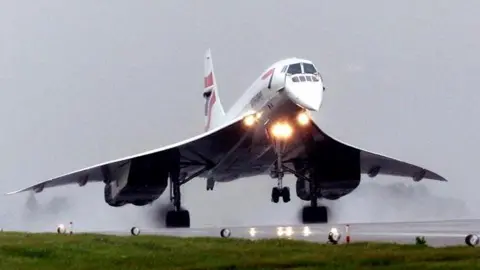
"After that, bearings from Newark were used in Concorde, Harrier jump jets and the original Mini.
"They may not be made anymore but the products from Newark have been used in engineering landmarks."
 PA
PAIn the late 1960s, Ransome and Marles merged with fellow British firms Hoffmann and Pollard to form RHP, a new company employing 17,500 people across eight factories.
In 1983, the site was purchased by Japanese bearing manufacturer NSK.
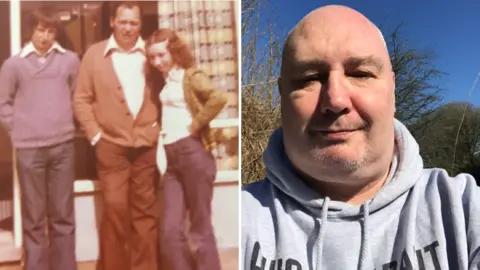
Kevin Bryan grew up in Newark and generations of his family - three grandparents and both parents - worked at the site.
He started in the late 1970s and said: "When I think back to it now, a lot of the machinery was very old fashioned and it had probably been there 50 or 60 years.
"And some of the supervisors were proper old school supervisors and with us youngsters they could be like school teachers, trying to be very strict."
 Kevin Bryan
At its height, the factory employed more than 5,000 people, and dominated the surrounding streets.
"My earliest memory of the place was my dad, Terry, going to work every day on his pushbike, as most people did back then," said Bryan.
"If you looked at the main road up to RHP, it was rows and rows of people on pushbikes.
"My next door neighbour, his dad was the same, it was just that everybody where I lived worked at RHP bearings."
With more competition from abroad and technology changing, the factory began to shrink, but by 2025 it still employed more than 400 people and produced around 500,000 bearings a year.
Its decline inevitably affected many of those who had once joined the crowds walking and cycling to work.
Bryan said: "My dad did his apprenticeship there and he was the factory joiner so he was always busy and he absolutely loved the place.
"It was all he knew, he was a fantastic joiner, he could make anything out of wood.
"I can remember the day he was told he was going to be made redundant.
"He was a tough man - old school - and it absolutely broke his heart".
Listen to BBC Radio Nottingham on Sounds and follow BBC Nottingham on Facebook, on X, or on Instagram. Send your story ideas to eastmidsnews@bbc.co.uk or via WhatsApp on 0808 100 2210.
