Lost Tudor tapestry returns home after 100 years

 Mike Hodgson
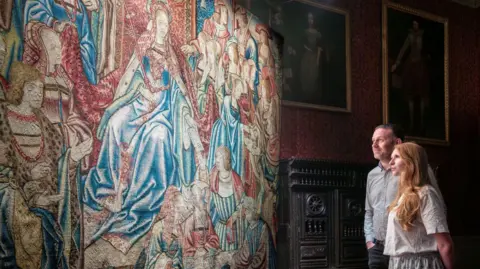
A lost Tudor tapestry that was reluctantly sold to help fund the running of a Norfolk estate has returned home after 100 years.
The artwork, which once hung in the King's Room at Oxburgh Hall, depicts a scene from the Old Testament Book of Esther.
Its location was unknown until last year when it was spotted for sale at a fine art fair in Maastricht in the Netherlands.
Claire Golbourn, from the National Trust, said: "The Esther tapestry survives in exceptional condition, with a richness of colour that remains striking for its age."
The tapestry was sold alongside six others in 1924 to French art dealers Seligmann & Co, based in Paris and New York, and was taken to the United States by an ocean liner.
The exhibition label on the item said 'Room of the King, Oxburgh Hall, Norfolk' and the National Trust worked to authenticate the item and trace it back to auction notes.
Through grant funding and a private donation, it was purchased and has since been returned to the estate.
 Mike Hodgson
Pierre Maes, director of The Royal Manufacturers De Wit, where the tapestry was listed for sale, said: "We are always searching for exceptional pieces with a unique history.
"On this occasion, we had the opportunity to make a significant contribution to a tapestry's history by returning it to its place of origin. It is a true honour and every art dealer's dream."
The seven tapestries were said to have originally been sold at auction by Sir Henry Bedingfield, 8th Baronet, however, the location of the other six items remains unknown.
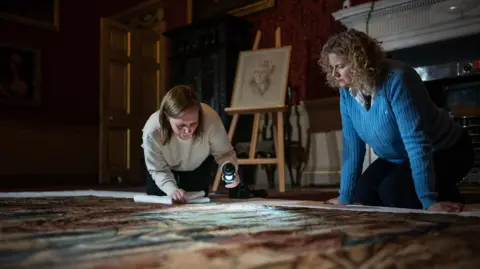
Golbourn, who is part of the National Trust's textile conservation studio, helped to assemble and authenticate the tapestry.
"While it has benefitted from minimal previous conservation and past reweaving, nothing can take away from the splendour of this tapestry," she said.
"The intricate detail of Esther's cloak and canopy, together with the remarkably realistic tassels, speaks to the extraordinary craftsmanship and artistry of the piece."
Do you have a story suggestion for Norfolk? Contact us below.
Follow Norfolk news on BBC Sounds, Facebook, Instagram and X.
