UK economy grew faster than expected in February ahead of Iran war

 Getty Images
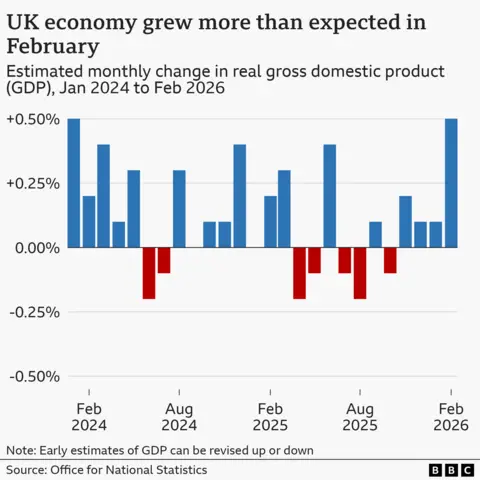
The UK economy saw its biggest monthly rise in more than two years in February, official figures show.
The Office for National Statistics (ONS) said the economy grew by a faster-than-expected 0.5%, while it revised its estimate for January up to 0.1% after previously saying the start of the year had seen no growth.
The figures cover a period before the outbreak of the US-Israeli war with Iran on 28 February, which has caused a major energy shock and experts warn risks a global recession if it is prolonged.
This week the International Monetary Fund (IMF) cut its estimate for UK growth this year, warning it was set to be the hardest hit of the world's advanced economies.
The IMF said it expected the UK to grow by 0.8%, down from the 1.3% prediction it had made in January before hostilities began.
The Fund said the downgrade was due to the impact of the war, with fewer interest rate cuts now predicted and an expectation that the impact of higher energy prices will linger into next year.
Most economists had forecast the economy would grow by just 0.1% in February. Deutsche Bank's Sanjay Raja said the actual figure had "smashed expectations" but also warned that it would not last.
The monthly increase is the biggest since January 2024 when the economy also grew by 0.5%.
The ONS said the key services sector - which accounts for more than three-quarters of the economy - grew by 0.5%. Services includes areas such as travel, accommodation, retail, hospitality, real estate, finance and entertainment.
Production output also grew by 0.5% in the month, and construction rose by 1.0%.
In the three months to February, a less volatile measure in comparison to the monthly numbers, GDP also grew by 0.5% - up from 0.3% in the three months to January.
The National Institute of Economic and Social Research (NIESR) called the latest expansion in the economy "sizeable" but said it expected a slowdown in March.
"Unfortunately, the latest energy price shock has likely pulled the rug on this momentum, with another year of above-target inflation and a softening labour market likely to come," said NIESR associate economist Fergus Jimenez-England.
Drivers in the UK have seen petrol and diesel prices rise sharply since the war broke out.
Heating oil users have also been hit by steep increases, although households in Britain will be shielded from rising energy prices until July under Ofgem's energy price cap.
The economic ripple effects from the conflict could push up inflation - the rate at which prices rise - which had been on track to fall back to the Bank of England's 2% target by spring.
A pick-up in inflation could also affect interest rates. Prior to the war they had been expected to fall, but now there is speculation rates will be held steady or even rise this year.
The change in expectations has already affected the mortgage market. Hundreds of deals have been pulled by UK lenders, with average mortgage rates rising to levels not seen since last spring and summer.
Dame DeAnne Julius, a former member of the Bank's Monetary Policy Committee, which makes interest rate decisions, said the economy had been "pretty stagnant" for more than half a year.
February's GDP rise was "a little chink of good light... but it doesn't change the overall picture," she told the BBC.
"We're still in the situation where the economy is not buoyant, an interest rate increase would not help in terms of growth, but the Monetary Policy Committee has to keep its eye first and foremost on inflation."
Ruth Gregory from Capital Economics said the "bumper" growth in February was "probably already extinguished" by the Iran war.
But she said it was encouraging that some of the sectors most exposed to the rise in energy prices had performed well, such energy-intensive mining, transport and retail.
James Murray, Chief Secretary to the Treasury, said growth "only happens when the economy is on solid ground".
"That's why in a changing world our plan to restore stability, boost investment and deliver reform is the right one to build a more stronger, more resilient Britain."
Shadow chancellor Sir Mel Stride welcomed the growth but said this week's IMF downgrade showed the economy was "totally unprepared for the recent energy shock".
The Liberal Democrats' Treasury spokesperson, Daisy Cooper, said the positive figures were "already in the rear view mirror as the UK is driven into a precarious economic crisis".
The SNP's economy spokesperson, Dave Doogan, said the news would "provide cold comfort to the thousands of Scottish households that have been hammered by sky-high energy and fuel bills".
A Plaid Cymru spokesperson called for action to support households and businesses facing "yet another squeeze" due to the war.
Also on Thursday, Tesco said the war in Iran was "creating further uncertainty for consumers and the economy more broadly".
The retail giant said this uncertainty made it harder to predict its results this year, and its profits could fall under certain circumstances.
Tesco boss Ken Murphy also said there were no issues with food availability, after reports the UK could face some food shortages by the summer under a worst case scenario of the Middle East conflict drawn up by government officials.
