Why has London got a cable car and who uses it?

 Yui Mok/PA Wire
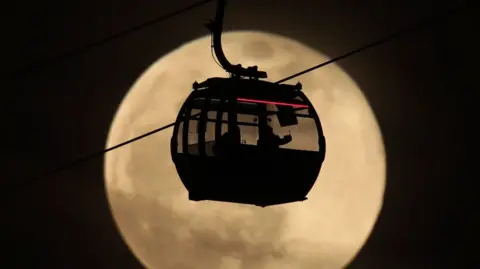
They are a familiar sight in the mountains of the French and Swiss Alps, but not in urban terrains - so why does London have a cable car?
Some call it the Dangleway (although officially it is now called the London Cable Car) on the day it opened in 2012, by a quirk of fate I was the first journalist on it ahead of the then-mayor Boris Johnson.
Somehow, I ended up in a car with the then Transport Commissioner Peter Hendy. Back then, the emphasis was on how the cable car could be a viable commuter route for lots of people and handy resilience if the Jubilee line went down. It was also touted as being a regeneration tool for the whole area.
But many at Transport for London are now pretty open in their belief that it's basically a tourist attraction. Surprisingly - perhaps - the cable car actually makes a tidy little profit.
It is also the only place on TfL services where you are permitted to drink alcohol -£32 per person for the champagne experience, if you're interested.
"The most expensive urban cable car in the world."
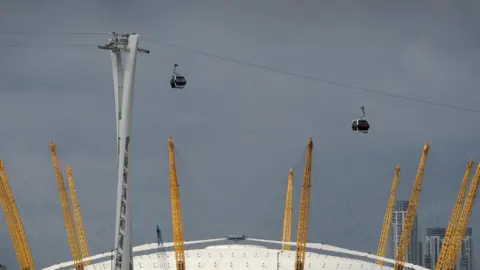
The idea for a cable car between the Royal Docks and the Greenwich Peninsula surfaced in the 1990s ahead of the opening of the Millennium Dome, but it never happened.
It was revived by Johnson to give a bit of pizzazz to the Olympic transport legacy. Even though TfL never said it would be open for the Olympics, it did open prior to the Games to much fanfare on 28 June 2012.
There was also criticism that it was a vanity project.
Costing about £60m, it was at the time the most expensive urban cable car in the world.
During that era, there was quite a lot of money available for new infrastructure - in fact £8m for the cable car came from the European Union as it was designed to help regeneration - so Johnson did not rule out other cable cars for London.
 PA Media
It has an operating cost of £9.8m, but generates a surplus (including advertising) of £1.6m a year.
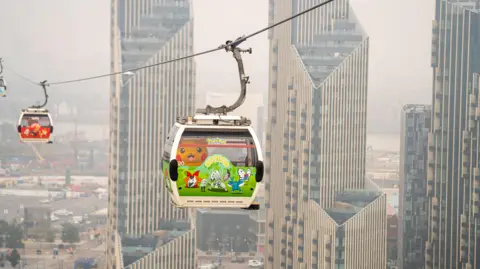
Along with the hire bikes, the cable car was an outlier for TfL as it was sponsored, first by Emirates and then by IFS AB. It now no longer has a lead advertiser, instead it wants to have more flexibility to focus on pop-up events to celebrate "seasons, major events and cultural moments in the capital".
 PA Media
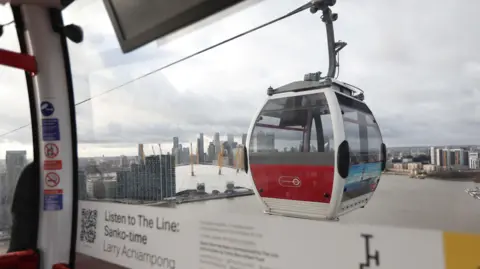
Last week, we counted the number of commuters using the Dangleway for two hours one rush hour. There were 40 users. Many were using it with bikes, as the crossing is one of the few ways of getting a bike across the Thames east of Tower Bridge.
In 2025, due to the lack of commuters, TfL cut the early opening hours, but the transport authority says tens of millions of journeys have been made on the London Cable Car since it opened.
The vast majority are tourists.
According to TfL, the cable car has been recognised among Tripadvisor's top 10% of things to do worldwide for two years in a row.
It can get very busy during the holidays and, at £7 for a single or £13.50 for a return, is relatively inexpensive as tourist attractions go. It is pricier than a Tube or bus fare, although a book of 10 singles for £20 brings the cost down to £2 a trip.
TfL figures show about 40,000 a month use the cable car during the summer.
Some have queried whether a transport authority should be running a tourist attraction, but all of those visitors we spoke to loved the experience. It's difficult to deny that the views are spectacular.
 PA Media
Danny Price, director of sponsored services and regulatory compliance, said: "Since opening in 2012, London's Cable Car has become one of the capital's most popular visitor attractions, welcoming around 1.5 million customers each year."
He added: "We have a number of exciting plans in development for the London Cable Car, which will help ensure it remains one of the best things to do in London."
Listen to the best of BBC Radio London on Sounds and follow BBC London on Facebook, X and Instagram. Send your story ideas to hello.bbclondon@bbc.co.uk
