Terrorism, wildfires and battery blazes - fire commissioner on LFB's challenges

 BBC
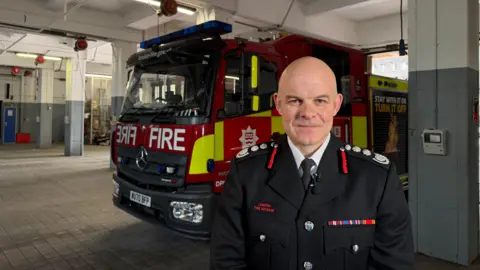
BBCAfter almost a year in the job, London's fire commissioner, Jonathan Smith, has been speaking to BBC London about how the London Fire Brigade (LFB) is adapting to a rapidly changing picture in the capital.
London's fire service spans 103 fire stations and includes 155 fire engines, 11 aerial appliances, 14 fire rescue units, as well as specialist urban search and rescue teams, drones and fireboats.
I met the commissioner at one of those fire stations - Lambeth - a Grade II listed building constructed in 1937 that overlooks the Thames and has a rich history as the brigade's former headquarters.
As the LFB looks to move forwards to meet new challenges, it is also planning to head back, by returning to its former Lambeth home over the next couple of years.
LFB figures show just how busy the service has been in recent times:
- Firefighters rescued an average of seven people a day during the last financial year, totalling 2,455 rescues and a rise of 2% on 2024/5
- Over the same 365-day period, 247 people were rescued from fires, an 18% increase on the previous year
- In total, firefighters carried out rescues from 44 different types of emergencies - the most common rescue was helping someone "collapsed behind a locked door" (1,050), followed by lift rescues (379)
- Firefighters also rescued five people every week at special service incidents, such as a child with a toilet seat stuck on their head and a woman with her hair caught in a bike chain
However, what quickly became clear in the interview was that whilst the brigade still works to tackle fires, it has had to adapt to new challenges, particularly in recent years.
Summer wildfires and winter floods bring twice-yearly challenges. There's been a 10-fold increase in lithium-ion battery fires on electric bikes. Terrorism is playing a bigger part in what the brigade does.
And as the challenges in the capital evolve, the question of funding is at the core of the pace in which the LFB can adapt.
When it comes to financing the work the service does, Smith says the cross-party support received from the mayor and the Greater London Authority has been good.
However, he points out funding is constantly needed for new equipment and training, to "keep pace with the changing nature of risk".
Terror response
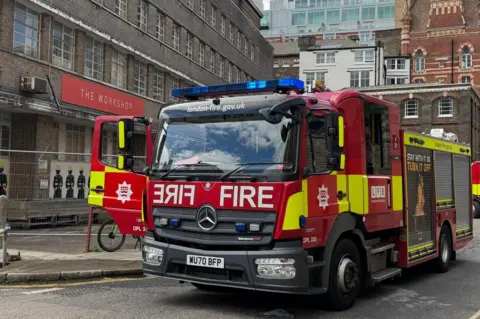
Responding to terror threats might not be something you would naturally associate with London's fire service, but it's something the brigade is increasingly involved in.
The commissioner tells me in times of international uncertainty, the service plays a key role in dealing with threats from both international and domestic terrorism.
"What can happen that can seem many, many miles away actually has ripples on the streets of London in a way that it doesn't in other parts of the UK," he explains.
"Arson has been the weapon of choice that's been used predominantly targeting both Jewish residents and the Iranian diaspora up in north-west London.
"We've had our fire investigation teams carrying out significant investigation work which has actually led to people being arrested by counter-terror policing and charges being levied."
All the brigade's pumps and helmets have ballistic protection, he points out, meaning "our frontline crews can respond to marauding terrorist attack".
"We have to continue to evolve and develop as a fire and rescue service because the nature of risk that we're dealing with continues to change."
Building safety
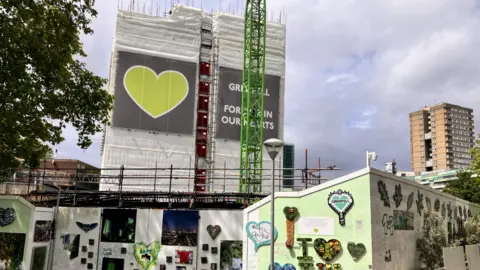
As we approach the nine-year anniversary of the Grenfell Tower fire, the disaster that raised the alarm on a number of safety defects on residential buildings in London and beyond, there is still an "unacceptable" number of unsafe buildings, according to the commissioner.
"What we've learned since Grenfell... is that there are far, far too many buildings, whether in London or other parts of the UK, that are simply not safe or fit for purpose."
As of mid-May there were 179 residential buildings in London with dangerous aluminium composite material (ACM) cladding, according to LFB data.
The same figures show the number of buildings which have a simultaneous evacuation plan has increased.
A simultaneous evacuation means in the event of a blaze, people must leave their flat or maisonette and close the doors behind them, rather than staying inside the property.
Prior to Grenfell, many buildings had "stay put" advice as the buildings were built to give some protection from fire for a period of time - but in some cases this has been retracted when buildings have been proven unsafe to remain inside.
The current number stands at 1,653, up on two months before as more buildings with fire safety defects are discovered.
Smith says the brigade has had to adapt since the blaze at Grenfell Tower.
"Because of the changes that we've made over the last five to six years in particular, our crews now are ready for the unexpected and to deal with if buildings are not behaving in the way that we would anticipate and expect.
"We've now got the procedures to be able to deal with it."
Battery fires
 London Fire Brigade
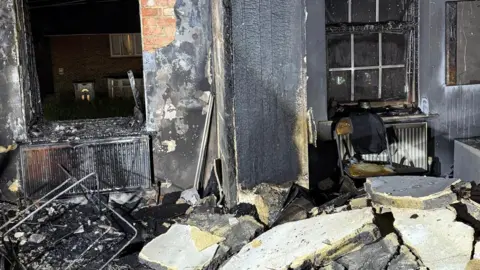
As the number of lithium-ion battery-powered goods in our homes increases with advances in technology, so does the risk of fire when those goods are not disposed of correctly.
Common household goods that contain lithium-ion batteries include smartphones, laptops, headphones, portable chargers and larger items like e-bikes.
Between 2020 and 2025, the LFB saw a 900% increase in fires caused by this type of battery.
"If we go back to when I first joined nearly 27 years ago, it was chip pan fires, it was people smoking in bed, it was kitchen fires and there's still issues there, but this is the way that fire risk in particular has evolved," says Smith.
Now faulty e-bikes and e-scooters are a common cause of fires.
When I ask Smith about the advice for those considering buying one, he says "the simple message is don't... because the risk is enormous.
"When these things are charged poorly or you're using equipment that isn't fit for purpose, they can go off like a bomb."
Climate crisis
 PA Media
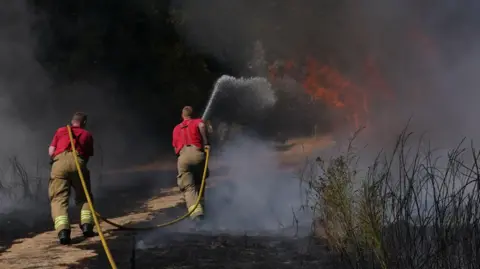
Wildfires and flooding have also become an increasing threat to London.
Last year, 122 wildfires were recorded by the end of August, the highest since the 2022 heatwaves and double the number seen in 2023.
"If you take the weather forecast that we're predicting for this weekend as a good example, we just simply weren't having a conversation about wildfires in London five, six, seven years ago, and now that's a regular occurrence," says Smith.
"That really goes to the heart of it - the risks that we're now dealing with are unprecedented.
"As the temperatures continue to rise and we see the ground become drier and drier, this is a risk now that we're seeing in London in a similar way to that you see in Portugal or the south of France or Spain or even Australia and Greece."
Additional reporting by Lauren Stanley
Listen to the best of BBC Radio London on Sounds and follow BBC London on Facebook, X and Instagram. Send your story ideas to hello.bbclondon@bbc.co.uk
