Campaigners call for vote on public water ownership

 BBC
BBCThe two campaigners at the centre of the recent Channel 4 docudrama Dirty Business have launched a petition calling for a referendum on water company ownership.
Oxfordshire-based Ash Smith and Peter Hammond, from Windrush Against Sewage Pollution (Wasp), are calling on the government to bring the water industry back into public ownership.
Smith, who was portrayed in the programme by Bafta nominated actor David Thewlis, said the petition was "how we stop being victims and start fighting back".
Responding to the referendum calls, a spokesperson for the government said nationalisation was "not the answer".
But Smith said: "I think people are sick of being told they can't have healthy rivers and seas, just because powerful financiers want to keep making money from our water bills.
"Our government is listening to them [water companies] but not to us," he added.
In calling for the public vote, Smith and Hammond were joined by musician and environmental activist Feargal Sharkey, who said he was "100% behind" the petition.
"It's unforgivable how the government is ignoring the evidence and the public, and saying water must stay privatised despite its catastrophic, expensive failure," he added.
Earlier this year, Smith and Hammond became the focus of Dirty Business - which was partly based on their decade‑long investigation into England's water companies.
The pair first began investigating why stretches of the River Windrush in the Cotswolds were becoming polluted in 2016, and have since been vocal critics of the industry and in particular their local provider, Thames Water.
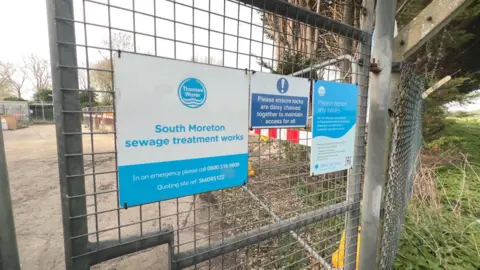
In March, a report by Wasp found that South Moreton sewage treatment works, near Wallingford, was the firm's worst offending site for "illegal spills", whilst the River Pang in Berkshire was the worst-affected river.
At the time, Thames Water said the works in South Moreton would be upgraded to reduce untreated discharges this year, and that it was delivering "record levels of investment across [its] wastewater infrastructure".
But Christian Dunn, a professor of environmental science at Bangor University said people "have to be very careful what you wish for" when it comes to nationalising the water industry.
"We cannot just assume that having something in public ownership is going to be better, and I would caution that," he said.
Dunn questioned the financial implications of bringing the industry under public ownership, and the funding battles that would follow with other government departments.
"The publicly owned water industry would be vying for money in the budget alongside health, alongside defence, alongside education. Do we want that?"
"There is no silver bullet to this problem, but we do need a national debate, and it needs to be nuanced, and it needs to be grown up," he added.
A government spokesperson said nationalising the industry would "cost taxpayers £100bn and take years to unpick the current ownership model, during which investment would dry up and sewage pollution into our rivers would get worse".
"This government is taking action to clean up our rivers, lakes and seas," the spokesperson said.
"We've already banned unfair bonuses, secured record levels of investment and introduced landmark legislation to hold water companies to account."
You can follow BBC Oxfordshire on Facebook, X (Twitter), or Instagram.
