Council to 'better explain' vertical drinking term

 Getty Images
Westminster City Council has published a revised licensing policy following a high-profile debate about what it called "vertical drinking".
Last month, the Conservative-run council released a draft policy that encouraged pubs and bars to provide more seated areas in place of standing ones.
It was criticised by local businesses, the government and London's Mayor, Sir Sadiq Khan, who said that you "can't run a world-famous nightlife district with a village-hall mindset". The council later clarified that it had not planned to ban people from standing as they drink.
In its latest statement, it said it was taking on board feedback to better explain technical terms like vertical drinking.
Westminster Council licenses more than 4,000 pubs, clubs, bars and restaurants, including venues in Soho, Leicester Square, Piccadilly Circus and Covent Garden.
It needs to update its current licensing policy - drawn up in 2021 - by 1 October.
In the draft plans that were published at the start of August, the council said it wanted to "discourage excessive drunkenness and encourage the provision of more seating in premises that serve alcohol for people to sit and enjoy a drink and order food by table service in place of open bar space that caters for high volume vertical drinking".
"The introduction of measures to reduce the extent of, or to remove opportunities for, vertical drinking could address the underlying reasons for the policy," the document read.
The guidance also suggested applicants for new licences should aim for "a predominantly seated operation with fixed seating", alongside waiter service replacing vertical drinking, and restrictions on customers consuming alcohol while standing.
The response drew criticism from the government, which said: "Busy pubs full of people talking to each other is not a public nuisance, it is British life and it is thousands of jobs."
Soho Business Alliance, which represents businesses in the area, said: "It's been like that for years where people are standing and drinking; it's not causing crime, it's not causing issues."
Responding, council deputy leader Tim Barnes denied there was a plan to ban drinking while standing up.
"Suggesting otherwise is a wilful misreading of the policy proposals with clauses taken out of context," he added.

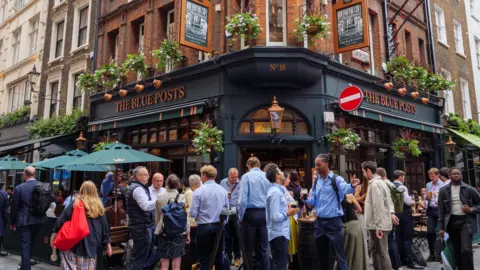
Supervisor at the Blue Post on Berwick Street, Samuel Maken, said standing-up drinking was "vital" for the hospitality industry in Soho.
"The punters coming and standing outside, they fill up a lot of the capacity we're able to take - there's very limited seating and limited space inside - so if you were to remove that, you're effectively removing half of our revenue that we could generate on a busy Friday and Saturday night.
"In terms of Soho, in the evenings in particular, it does have the kind of after-work vibe where people like to come out and stand - it [banning vertical drinking] would be completely detrimental to the whole aesthetic and vibe in Soho.
"It's a bustling community. It's one of the busiest spots in London. It's culturally significant, historically, if you look at all the musicians and the scene that's been born out of this area."
Valentina, who was visiting from Miami, said she "loved" drinking outside.
"I think everyone should have it and it should stay like this. I prefer being outside, always.
"It makes it more lively, more attractive for people to come and have a drink. People see each other drinking outside, have a chat."
Another customer, Mark, said one of the reasons he came to this pub was "to stand outside in the sunshine and watch people go by".
"I immerse myself in this experience. I don't want to sit in the pub, you know, just out here you can see all sorts of people and stuff."

Customer Phil said he "loves being standing up" and if punters were made to go indoors or into a pod he would go elsewhere.
"It's what you come up Soho for. Stand outside, people watching, get the vibe.
"It'll kill Soho. It's just been a place for people drinking and meeting up in bars and pubs for hundreds of years really."
Another drinker said he went to the USA and it was "rubbish".
"You go in, you have to sit down, you sit at the bar and you're surrounded by people you don't really want to talk to. You feel obliged to talk to the guy you don't even know next to you and you get bored of him after a while.
"You can't walk around, chat with different people, be sociable, see your mates, have a wander.
"And I think it's healthier standing up as well, isn't it? Especially if you're working all day behind a desk, you want to stand up."
'Fund the services'
In its latest guidance published on Monday following the summer consultation, the council said policing was the concern raised most often, adding officer numbers had fallen in recent years and the Met's licensing team had been halved in the past year.
It is now asking the mayor to reverse those reductions and pay for visible, dedicated policing in the West End during the evening and overnight.
The council also wants night bus routes in central London extended, saying recent cuts had made it harder for people to get home, and is calling for Night Tube services to run on Thursdays.
Friday and Saturday trade has recovered towards pre-pandemic levels, it said, but other nights remain quiet and some venues are struggling to stay viable.
Barnes said: "A lack of investment in policing has left the Met objecting to many licensing applications over public safety concerns.
"People struggle to get home from a night out when late night bus routes have been cut and overnight Tube services are non-existent during the week.
"We'll take this on board and do our bit to support the hospitality industry but we need the mayor's team to fund the services which make London a 24-hour city."
The council said it would review its licensing policy each June and set up an expert advisory group.
A spokeswoman for the mayor said the number of officers in the West End had doubled.
"In addition, Sadiq's newly opened Command Cell in the heart of the West End is now serving as a central point for police and partners to share intelligence, identify suspects and co-ordinate action to make our streets safer for Londoners and visitors alike."
She added that the capital's Night Tube service "provides a vital boost for our night-time economy".
Transport for London and the Metropolitan Police have been approached for comment.
Listen to the best of BBC Radio London on Sounds and follow BBC London on Facebook, X and Instagram. Send your story ideas to hello.bbclondon@bbc.co.uk
