Reports of melted roads rise by 67% in three years

 Richard Daniel/BBC
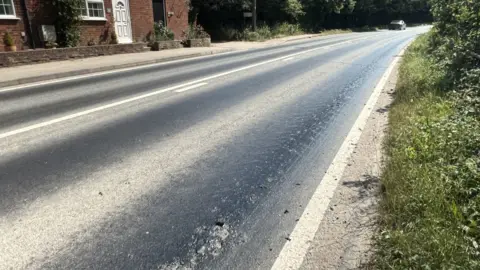
The number of cases of roads melting in the East of England has risen by 67% in the past three years, data obtained by the BBC shows.
The region's highways authorities reported more than 200 cases of melting roads in the past four years, following the BBC's request for information.
Experts said that part of the problem was caused by most UK roads being designed for cooler weather rather than prolonged periods of "extreme heat".
The Department for Transport (DfT) said it was supporting local highway authorities to improve the resilience of road networks through guidance, tools and resources.
Earlier this year the A143 at Stanton, near Bury St Edmunds, Suffolk, was shut as an emergency measure amid reports patches of asphalt were being lifted up by cars using the road.
It was the second time this year the road surface was reported to have melted as a result of high temperatures.
But the BBC, which asked all highways authorities in the East of England how many instances of roads melted by hot weather they had dealt with in each financial year since 2023, has now established the Stanton incident was merely one of dozens across the region.
According to comparable figures from eight authorities, the number of melted road cases rose from 33 in 2023-24 to 55 in 2025-26.
In Suffolk instances of melting roads rose from three cases to eight and in Norfolk the number of "dustings" - when gritting lorries spread light dustings of sand or stone to prevent road tarmac from melting - rose from 29 to 46.
Buckinghamshire Council did not provide data for the 2023-24 to 2025-26 but said it had received 59 cases since April this year.
Essex had one incident in both 2024-25 and 2025-26 and a further six cases since April this year.
West Northamptonshire Council said it had two incidents in the past three years while North Northamptonshire Council said it did not hold data about melted roads.
Cambridgeshire, Hertfordshire, Thurrock councils said they had not experienced any incidents with melting roads in the past three years.
As well as the Stanton cases, Suffolk County Council said it had a further eight incidents this summer.
A spokesman for the authority said: "While incidents of roads being affected by hot weather remain relatively uncommon, Suffolk Highways has experienced a small number of cases following periods of exceptionally high and prolonged temperatures."
The council said it used granite dust during periods of "extreme heat" and said it "continues to work with other local highway authorities, industry partners and suppliers to explore innovative maintenance techniques and materials that improve network resilience".
This work includes looking at new road treatments that can withstand a wider range of temperatures.
"Through ongoing research, trials and sector-led collaboration, the highways industry is continuing to develop and identify best practice solutions that will help ensure the long-term resilience and performance of highway assets," the spokesman said.
 Dr Mashael Kamran
Dr Mashael Kamran is a post-doctoral research associate at the University of Cambridge whose work looks at the future building and maintenance of the country's transport infrastructure.
"Many of our roads were built for the cooler winter weather rather than the warmer weather we are seeing," she said. "When air temperatures reach 30C (86F), the roads below can go up to 50C (122F). On top of that, when you've got heavy duty traffic as well, that can cause rutting of the roads."
She said tight council budgets meant many authorities were increasingly surface dressing or patch repairing roads rather than relaying them, which meant they remained susceptible to melting in hot weather.
"That doesn't really help in a heatwave situation," she said.
She said part of her work involves exploring various road materials that perform at a wider range of temperatures and how to prioritise where limited budgets are spent first.

The Chartered Institute for Highways and Transportation (CIHT) said high temperatures were having a "significant impact" on roads.
It said when air temperatures are 30C the road surface can reach between 40C and 50C adding that some roads start to soften above 50C.
Sue Percy, the chief executive of CIHT, said: "Climate disruption is no longer a future challenge.
"Highway authorities and transport operators are already seeing the effects of higher temperatures and more extreme weather on the transport network.
"When transport networks are disrupted by extreme heat, the consequences go beyond damaged infrastructure. Communities can lose access to jobs and essential services, businesses face delays and disruption, and the wider economy suffers."
 Luke Deal/BBC
A spokesperson for the DfT said: "We recognise the impact of extreme heat on our road network, which is why we are investing a record £7.3bn in local highway maintenance, and working closely with local authorities to help manage the impacts of hot weather on roads."
