Why can golf courses stay green during droughts?

 Getty Images
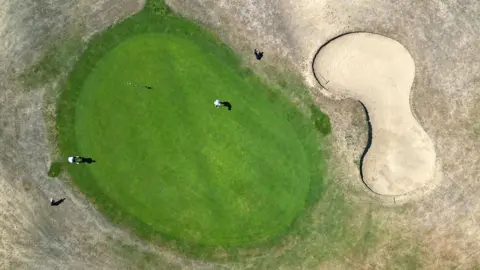
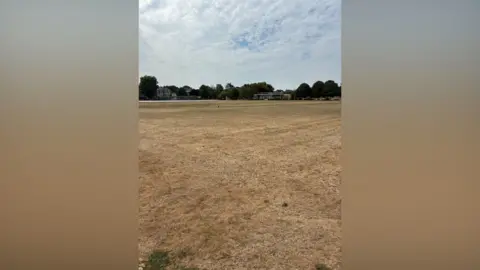
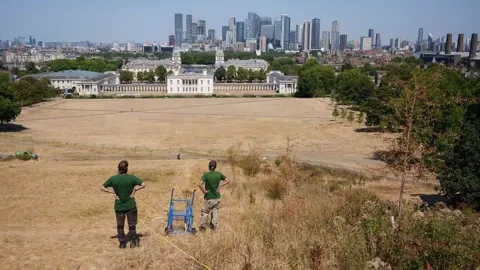
While London's parks are showing the strain of a prolonged drought and high temperatures, some spots in the capital are still sporting pristine green grass.
School playing fields and golf courses appear partly unaffected by the hosepipe ban imposed by Thames Water on most of London at the end of July.
Dulwich College and St Paul's School have come in for criticism for the lushness of their playing fields at a time of concern about the water supply, while London's golf courses are also being eyed with envy by homeowners whose lawns are turning brown.
Complex rules
While there is a hosepipe ban in force, there are numerous, specific and varied exemptions.
For example, vulnerable customers on the priority services register do not face a ban, which is the same for those needing to use a hosepipe to maintain a domestic fish pond or to fill pools within places of worship that are used as part of a religious ceremony.
The full list is on the Thames Water website, and the rules are complex.
A household cannot use a hosepipe to clean their windows, but a professional window cleaner can.
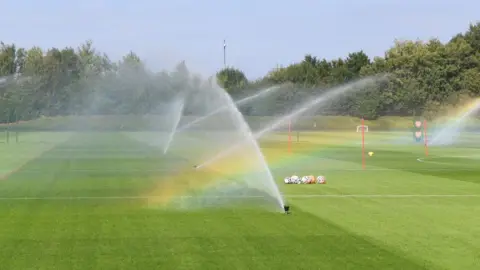
Sports grounds including golf, cricket and football can use a hosepipe or sprinkler, but can only water the grass areas "actively used for play", not the entire surface.
 Getty Images
Dulwich College said it followed the rules set down by Thames Water.
A spokesperson said: "The limited irrigation we undertake is solely to maintain safe playing surfaces during an extended period of exceptionally dry weather, not to keep the grounds green for aesthetic reasons.
"Without limited regular watering, pitches quickly become unusable and can take several weeks to recover.
"Maintaining them now uses less water overall than allowing them to dry out completely and then attempting to restore them before they are next used."
St Paul's School said it was watering "just the pitches we will be using in three weeks when pupils return to minimise injury risk, not the rest of the grounds or flower beds".
A spokesperson added the rules on watering the sporting grounds are the same for "all the local sites including Barnes Elms and Barnes Cricket Club that are council-run".
Dr Jonathan Paul, associate professor in Earth Science at Royal Holloway University of London, told BBC London that despite the numerous exemptions and caveats set out by Thames Water, hosepipe bans do make a difference.
He said: "The places that have exemptions, the total volume of water which is used on them is relatively small compared to the water which is saved when millions of households in the drought-stressed area switch off their hosepipes."
Even so, Paul added that "the exemptions were last codified 16 years ago" at a time when "the climate was very different".
"So I think it's very opportune. It's a really good time to address them from a legislatory point of view again, while also thinking more about ways to prevent the drought.
"We had multiple heat waves starting in May, going through June and July and very little was put in place."
 St Paul's School
Thames Water said golf courses were only permitted to irrigate their tees and greens with mains potable water, more commonly known as drinking water.
Golf courses and (other playing fields) can also use non-potable other sources.
Dulwich Golf Course told BBC London: "The recent hosepipe ban from Thames Water affects most of us living in the surrounding area.
"Fortunately, the club has a borehole and this is licensed by the Environment Agency, our licence was renewed in 2025 and we are able to extract up to 36,000 cubic metres of water per year between 1 March and 31 October.
"To put this into perspective, an Olympic-size 50m pool will hold around 2,500 cubic metres, so although we have an available supply, we are using it sparingly, only applying it to areas where it is required to keep the grass healthy and allow for repairs."
 Getty Images
Thames Water said its 16 million customers were using "an average of 100 million litres more water across London and the Thames Valley every day".
The water company said this was happening alongside "a very dry spring and record-breaking hot weather in May, June and July".
They added: "The lack of rainfall also means our natural water sources are not being replenished.
"The Met Office is predicting this hotter, drier weather will continue. The Environment Agency have declared a drought.
"We need to protect our supplies now, so we can keep taps flowing as we move through the summer and beyond.
"The hot weather also means more water is lost through evaporation from water bodies such as rivers and lakes."

However, Cat Hobbs, director of We Own It, told BBC London: "Since 1989 (water companies) have extracted £85bn in dividends.
"And when you get your water bill through the door, a third of that is going directly out again into shareholders' pockets and into the interest payments on the debts that they're racking up at your expense.
"We're all in this rip-off right now and it really has to end because what it means is that we're wasting essential money that could be used to reinvest into the infrastructure to stop leaks and we're wasting water."
Listen to the best of BBC Radio London on Sounds and follow BBC London on Facebook, X and Instagram. Send your story ideas to hello.bbclondon@bbc.co.uk
