Intriguing slogan, names and cartoon found carved into WW2 defences

 Scape
ScapeArchaeologists have recorded names and drawings left by the builders of anti-tank defences installed at a Fife beach 86 years ago.
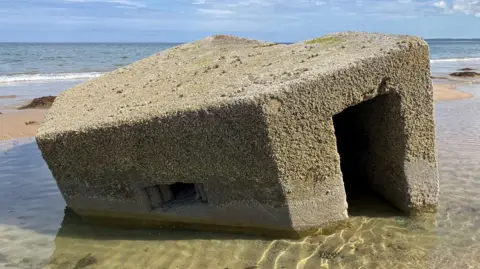
The concrete blocks were placed at Tentsmuir, near Leuchars, in 1940 to defend against the threat of a German invasion during World War Two.
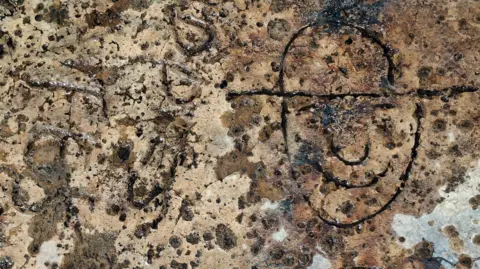
A team from the University of St Andrews charity, Scape, recorded initials along with a cartoon solider and marks left by tools pushed into the concrete when it was still wet.
Scape said parts of the "dynamic" coastline were at risk of erosion.
The Scape team was assisted by volunteers and colleagues from St Andrews University.
Hong Kong Polytechnic University used sensors to locate sites hidden beneath sand.
Only the tops of many of the buried anti-tank cubes are visible, and some of these were marked by their builders.
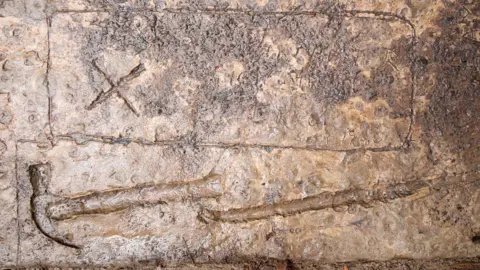
Archaeologist Prof Tom Dawson said on one cube the builders pushed a hammer and crowbar into the wet cement, producing an outline of their tools.
Another had the outline of a monkey wrench, together with the initials AMPC, which stands for the Auxiliary Military Pioneer Corps.
Dawson said: "This cube also says 'The Kiddies', a nickname for the Scots Guards, although it is unsure if this is what it refers to.
"The cube also has several names on it, including Sgt Ince, T Gates, HB Moss, and Georgina, together with a cartoon face of a smiling soldier in a tin hat."
 Scape
Scape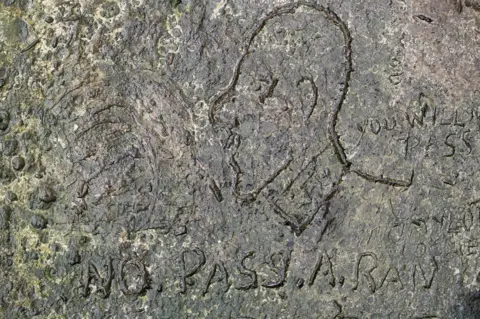 Scape
ScapeDawson said the team was intrigued to find "no passaran" written on a cube.
He said it looked like someone had attempted to write "no pasaran", an anti-fascist slogan from the 1936-39 Spanish Civil War which translates as "you will not pass".
Dawson said the expression was still used by some people today, and was the title of a single released last year by Scottish indie band The Bluebells, famous for their hit Young at Heart.
"There is also the outline of a figure on this cube, shown in profile with a high collar," said Dawson.
"Although uncertain who it is meant to be, it has an uncanny resemblance to Spanish fascist leader, General Franco, although why someone would depict him in 1940 is unsure."
WW2 defences can be seen on many of Scotland's beaches and shorelines, including at Findhorn in Moray and near Cromarty in the Highlands.
The defences include concrete blocks and larger structures called pillboxes, and at places such as Tentsmuir and Culbin there are the remains of wooden poles designed to deter troops from landing in gliders.
Scape has been recording coastal heritage sites affected by climate change for the past 25 years.
In 2022, it worked with volunteers to record boulder-built fish traps and wooden posts which once supported stake nets for catching fish along the Moray Firth coast.
Near Newton of Petty, east of Inverness, they recorded the remains of a 17th Century tidal mill and on the western shore of Findhorn Bay in Moray a "graveyard" of large early 20th Century sailing herring drifters.
