Detectorist 'overwhelmed' to discover huge hoard of treasure lost in shipwreck

 Amgueddfa Cymru
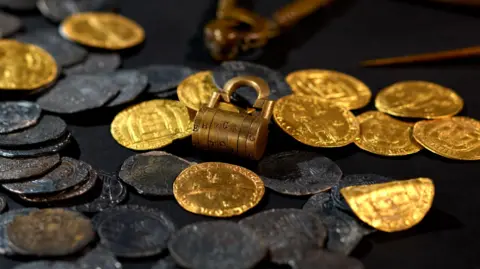
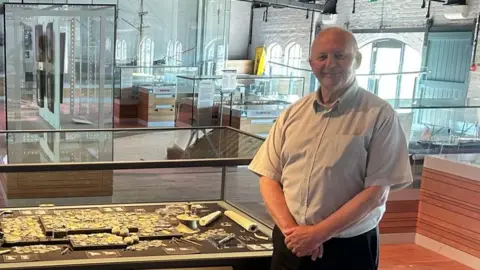
A huge collection of treasure lost in a shipwreck before being uncovered by a metal detectorist has gone on public display for the first time.
The treasure dates back to 1583, when a valuable cargo of grain was sent to Spain by ship. A violent storm meant both the ship and payment were lost on its return.
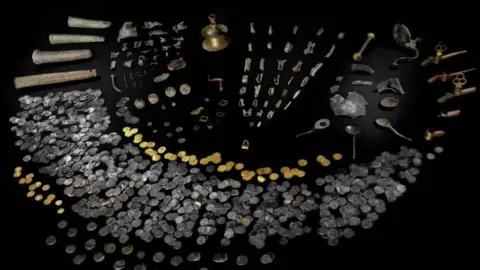
Peter Hughes, 69, spent 21 years uncovering hundreds of coins and other items with his metal detector, after storms blew away the sand concealing them on Margam Beach in Neath Port Talbot.
He described the day he first struck gold, in 1996, as "just incredible".
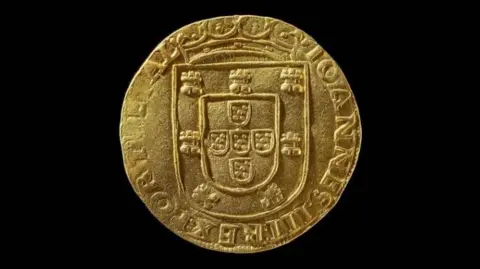
"When I lifted the coin from the sand, and the sand fell off the coin, it glowed like the sun in my hand," said Hughes.
 Amgueddfa Cymru
"I was overwhelmed, because I saw the figure of a saint holding a ship, Saint Vincent, and I thought it was a token at first.
"But when I turned it over and saw the shield of Portugal, then I knew it was a coin. I was overwhelmed with excitement, the thrill was unbelievable."
Hughes' finds include several historical gold coins from the reign of Ferdinand and Isabella of Spain.
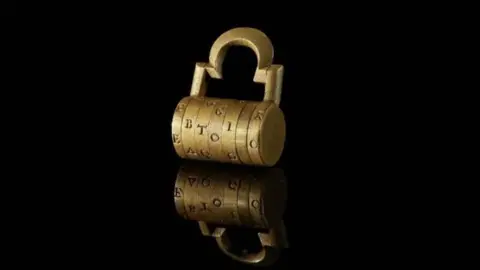
There is also a Boatswain's whistle and a combination lock from one of the wooden chests - with its code still to be cracked.
 Amgueddfa Cymru
It is estimated that only a quarter of the money that was aboard the Ann Francis ship, which was caught in the storm on 28 December 1583, has been discovered.
Hughes said he initially did not know what to do with his discoveries, until he contacted Amgueddfa Cymru, Wales's national museum.
"The objects and the treasure belong to the people, and belonged to the heritage of Wales," said Hughes.
"The Pirates of the Caribbean come to mind when I look at it," he added.
 Amgueddfa Cymru
Hughes said he had been to the beach more than 1,000 times and spent thousands of hours searching for the shipwreck's treasure.
He said the vast majority of his visits to the beach had ended up with him finding nothing, adding that it was lucky he had a "high tolerance to disappointment" and the "thrill of searching just kept me going".
The treasure has now gone on display at the National Waterfront Museum in Swansea.
Amgueddfa Cymru said the stretch of beach was now a protected site to preserve any other potential remains of the ship, meaning it was no longer legal to search there.
"Not only are the coins and artefacts spectacular, but they are backed up by a wealth of contemporary records that bring together stories of sailors, looters, lords, a smuggler and even a woman accused of witchcraft," said the museum's Alistair Willis.
"These stories and the collection are fascinating, and it is wonderful that Amgueddfa Cymru has the opportunity to display them."
Willis also hoped it would inspire other metal detectorists to report their findings.
 Amgueddfa Cymru
What should you do if you discover treasure?
Treasure has a variety of definitions, as per the Treasure Act of 1996.
In Wales, if you find treasure it must be reported to a Finds Liaison Officer within 14 days of first finding it or within 14 days of realising an item might be treasure, even if you have had it for longer.
Only items officially defined as treasure need to be reported and there is a fine or up to three months in prison for not reporting.
There are different rules for Scotland and Northern Ireland.
After a find is reported, you will be contacted by either a Finds Liaison Officer or museum curator to talk about how and where you made the find.
The Finds Liaison Officer or museum curator will then write a report on the find and the coroner will hold an inquest.
The Finds Liaison Officer will help you get the coins assessed by experts to determine if they meet the legal definition of "treasure" under the Treasure Act 1996.
If a museum wants the treasure, the Treasure Valuation Committee will ask an expert to value the find.
They will recommend to the Secretary of State for the Department for Culture, Media and Sport how much the treasure is worth and how much should go to anyone eligible for a share of a reward.
