Relish and dread as Starmer 'shambles' hangs over Scotland and Wales elections


 BBC
BBC"We're living the dream," a minister jokes.
Labour might have to rely on black humour over the next couple of weeks.
Each day brings a vast set of elections closer - local tests in England, and national ballots in Wales and Scotland - votes that another cabinet minister frets "will be a disaster".
We've been travelling around Wales this week, and Scotland last week, talking to the politicians vying for power, and the most important people of all - the public who'll make the choice on 7 May.
Just when Labour needs to be going hammer and tongs in a campaign, instead, almost every day brings fresh embarrassment to the prime minister over his decision to give Lord Mandelson one of the finest jobs in the land - our man in Washington.
Ructions in Whitehall. Rancour in Labour. A sense the government doesn't seem to have a grip. How big is the impact in Wales and Scotland of Sir Keir Starmer's woes?
"It's just so huge," says a senior Labour MP who's been knocking on voters' doors in recent days.
But these elections aren't remotely all about the government's recent horror show - we'll come to that in a second.
Voters will decide who makes important devolved decisions affecting the lives of millions of people - the kind of schools kids go to; the standard of the care patients receive when they are sick; even income tax rates.
Both the Labour administration in Cardiff and the SNP government in Edinburgh have been in charge for a remarkably long time - Labour since 1999, the SNP since 2007. It's perhaps not surprising, then, that voters we met in both countries expressed a similar level of disillusion with the status quo, frustration with a patchy track record on public services, and a sense devolution itself has not been all it was cracked up to be.
The two countries are poised to make very different decisions on what's next.
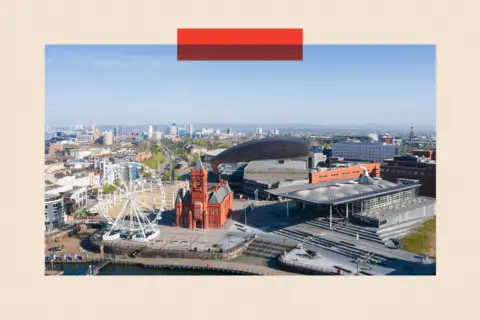
Wales saw red - but no more?
 Getty Images
In Wales, it feels like Labour's time is more or less up. Canvassers report back praise on the doorstep for how Starmer held off from going to war with the US in Iran. But beyond that, the mood is bleak. One party source tells me "it's been a long time coming - the failures of the Welsh government keep coming up on the doors".
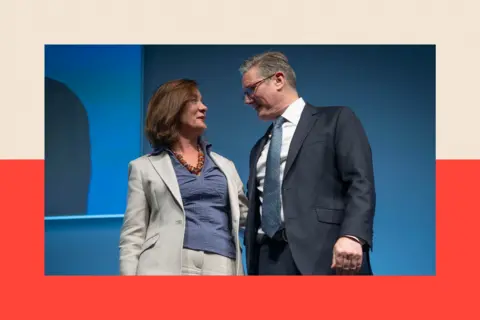
In the blazing spring sunshine on a Swansea rooftop, Welsh First Minister Eluned Morgan tells me she'll keep "fighting and fighting", but accepts the election might be so tough for Labour that she could lose her seat. I don't remember covering another election where a party leader admitted their own perch in Parliament might disappear.
Don't underestimate how totemic a Labour loss would be if it happens. The party has been winning in Wales for a century. Plaid Cymru leader, Rhun ap Iorwerth, and Dan Thomas of Reform are bouncing around the country, both believing they have a real shot at power. If either wins it would be the first time the post of first minister has been under their party's stripe - and the first time anyone other than a Labour politician has been in charge.
Be prepared for haggling after the results themselves, mind. A new proportional voting system in Wales makes it unlikely any one party will have a majority this time around, and it's hard to make accurate predictions.
 Getty Images
Plaid's ap Iorwerth says he'd happily run a minority government - a calculation that the Lib Dems, Greens and Labour would allow Plaid to form an administration, because they'd never dream of backing Reform.
Tory leader Darren Millar has suggested he'd be open to working with Reform, while Reform leader Thomas - who also seems to be relishing the campaign - insists he's campaigning to win a majority.
Let's see. There's also the possibility either Reform or Plaid wins the most seats, but the other wins the most votes. Under that headscratcher the party with the most seats would be the winner, theoretically, but you can already imagine the narrative of unfairness that the loser could spin.
The old certainties have gone and parties who were tiny outfits not so long ago stand to gain.
SNP confidence in Scotland – but can they be sure?
Several hundred miles away, the traditional order in Scotland was turned over in 2007, when the SNP stunned the political establishment by beating Labour in another of its spiritual homelands.
The party has won every Holyrood election since. Despite all sorts of scandals and a less than glowing record on public services, it looks like voters will let them enter their 20th year of power.
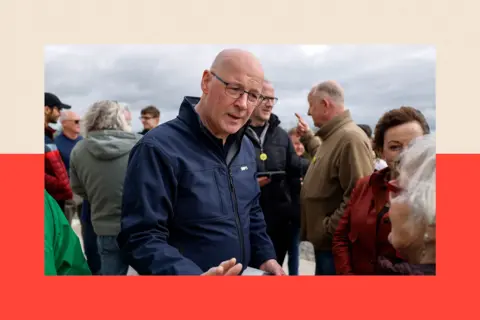
Scottish First Minister John Swinney is credited with restoring calm to the party after a crazy few years when its two big stars - Alex Salmond, then Nicola Sturgeon - crashed.
 Getty Images
Swinney told us last week he was "confident to predict" the SNP would win a majority, but as in Wales, the political system makes it hard for any one group to get over that threshold, and it's tough to make predictions. One Labour minister tells me they are "gobsmacked by [the SNP's] lack of expectation management".
Reform is snapping at the heels of both the SNP and Labour, and looks to make big advances. Nigel Farage's party is campaigning hard on immigration, particularly in Glasgow where a high number of asylum seekers have been housed. That said, Reform's rivals have described their campaign as a "binfire", with candidates lost over offensive views and Scottish party leader Malcolm Offord having to apologise for a homophobic joke years ago.
The Greens have plenty of new members, though the zip of the party in England doesn't feel matched here following a bruising experience of being in government with the SNP.
Meanwhile, Lib Dem and Conservative leaders' campaigns have been very on-brand - the former making frangipane tarts at a cookery school in Edinburgh's fancy New Town; the latter knocking doors alongside a labrador in a comfortable Glasgow suburb. No longer the big players they once were, the Lib Dems and Tories are trying to max out on a second ballot where voters select a party to represent their whole area, not the individual politician for their constituency - known as the "peach vote" because it's cast on a peach-coloured piece of paper.
Plus, the Lib Dems and Tories are trying to avoid the independence-backing SNP and Greens winning enough votes to claim majority support for Scottish independence.
It's worth noting an irony in both Wales and Scotland. The nationalist parties are likely to prosper, but independence hasn't been a major part of the political conversation in either country this time. Plaid admits independence isn't on the table for now. The SNP still believes it would have a mandate for a new independence referendum if it got a majority. But for voters, the cost of living, the NHS and immigration have been the topics of concern in the run-up to polling day - not constitutional issues.
'Shambles after shambles'
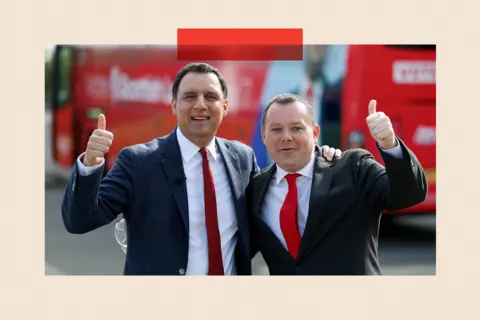
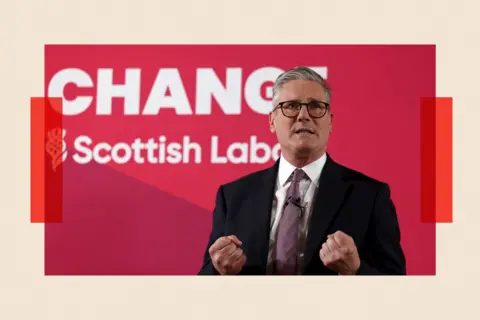
And then there was Labour. A year ago, it looked like Scottish Labour leader Anas Sarwar had a good shot at returning to power in Holyrood, but in 2026 that seems out of reach.
We meet him leaping off his battle bus in another well-to-do Glasgow suburb, where he's making his repeated plea to voters: "The SNP have had 20 [years], give me five."
Noise down in Westminster could put paid to that. Labour up here in Scotland believes it has been thoroughly hobbled by the mistakes and mishaps of Starmer's time in office so far - Sarwar went public in February to proclaim Starmer the wrong man for prime minister.
 Getty Images
Sarwar's idea was to distinguish himself from the bitter disappointment many Scots feel with UK Labour. That gamble has not translated into a big bounce in the party's chances. As one of many disaffected Labour or former Labour voters in Scotland tells me: "It's been shambles after shambles." He used to deliver leaflets for Sarwar.
This election isn't a simple health check on the UK government, but it's impossible to separate the mood of gloom around Downing Street from Labour's sense of dread in Scotland and Wales.
One experienced SNP campaigner, grinning ear to ear, tells me Labour's UK performance has "been an absolute gift".
Is Keir Starmer a good prime minister, I ask Welsh First Minister Morgan? There's a tiny, but telling pause, before her more diplomatic than enthusiastic answer.
"He's helped us in Wales."
She then talks about nuclear investment, sticking carefully to the party line. She's also keen to point out the moments when she has disagreed with the Westminster party, like on the winter fuel allowance decision.
As ever, much of the Westminster bubble seems like it is eating itself.
 Getty Images
Ministers disagree on whether there will be a challenge to Starmer after the May elections. Some reckon "it's terminal", a challenge is on the way. Others say the fundamental lack of agreement on a successor is a huge block, making a change in leader self-indulgent and a huge risk.
A poll by the consultancy Portland Communications of 2,042 people suggests the public echo that dilemma. The research, shared with us this weekend, suggests 12% of voters believe Starmer should stay on as prime minister if Labour loses a significant number of council seats in May.
But the same research, from 16-20 April, suggests that among Labour voters, Starmer outpolls all of the other possible contenders for the job on a variety of factors.
The Labour Party is in an unhappy state of suspended animation – unsure whether to stick with a troubled status quo, or unleash the potential chaos of a leadership election.
The outcome of the coming elections could determine whether the unhappy contingents find the courage to move, or whether Starmer and what feels like his diminishing group of allies use the moment to draw a line under disappointments and crack on with new zeal.
Whatever the intrigue of the next ten days bring in Westminster, the public's decisions around the UK will come first.

BBC InDepth is the home on the website and app for the best analysis, with fresh perspectives that challenge assumptions and deep reporting on the biggest issues of the day. Emma Barnett and John Simpson bring their pick of the most thought-provoking deep reads and analysis, every Saturday.Sign up for the newsletter here
