Why Starmer still can't move on from the Mandelson mess


 BBC
BBCEveryone's cross.
The prime minister's furious. Whitehall's angry. Labour MPs are frustrated. But giving a top official, Sir Olly Robbins, the boot has not brought an end to this fiasco, nor to the political blowback for Sir Keir Starmer.
As one party insider suggests in disbelief: "There's no point Keir saying again and again he's angry, when that's exactly how the public feels about him!"
The prime minister's original decision to give Peter Mandelson the US ambassadorship, one of the best jobs in the land, had risks from the start that could be seen from space. Now we know the former Labour minister didn't clear security checks, perhaps it was even, in the words of one government source, "absolutely mental" - a disastrous episode of "don't ask, don't tell" spreading political poison months on.
First you have to understand, I'm afraid, the labyrinth of Whitehall's process. As we revealed in September, No 10 was warned about Peter Mandelson's links with the late sex offender Jeffrey Epstein before giving him the job. Those warnings were in the first government report that checked out the Labour peer's background, produced by the Cabinet Office's Propriety Department.
Starmer's team asked Mandelson three further questions after that report and were satisfied with his answers, although they now believe he misled them.
Step two: crucially after the prime minister had given the former Labour minister the job, there was a security check, known as developed vetting. As we reported in the autumn, that's a standalone confidential process, which involved an in-person interview, financial checks, and "ought to have been completely forensic", said one senior figure. To protect confidentiality, the details of those investigations would not have been passed on to No 10 or ministers.

As sources told me in the autumn, and government still says publicly now, no concerns were raised with ministers as a result, even though the agency that checked him out had recommended that he didn't get the job.
That might also seem insane nearly 18 months later, but to explain: there is process and then there is political reality.
Under an obscure bit of the law - section three of the Constitutional Reform and Governance Act, if you are really interested - ministers do not have powers over security vetting. The vetting agency also only provides recommendations to officials at the Foreign Office - they don't make decisions about who gets what job. Think of it like a credit checking agency: they might delve into your financial background, but it's the bank that decides in the end if you get the loan.
In this case, the agency's concerns were passed on to the most senior official in the Foreign Office, Sir Olly Robbins. But he didn't necessarily see the full documented verdict at the time. And he seems to have concluded that the concerns he was told about could be managed. As one former senior official says: "Vetting is a process, not a point, it's not like a test you pass or fail - it's about managing risk, not big thumbs up or down."
When he appears in front of MPs on Tuesday, Robbins will no doubt be pressed on why he thought the gamble was worth it. But the political reality? Before Robbins' department took a look, the former peer had already been through a separate government check, and concerns had already been shared with No 10. But Starmer had decided to go ahead anyway, and the White House was expecting Mandelson. As the now former top mandarin at the Foreign Office underlined to MPs last year, when the vetting had actually been taking place, "it was clear that the prime minister wanted to make this appointment himself".
 PA
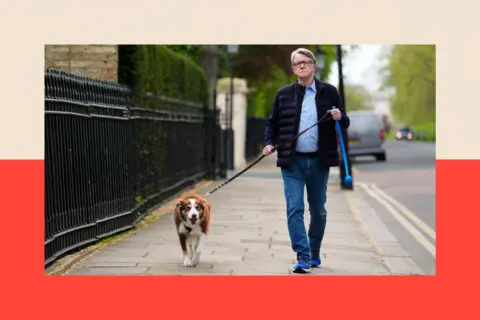
PAIn Whitehall, some are amazed that a highly capable and experienced official took the decision to clear Mandelson for the job despite the vetting verdict, without lodging concern somewhere. One said: "It is impossible to believe that Olly would have done this on his own. He is known to be obsessed with process – what did he have to gain by taking a risky decision like this without a paper trail? It just doesn't add up."
MPs and advisers now say it's "incredible" and "unforgiveable" and that they are "aghast" that Robbins didn't flag the problem to ministers at the time.
The law suggests ministers ought not to be involved. The process is meant to be confidential. And one ally of Robbins tells me simply: "He hasn't done anything wrong." It's a line that was echoed by his predecessor, Lord Simon McDonald, on Saturday: "No 10 wanted a scalp and wanted it quickly."
The view at the top of government, though, is that it is unconscionable that Robbins didn't stick his hand up when the prime minister and other ministers said repeatedly in public that the process had been followed, and explicitly, that Mandelson had been cleared by vetting. One bit of the law might say that vetting must be a confidential process. But the civil service code says officials must correct errors as soon as possible, accurately present options and facts and not knowingly mislead ministers, or Parliament.
A former Foreign Office minister says it's astonishing that ministers didn't press for more information about the vetting process when Mandleson was given the job: "It's shocking, and it's also incompetence - when giving a job to someone of that nature, and nobody asked the question! Whether David Lammy (foreign secretary at the time) or the PM didn't ask: Is everything OK?"
One senior Whitehall figure suggests: "Olly Robbins has seemingly been sacked for not creating a problem for the prime minister. Which is novel. The great lesson from all this is that the Labour government want the civil service to save them from their own judgments."
'It doesn't stack up'
What is more baffling than the botched decision-making at the time is that officials have been going through what happened behind closed doors for months. The prime minister has repeatedly promised everything is being pored over, with countless earnest statements about how no stone will be unturned.
When he was giving repeated assurances that the rules had all been followed properly, on one of the hottest and most embarrassing political controversies in years, did Starmer really not think to ask if Mandelson's security checks had come back clean?
If you're feeling charitable, he, of course, is a pretty busy man. But then did no-one in his team think to ask that pretty basic question during the many months when the government has been under the cosh over giving Mandelson the job?
It's not until the past few weeks that the vetting decision seems to have been uncovered. And it was the work of journalists, not the promised transparency from ministers, that brought it to light.
Some experienced government insiders find it hard to believe the official account. One told me: "It is inconceivable that there was a flag from the vetting that did not come up between September and now. I just find it very hard to believe that anyone outside of the foreign office didn't know - it doesn't stack up."
 DOJ
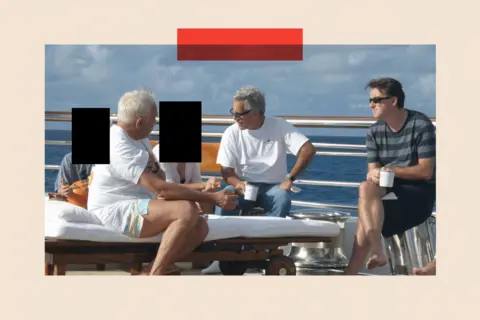
DOJAbove all else, given the Mandelson mess has caused the prime minister deeply serious and repeated political trouble, did he - a former chief prosecutor - really think not to ask if anyone had checked all his references in the last few torrid months? It suggests, as a party insider worries, "he's just never, at any point, gripped the danger".
This is not the first time Starmer has been criticised by his rivals for a lack of curiosity about the government he runs, risking the impression that he is somehow a bystander - a witness to what happens in Whitehall and Westminster, rather than its central character.
It's one thing being "mortified and furious" when things go wrong, as one Starmer loyalist describes it when things go south - but that's a reaction to government, not an action. One senior Whitehall figure claims this latest bout of panic over Mandelson "sums up Starmer's premiership: a man who claimed he was grown-up public servant turns out to be hopelessly out of touch with the detail, not interested in the actual processes of government and devoid of any political antenna". Ouch!
'It's so painful to Keir'
By publishing an account of a recent meeting about the mess, it's been made clear the prime minister didn't know what had happened. One of his senior ministers, Darren Jones, says it's a "failure of the state". Starmer himself has found lots of different words to say the same thing - that he is mightily hacked off. It's plain to see that No 10 does not accept it's their failure and the rapid firing of Robbins shows they where they are determined to place the blame.
The horror of this row's return is not just that it connects the Labour government with the worst excesses of power - the friendship between a prominent Labour figure and a disgraced wealthy billionaire and his abuse of vulnerable young women. And it's not uncomfortable just because of how it clashes with Starmer's 'Mr Rules' persona - as one ally says: "It's so painful to Keir, who prides himself to be a person of integrity - and this is just wiping that away in the eyes of the public."
But this is happening at a time when Labour is about to face millions of voters in a vast set of elections in Scotland, Wales and across England. The party felt like it was almost, with some praise for Starmer's handling of the war, starting to catch a break. Then, this most embarrassing of scandals blows up again - a mess, fundamentally, created, not by Whitehall, but by Starmer's original decision to bring Mandelson back into the fold.
 PA
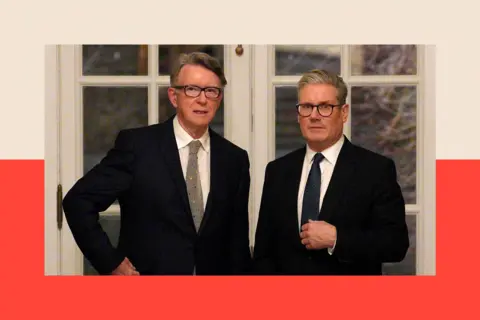
PAOne MP with the unforgiving task of banging on doors in the rain this week told me: "It's so incredibly frustrating for Labour activists, councillors and candidates across the country to once again have campaigns derailed by this mess. It is unbelievably incompetent from Keir to have us in this situation again, three weeks out from an election." Another senior MP told me it's just a sinking feeling: "Oh no, here we go, again."
With those elections in just a few weeks, no Labour figure is now likely to jump-start a bout of leadership frenzy, but don't doubt that is on many MPs' minds. Another told me: "It's not possible to put any more nails in his coffin without it being made of nails, but this is another one."
Robbins' exit also creates more bad blood between ministers and the civil servants they need to make their plans work - friction a struggling government can ill afford. And it's also worth noting the departure creates a vacuum in foreign policy - one of the few arenas where the prime minister is generally considered to have a decent record.
There won't be a break from this until the middle of next week at the earliest. Starmer himself will face questions on Monday. Sir Olly Robbins has been summoned to give evidence in front of MPs on Tuesday, P45 in hand. He's getting the blame: his original judgment that he could clear Mandelson for take-off to DC despite the vetting agency's concerns will take a hammering. But Robbins' allies insist he believes he was working within the rules. And ministers are yet to explain clearly why they think he was not.
It's easy now to say Mandelson should never have been given the job in Washington, although there were clear reasons why it was tempting to send a flamboyant maverick with a troubled past to appeal to another flamboyant maverick with a troubled past in Donald Trump.
It's easy, too, to say that the way Mandelson was appointed was bonkers, that the process failed. But ultimately it was a political decision to give the job to a politician with huge talent but a reputation for finding himself in huge trouble.
Many months since Mandelson's forced exit, the prime minister is still struggling to demonstrate decisively that he can move on.

BBC InDepth is the home on the website and app for the best analysis, with fresh perspectives that challenge assumptions and deep reporting on the biggest issues of the day. Emma Barnett and John Simpson bring their pick of the most thought-provoking deep reads and analysis, every Saturday.Sign up for the newsletter here
