Fridge collections suspended over national backlog

 George Clerk/Getty
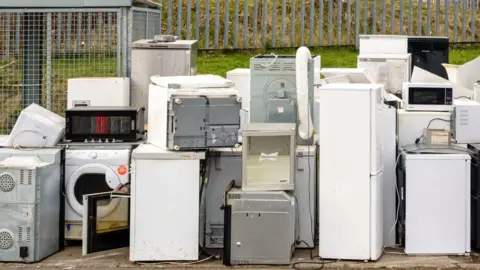
Council fridge and freezer waste collections have been suspended in Nottinghamshire due to a national shortage of space at disposal sites.
Collections will be suspended for four weeks initially from Monday next week and will be reviewed weekly, the county council said.
A council spokesperson said: "We fully recognise that this will be frustrating for residents and we would only take this step where it is necessary."
A spokesperson for the Department for Environment, Food & Rural Affairs (Defra) said it was "working closely with the Environment Agency, industry and local authority stakeholders to manage the impact of treatment capacity shortages".
A Nottinghamshire County Council spokesperson said the issue was affecting councils across the country and was "outside the direct control of local authorities".
"The county council held off requesting a suspension for as long as it reasonably could, and for longer than a number of other councils, while we continued to explore available treatment and disposal options," the spokesperson added.
People are being asked not to leave fridges and freezers out for collection during the suspension.
The council said it would work to reinstate the service "as soon as suitable disposal capacity becomes available".
In Nottinghamshire, smaller district and borough councils are responsible for collecting waste, while the county council is responsible for processing and disposal.
Mansfield District Council has asked people to safely store appliances at home until collections can resume.
Fridges and freezers require specialist dismantling due to the gases they contain, which can be harmful to the environment.
The Environmental Services Association (ESA), the trade body representing UK waste operators, said there were only a small number of specialist facilities across the UK, compared to conventional waste management.
Jacob Hayler, executive director at the ESA, said there had been a number of serious fires and commercial closures of these facilities over the past year.
"The result is that capacity is now constrained nationally until facilities can be brought back online or new capacity is permitted and developed," he said.
"In the shorter term, this presents knock-on challenges for local authorities, who only have limited storage space for these bulky items.
"The regulator has responded by allowing storage facilities to stockpile higher volumes of waste fridges and freezers than would otherwise be permitted, but this is a short-term measure to alleviate pressure rather than a long-term solution."
Recent heatwave conditions are also believed to have exacerbated the shortage, because plants have to operate at reduced capacity when temperatures exceed 30C (86F) to avoid equipment overheating.
Nottingham City Council, meanwhile, has put in place a restriction of one fridge/freezer per visit per week at its recycling centre in Lenton.
The council said it was asking residents to ask their retailer to take back their old fridge or freezer when they have a new one delivered.
Somerset Council and its recycling site operator, Biffa, said only one fridge, freezer or other type of cooling appliance would be accepted per household to any of its 16 recycling sites during August.
Peterborough City Council also stopped accepting fridges and freezers at its Household Recycling Centre in Fengate from 9 to 13 July.
A Defra spokesperson said: "We appreciate the challenges currently facing local authorities, and are working closely with the Environment Agency, industry and local authority stakeholders to manage the impact of treatment capacity shortages.
"This includes allowing the storage of fridge and cooling equipment on temporary sites provided certain conditions set out by the Environment Agency are met.
"We expect capacity in existing treatment facilities to increase towards the end of summer as temperatures fall and we will be closely monitoring the situation over the coming weeks."
Listen to BBC Radio Nottingham on Sounds and follow BBC Nottingham on Facebook, on X, or on Instagram. Send your story ideas to eastmidsnews@bbc.co.uk or via WhatsApp on 0808 100 2210.
