Ukraine's Baltic allies unsettled by repeated drone incursions

 Reuters
Drone sightings are becoming increasingly disruptive for Estonia, Latvia and Lithuania, and Nato fighter jets have been scrambled after air alerts were triggered several times over this week.
The three Baltic countries - all Nato member states - have been among Ukraine's most steadfast supporters and most vocal critics of Russia.
They are now finding themselves caught in the crosshairs of Ukraine's increasingly effective long-range drone campaign against Russian targets near the Baltic Sea.
Although drone incidents have been reported since 2024, the recent uptick in drone sightings has heightened unease and increased political tensions in the region.
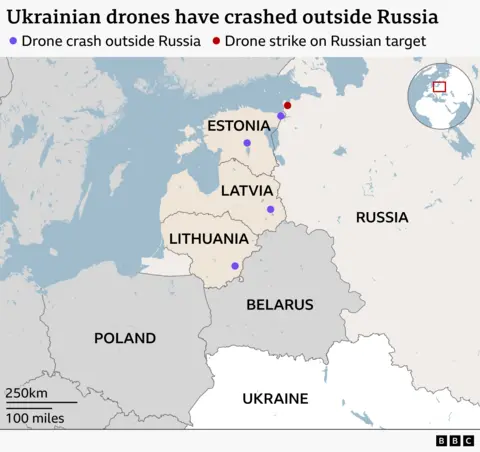
Last week, the government in Riga collapsed over its response to Russia-bound Ukrainian drones straying into Latvian territory.
On Tuesday, a Nato fighter jet shot down a drone over Estonia.
Another drone entered Lithuania's airspace the following day, causing Vilnius Airport to close, traffic in the city to be halted, and residents in the capital to be sent to air raid shelters, not least the president and prime minister.
On Thursday, Lithuania and Latvia each detected drones in their airspace and Nato fighter jets were again scrambled.
Kyiv has apologised for the incursions while blaming Russia for redirecting the drones through the jamming of guidance signals.
For its part, Moscow has accused the Baltic states of allowing Ukraine to use their airspace to strike targets in Russia - a claim that all three countries, as well as Kyiv, have forcefully pushed back on.
Russia was continuing to "spread false accusations, threats and deliberate provocations", said Estonia's foreign ministry on Thursday.
"Let us be absolutely clear: Estonia has not allowed its territory or airspace to be used for attacks against Russia. These claims are false and Russia knows it."
Similar statements were issued by the governments of the other Baltic countries and were backed by their European allies.
The "absurdity" of Russia's claims would be "laughable", said Belgium's foreign minister Maxime Prévot, if Moscow were not "jeopardising security".
European Commission President Ursula von der Leyen was adamant: "Russia and Belarus bear direct responsibility for drones endangering the lives and security of people on our Eastern flank."
Drone crashes in the eastern regions of Latvia and Estonia are likely due to them flying through northern Russian territory to attack Russian energy infrastructure such as oil export facilities in Ust-Luga - and then crossing the border by veering off course or being diverted, through jamming or electronic warfare systems.
On two occasions the drones struck an empty oil tank in Latvia and a power station pipe in Estonia.
The pinpoint precision suggests that in at least some cases the reason for the crashes may not have been Russian jamming knocking out the drones' GPS - but rather an artificial intelligence error which led the drones to strike targets that resembled their programmed objectives.
The drone sightings over Lithuanian territory also pose questions.
The country does not share a border with Russia - apart from the small exclave of Kaliningrad - and any Ukrainian drones that reach its airspace from the east must fly across Belarus.
The Lithuanian defence ministry confirmed to the BBC that it was Minsk that notified Vilnius about drones flying towards its airspace on Wednesday, and that the object that triggered the alert was believed to have flown in from Belarusian territory.
What is unclear is why Belarus would warn its neighbours of approaching drones instead of shooting them down itself. It has also accused the Lithuanians of allowing a Ukrainian drone to fly over its territory into Belarusian airspace.
For all three Baltic states the recent drone incidents pose significant security threats, and their respective presidents issued a joint statement late on Thursday, calling on their Nato allies to turn their current mission of policing airspace over the Baltic states into a "comprehensive air defence mission".
