The scientist who fled the Red Army, turning displacement into discovery

 Armagh Planetarium
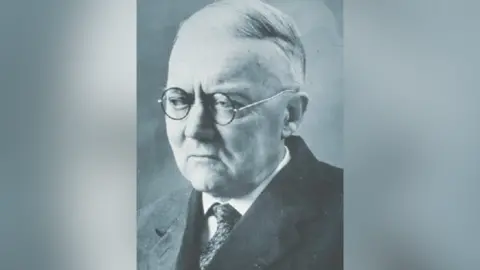
A renowned scientist who fled his homeland during World War Two to escape the Red Army and later ended up in Northern Ireland has had his life chronicled.
Thousands fled Estonia in 1944 to escape Soviet occupation. Among them was astronomer and astrophysicist Ernst Öpik.
In a twist of fate his grandson Lembit would become more famous than him, being a Liberal Democrat MP through the early 2000s and later going on I'm a Celebrity... Get Me Out of Here! and dating one of the Cheeky Girls, Gabriela Irimia.
But though Lembit was briefly a star, Ernst had his eyes on the stars - and one history student would like Öpik to have more recognition.
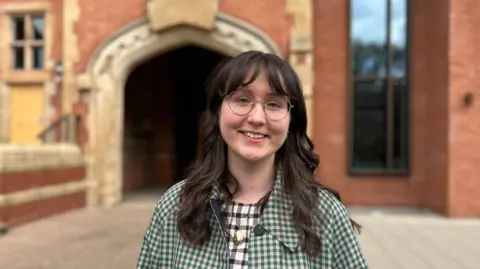
Maddy Kennedy studies public history at Queen's University Belfast - it is a field that examines how the general public interacts with history.
As part of her course she spent several months as an intern at the observatory, where she researched Ernst Öpik's life beyond his scientific achievements.
"It is true that Öpik was a fabulous scientist," she said.
"What really intrigued me was how did he end up in Armagh?"
It is a story that involves war, displacement, a cart ride across Europe, a refugee camp and some visa troubles.
But ultimately it is Öpik's scientific work that gave him the chance to end up in Armagh.
Kennedy said aspects of Öpik's life before he arrived in County Armagh had been blurry, and her research helped establish firmer dates and a clearer chronology.
When Öpik was born, Estonia was part of the Russian Empire and he would later study at the University of Moscow.
 Getty Images
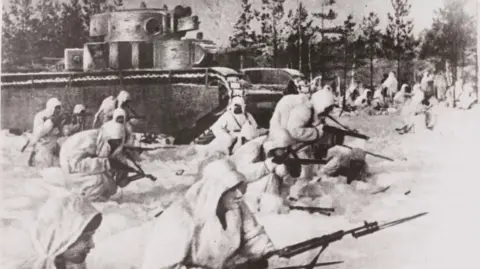
Estonia gained independence after World War One and the Russian Revolution, but was later occupied by the Soviet Union and then Nazi Germany during World War Two.
The Soviets eventually pushed the German Army back and it was the advance of the Red Army and the prospect of another brutal occupation that drove Öpik to flee.
He and his family journeyed for hundreds of miles by cart from Tartu in southern Estonia to Hamburg in northern Germany.
There they lived at a refugee camp where conditions were poor.
 Armagh Observatory and Planetarium
About this time Eric Mervyn Lindsay, a scientist from Portadown who knew Öpik because the latter had examined his PhD while at Harvard, became aware of his predicament.
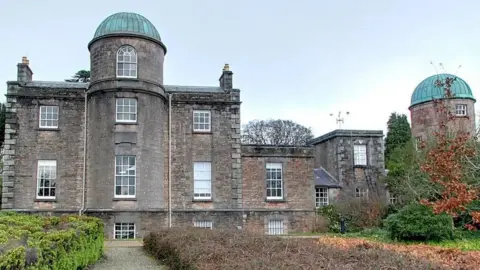
Lindsay by this point was the director of the observatory in Armagh and invited Öpik to work with him.
After months of visa difficulties Öpik and his family were able to leave the refugee camp and move to Armagh.
He lived in Northern Ireland until his death in 1985 and worked at the observatory well into old age.
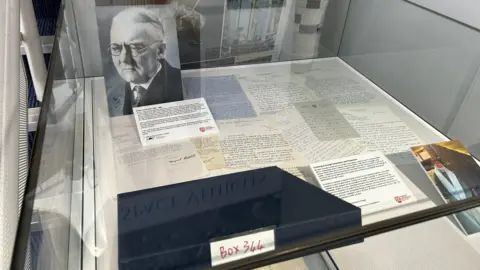
New details about his journey and life before Armagh were found in a trove of 305 letters and documents which Kennedy helped organise and archive.
The material, alongside Russian-language sources and collaboration with other academics, including the University of Tartu and former astronomer Dr John Butler, formed the basis of the exhibition at the planetarium.
Kennedy said the work began with a box of letters that had been sitting untouched since the 1980s.
The first task was to put them in chronological order, something made more difficult by the fact that some of the documents were undated.
"So you have to do a little bit of detective work and try and figure out when this might have been from," she said.
"That was probably what took the longest, getting everything into order."
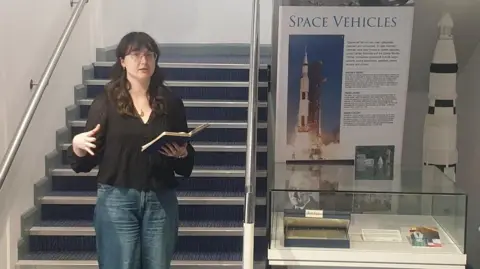
Kennedy was drawn to his story because she speaks Russian which allowed her to access sources largely untouched in English-language research.
"I'd spent a year abroad studying in Estonia, so I felt that connection," she said.
 Armagh Planetarium
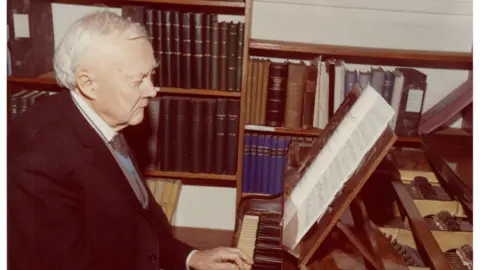
Throughout her research, she uncovered small details of his life - how he lost an eye as a child when his brother shot him with a bow and arrow, his travels through Central Asia and the music he composed - as well as a more significant revelation: a second family he had left behind in Estonia.
Reflecting on Öpik, Kennedy said he was an interesting man who was dedicated to his work but, like many people, became more complicated the closer he was examined.
She described his as an eccentric character who could be quite bold and unafraid to speak his mind.
"I really admire him as a composer. He composed thousands of works for piano, which I think is very impressive for a man who was also so dedicated to his science," she said.
 Armagh Planetarium
"But I think ultimately my takeaway is that he was a man of secrets," she said.
"The hidden family thing was a big revelation for us in that we don't really know the dynamic between the two families.
"I feel like I'm not done with Öpik yet to be honest. I'm quite attached to him now and I would really love to uncover some more details about his life."
She said she hoped her work would highlight the sometimes underappreciated work that archivists play in recording history.
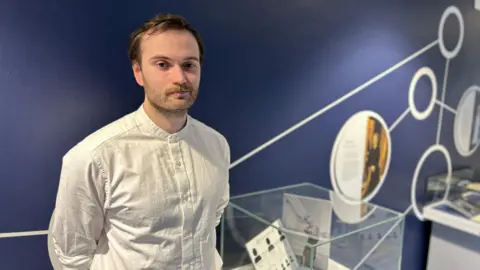
Matthew McMahon, the museum collections officer at the observatory, said the exhibition deliberately focused not on Öpik's scientific achievements, but on his personal story.
He added that Öpik's name still carries weight in parts of the world but that he is perhaps underappreciated locally.
"In Estonia, his native country, and within pockets of the world, Öpik is still a rather well-known figure," he said.
"Within Armagh and within Northern Ireland, he should definitely be considered more.
"He's evidence that we have benefited in the past very strongly from the refugees and from the people that have come to make new lives in Northern Ireland."
