'We earn while we learn, it's best of both worlds'

 BBC
BBCAs thousands of students weigh up their next move after picking up A-level, T-level and BTec results, five apprentices in Hull are celebrating earning first-class honours degrees.
The achievement marks the end of years of combined study and work for the young engineers at Spencer Group.
Alistair Sceats, Thomas Dubej, Jack Waslin, Matthew Hunter and Oliver Wilkinson said the apprenticeship pathway gave them the best of both worlds, allowing them to earn while they learned.
It comes after Prime Minister Andy Burnham announced new vocational courses would be available to give young people a clearer route into full-time employment.
Site engineer Sceats, 25, said: "Obviously, we've been earning as we've been learning. I've got a career path and I know where I'm going, it's been really useful."
All five were former students at the employer-led Ron Dearing University Technical College before joining the Spencer Group at the age of 18.
Dubej, 23, added: "I was over the moon and relieved when I found out that I'd got a first-class honours.
"Hull certainly does a very good job at supporting local businesses and young talent. Industries are constantly growing and are always going to need new skills."

Burnham said he was "on a mission" to reduce the number of young people not in education, employment or training, also known as Neet.
Figures from the Office for National Statistics show more than one million people aged 16 to 24 are currently Neet.
Burnham's ambition to strengthen links between education and the workplace comes alongside a new bursary scheme, which aims to remove financial barriers to accessing apprenticeships.
Yvonne Moyer, group HR director at Spencer Group, believes the government could learn from places such as Hull.
She said: "If they came and saw what was happening in this city, if they used Ron Dearing UTC as an example of that education and met with some of the employer partners, we could show them just how successful it is."
Site engineer Waslin, 25, said being able to study while working had "definitely been a motivator".
"Instead of just going to uni and hoping we finish with a job, having the job as well as the people I'm working with alongside me with all that experience, it's just driven me to have a vision of what I'm going to achieve and just be more proud about what I'm completing at university", he said.
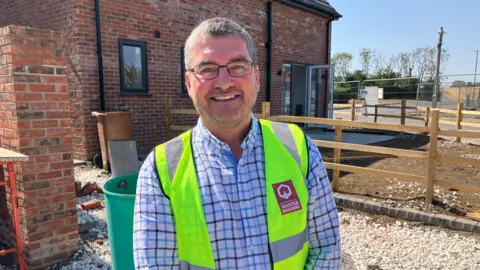
Chris Carr, managing director of Carr and Carr Builders in Grimsby, said industries such as construction are ideal for young people looking to forge a career but said it was often overlooked.
"I still think we've got a bad impression with parents... especially with the A-level students, we are not seen as a great career choice," he said.
"The main thing now is that we've got very technical with housing and we do need more of the A-level students coming into the industry.
"In Europe, construction workers are seen as being really high profile. They're seen on the same level as a solicitor, with three or four years training.
"But in the UK, especially, we're known as a career of last resort."
There is an ongoing debate about whether university or an apprenticeship is the better option for young people leaving education.
University has traditionally been seen as the pathway to higher-paying jobs and greater career prospects.
However, rising tuition fees, increasing student debt and the growing cost of living have led many to question whether a degree is the best option.
As a result, there has been a growing push towards apprenticeships and other practical routes into employment.
But Sarah Whitaker, director of UK student recruitment at the University of Hull, said university is still a strong option for young people.
She said: "There is such a wealth of information out there about different things like apprenticeships, about degrees, it's about making use of all of that information and making sure that you find something that is the right fit for you.
"But we do really believe that university still offers one of the best opportunities to really find yourself and find that path in life where you can be successful."
Additional reporting by Holly Phillips.
Listen to highlights from Hull and East YorkshireorLincolnshireon BBC Sounds, watch thelatest episode of Look North.
Download the BBC News app from the App Storefor iPhone and iPad orGoogle Play for Android devices
