'With debt rising and jobs scarce, were our degrees worth it?'

 BBC
BBCWith student debt rising and competition for jobs fierce, an increasing number of people now think a university degree is not worth the time and money.
A British Social Attitudes survey found a third of respondents were disillusioned by degrees, while more than 25,000 people told MPs they were confused by student loan terms and conditions.
We spoke to students in Sheffield, Leeds and Bradford to see if they still felt positive about their prospects.
Ellis Nevitt, 22, has just finished the final year of his chemistry degree at Sheffield Hallam University.
He worked part-time throughout his studies and struggled with rent and energy bills during his three-year course.
"As soon as you're done with your degree, you have to move home with your parents," he said.
"It's a bit demoralising really when you've gone away, you've gone and lived by yourself, you've got your degree, you want to go and get a job, but then you've got to sort of delay that, put that off and go and move back home.
"It feels almost like a step back in a way."
He said there was "so much competition for so few" graduate jobs and estimated he had about £45-50,000 of student debt accrued.
"It's a burden, and I think the reality for me is that you sort of accept that you're not going to pay that off really at all.
"We think this is an extra tax for the rest of our working lives."
A Treasury Committee inquiry is examining student loan plans in England and whether repayment terms are "reasonable".
The inquiry heard that 52,000 people responded to a call for evidence, with more than half saying they did not understand the terms and conditions.
Meanwhile, the British Social Attitudes survey found 34% of people in 2025 agreed a university education "just isn't worth the amount of time and money" - up from 14% in 2005.
This is the highest level of concern about the value of a degree for 20 years.

Molly Pemberton has more experience than most of student life in Sheffield.
Now 27, she did a fine art degree followed by a master's, and now works full-time at the students' union.
She said her student debt had reached £60,000 because she also took out a postgraduate loan.
"It's such a burden when you're starting out in your career," she said.
"You want to get a higher paid role but that also means you're paying back more of your loan and the way that the system's set up means that you probably never will pay it off, and it keeps on increasing."

Jacob Blagden, 23, is one of the lucky few - he has secured a job in his chosen field, construction project management, and will start shortly after completing his master's degree.
Blagden lives at home as Sheffield is his home city, and his new office will be nearby on Leopold Square.
He works in a cafe for two days a week, and for him university has been worthwhile, but he still thinks fees are high.
"It's too expensive for what you're getting," he said.
"I started my undergrad during Covid, so we had that impact. That stopped me being able to go to a different university and I ended up choosing Hallam."
Despite finding a coveted job, Blagden said he would not choose the university route if he had another chance.
"I'd go down the apprenticeship route personally, but I feel like I learn a lot better by doing rather than necessarily being sat in a class all the time."

Adam Czernianian, 20, is studying business management on a degree apprenticeship scheme at the University of Bradford in partnership with Morrisons, one of the city's major employers.
He said: "You get your experience while on the job and come out of it with a degree at the same time, and you get paid with no debt.
"I want to go into a management role. I'm going into that now and then I'll carry on and hopefully roll into department manager at the end of it.
"It's through Morrisons and the head office is over here, so they put us into this uni."
Daniel Obiku is self-funding his master's in advanced civil and structural engineering at Bradford with support from his father, and believes it will lead to well-paid employment.
"It's always been my passion," he said.
"I studied civil engineering at undergrad. I love the idea and the concept of construction - seeing things getting erected, the whole site build-up.
"I would love to work in the construction industry.
"I've got this flexibility in engineering. If you can start up something on your own, you can build up a firm on your own, I can start small and advance as time goes on.
"It's expensive but it's worth it."
 BBC/Grace Wood
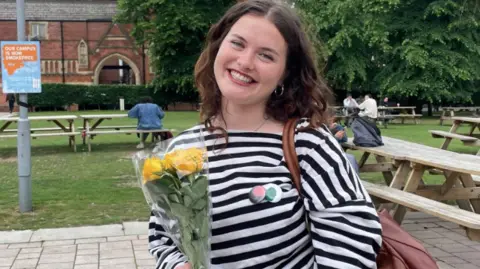
Meanwhile, 22-year-old Nell is celebrating the end of her maths degree at the University of Leeds.
Traditionally considered one of the best subjects for employability, its graduates often follow a path into finance roles, and Nell does not regret her choice.
"In middle-class circles it's definitely seen as the mandatory thing to do, but that thing is going to put you into £27,000 of debt," she said.
"I don't regret it at all, but I think for a lot of people I know if other options were promoted to them they would have done things very differently.
"I don't think I ever will pay it back, to be honest - I'm just banking on them wiping it at some point."
The Department for Education said it understood the concerns graduates had about the student loan repayment system and had "taken steps to make it fairer", including raising the repayment threshold and capping maximum interest rates this year.
Listen to highlights from South Yorkshire on BBC Sounds, catch up with the latest episode of Look North
