'People accused us of using AI for our Eurovision logo'

 PALS/EBU
Amongst the hordes of people who have descended on Vienna for the 2026 Eurovision Song Contest is a very proud design agency owner from Sheffield who cannot walk through the attractive, baroque streets without seeing her own handiwork.
Plastered across the city is her company's striking branding, specially designed for the 70th edition of the musical extravaganza.
But for Amy Bedford and her "tiny little company" PALS the "incredible honour" of working on the design has been sullied by online accusations it was generated by AI - a charge she vehemently denies.
"You would never ever use AI to make something as important as a brand of the Eurovision Song Contest," she said.
"It's too big, it's too important, it's too loved.
"It's too globally recognised and needs to be trademarked, because the client needs to earn the IP, and that needs to be very transparent."
 PALS/EBU
Explaining her winning concept, Bedford said: "We had this central proposition that was all about the beating heart of the competition.
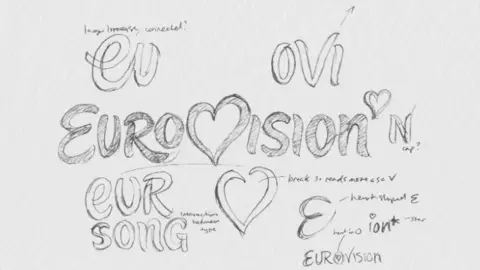
"I worked with different graphic designers, a typography studio, 3D Houdini artists, and I hired one of the UK's best hand-drawn lettering logo artists to essentially evolve the logo."
After eight months of painstaking development work, the logo was released to the world and an expectant Eurovision fanbase.
But, she said, it did not receive the reception she had hoped for.
"Some of the superfans took umbrage," she said.
"When we launched it there were Reddit and Subreddit articles [saying] that we created it on AI."
Among the Reddit comments, one said: "It looks like AI because AI is trained and designed to produce a corporate clean inoffensive sterile look. It's essentially a commonality recreator machine".
 PALS/EBU
Bedford also points out another design in the range that has fallen under suspicion.
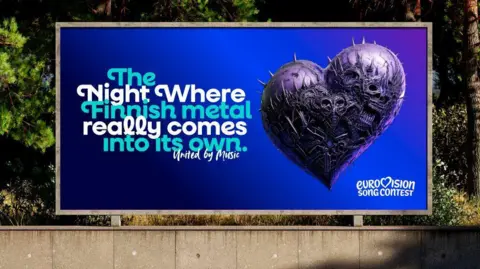
"We created a chameleon heart that reflects that every year there will be a new iconic Eurovision heart shape, that reflects either the art or the acts of the industry.
"We made a heart that was made of 70 different layers by a brilliant Spanish 3D artist and because the original woodwork was so good, everyone said that it was AI and made on a computer, which it had been, but with a human not a robot."
Although Bedford is sanguine about the AI accusations, elsewhere in the industry many artists have grown weary of technological advances.
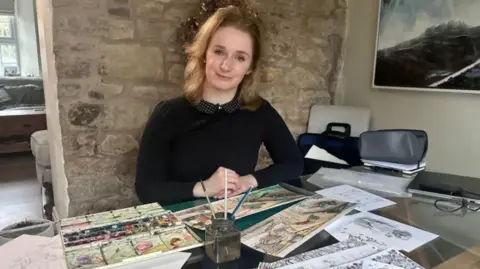
Eleanor Tomlinson, based in East Yorkshire, describes herself as an artist and illustrator who "celebrates wildlife and the local countryside" through watercolours.
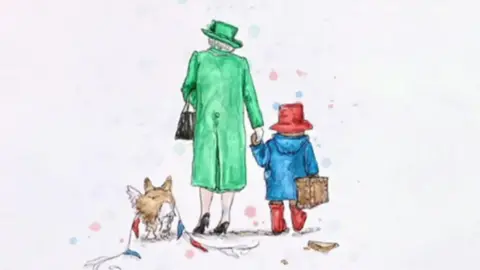
A sketch she created of Queen Elizabeth II walking hand in hand with Paddington Bear to mark the Platinum Jubilee in 2022 was both widely loved and then recreated several times over using AI.
She said: "When I see something that is my original work, that has been photoshopped, edited and gone through a process of AI and, in a lot of cases, my signature is kept on the artwork and I don't want my name to be attached to.
"Some of the pieces are making a political statement, when mine was a really sort of innocent, happy, celebratory piece."
 Eleanor Tomlinson
Although she admits to feeling "resigned" to the changes AI has brought to the industry, she does think there are positive steps she can take.
"What I often do now is share the process and the space behind the art.
"I post something that was like a half-finished piece behind the scenes view, that would get more engagement than the finished piece.
"I think that's going to become more and more of a USP and important factor in creatives and small businesses, showing that there is a person behind it.
"And, I'm hoping that we'll see a much higher value put on things that have been made or created or designed by an actual human."
 Jonathan Wilkinson
Sheffield artist and painter Jonathan Wilkinson graduated from Sheffield Hallam University 20 years ago with a Fine Arts degree. He still works from his attic studio in the city and his urban landscape prints adorn many walls across South Yorkshire.
He said he's also "adjusted" the way he showcases his work.
"I do a lot of pencil work first. It's what I've been doing for 40 years but I never used to really share that, but I've started to let people see it on Instagram, to show my workings and see that this is created by a human".
Wilkinson acknowledges that he has lost income because of AI.
"There was a particular illustration job that I had for quite some time as a freelancer," he said.
"I would get paid a decent daily rate to do it, but I guess you don't really need to pay that anymore when you just can generate a version of it in a matter of minutes."
So is it easy for people to spot the difference between AI prints and those generated by a genuine artist? Wilkinson is hopeful that the public are becoming more attuned to the differences.
"I was in a major coffee chain the other day with a huge mural stuck on the wall and, because it'd been blown up and because I've got an eye for this, I could tell it was AI.
"What's disappointing is that paying for some local art would be a drop in the ocean to a big billion dollar company like that."
'People are craving authenticity'
So if AI is both helping to copy artists' work and costing artists commissions, where does this leave the next generation of creatives?
Alex Watson has been a graphic designer for 15 years and teaches the subject at both Sheffield Hallam University and Doncaster College.
"When I was at university in 2010 we used to have big cohorts of 220 students, now it's probably about 40.
"I think people are just looking at different ways of teaching themselves and are worried about getting jobs because of AI."
But Watson also believes younger generations offer hope for the future.
"People are craving authenticity. They want something that's made by a human. I think it's really obvious when things are AI now. Things all just look the same.
"Our students don't want to use it. They're wanting to change things. They grew up with all this technology so now they want something different".
Listen to highlights from South Yorkshire on BBC Sounds, catch up with the latest episode of Look North
