Voice notes are massive in some countries but not the UK - here's why


 BBC
BBCOn an August day in 2013, WhatsApp, the messaging app now owned by Meta, made an announcement. With relatively little fanfare, they revealed the voice note, the messaging feature that lets you send a clip of your own voice to friends and family.
"We know there's no substitute for hearing the sound of a friend or family member's voice," the company enthused in a press release.
Thirteen years on, receiving a 10-minute clip from a friend, telling you about a complex family feud or workplace drama, is an experience that is loved by some and loathed by others.
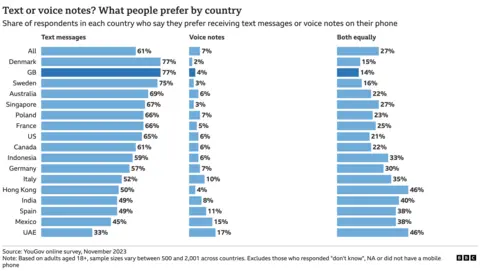
In places like India, Mexico, Hong Kong and the United Arab Emirates, voice notes are almost matching the popularity of written texts as the preferred form of electronic communication.
But curiously, the truth is that compared to many places, Britain never seems to have quite caught the voice note bug.
 Reuters
A YouGov survey of more than 2,300 British adults, published this month, found that while voice notes have become slightly more popular in the last year, still only 15% communicate via voice note regularly (i.e. a few times a week). Across men, women, and across every age group - including Gen Zs - voice notes were the least popular method of communication.
And in 2024, YouGov found that Britain was the most voice note-averse country of the 17 mostly rich nations it surveyed, with 83% of respondents saying they prefer text based messages to voice notes (and only 4% saying they prefer voice notes).
So, why do voice notes prove so divisive? And why have they taken some countries by storm, while failing to truly take off in Britain?
A happiness boost
In 2011, researchers at the University of Wisconsin-Madison in the US measured how a group of children's hormones reacted when they got phone calls from their parents, compared to text messages.
It found that the levels of the stress hormone, cortisol, went down when they heard their parent's voice in a phone call, while oxytocin, the hormone involved in the formation of positive relationships and bonding, increased.
The study looked at phone calls rather than voice notes, but its key insight - about the value of hearing a loved one's voice - may still be relevant.
Prof Seth Pollak, one of the psychologists behind that 2011 study, now says it's worth running the study again, looking specifically at voice notes.
"I do think it would be interesting to [include] something that was pre-recorded, where we're hearing somebody and they're speaking but they're not necessarily responding to what's going on with you," he says.
His "hunch", he says, is that a pre-recorded voice note will probably "pack less of a punch" emotionally than a live phone call in which you're able to respond in real time to whatever you're hearing.
Meanwhile Dr Martin Graff, a psychologist at the University of South Wales who researches online communication, says voice notes can offer more emotionally layered ways of speaking.
 AFP via Getty Images
"I think it possibly hangs on what used to be called media richness theory," he says. "[It] means that if you're sending 'rich media' – i.e. not just text, but you're sending voice as well – it conveys an emotion, and that might lead to what we call uncertainty reduction, so we're more sure of the person with whom we're talking."
No wonder then, that dating apps like Bumble, Happn and Grindr have all introduced a voice note function over the last few years.
But why, then, are many British people still so stubbornly against them?
A pro-voice note country
Prof Jessica Ringrose, a sociology professor at University College of London, says that British people are perhaps more reserved in their communication styles than other cultures.
She said voice notes would appeal "if you really love talking, and you've got that communicative and also performative element of how you do your relationships" - and that isn't, generally speaking, as common in British culture, which is typically seen as relatively emotionally reticent.
"I could definitely see that British people would be less inclined [to send voice notes] and briefer in their interactive style," she said, though she admitted it is "hard not to stereotype if you talk about this".
In the absence of up-to-date science, I conducted some (highly unscientific) research of my own. I'm a British person with Indian heritage, giving me a vantage point over two countries with radically different feelings towards voice notes.
India is one of the most pro-voice note countries in the world; the 2024 YouGov survey found that 48% of Indian respondents either preferred receiving voice notes, or liked receiving them just as much as texts, compared to just 18% of people in Great Britain.
So first, I asked friends - and friends of friends - in Britain.
As it happens, I love voice notes. But I'm aware that they get on my sister Ramya's nerves.
"The reason I hate voice notes is, it's so imbalanced," Ramya told me.
"For the person who's sending the voice note, it's super easy. They just have to press the button and then they can ramble on. But for the person who's receiving… they've got to just pay all their attention to this voice note.
"You get a six-minute voice note, and you don't know if they're telling you that their house burnt down and their cat died, or if they're just talking about how lovely their day is."
The Gen Z apprentice on my team, Gyasi, told me he found them "a bit of a nuisance", specifically because you need headphones to listen to them.
But perhaps counter-intuitively, given younger people in Britain are most likely to use voice notes, Gyasi's mother, 53-year-old Buzz, said they were a handy way of putting off an overdue phone call.
Meanwhile Daniela, 30, said: "Voice notes stress me out a little bit, because once you open them you're committed to listening to the whole thing."
Josh Parry, the BBC's LGBT and Identity reporter, is perhaps the biggest voice note-lover in my life. His messages have been known to get up to 15 minutes long on occasion (no, I'm not exaggerating).
"I think that they can add really good context when you're talking about something, you can discuss things in a way that maybe is a bit harder to write down, and you can get across the nuance," Josh told me.
"It's also really handy instead of texting when I'm walking the dogs."
Another friend, designer and business owner Naomi, said they are useful when her hands are full – "I love sending voice notes when I'm busy… if I have lots going on, if I have the kids around and I'm trying to multitask."
"It feels like a nice way to be a bit more connected," she said.
The language factor
In India, the country of my heritage, almost half of the population prefer voice notes, or at least like them just as much as texts, meaning voice messaging is now baked into the way Indians communicate.
The Indian wing of WhatsApp recently released a glossy, nine-minute advert telling the story of a fictional newlywed couple in rural India who fall in love via voice note. And on the opposite side of the joy spectrum, there are reports criminals in India have been choosing to issue threats over voice notes.
Some say that it's down to language. In multi-lingual cultures such as India, voice messaging is an easier way to mix languages. For example, people who speak Hinglish – a fluid mix of Hindi and English – can do so more naturally.
 NurPhoto via Getty Images
Shreya, a college student in Pune, in the Indian state of Maharashtra, told me her friend group mainly uses voice notes "because we use a lot of languages".
"So I usually switch between my mother tongue, which is Marathi, and English," she said.
"I've tried the Marathi keyboard, but it's really complicated to use," she added, saying that the only person she knows who uses the Marathi keyboard to type is her grandmother.
Namratha, a 29-year-old who lives in Khargar, near Mumbai, says that because people speak multiple languages, but can't necessarily read and write in all of those languages, voice messaging makes communicating easier.
"Maybe I know their language, but they don't know mine well enough to actually write it - they might know how to speak it but not to write," she said.
But some things do transcend borders - like the need for gossip.
Shreya, for example, told me voice notes "also convey expression better… so when it comes specifically to spilling the tea [gossiping], we expect a voice note."
The topic is under-researched in India, though Prof Kathryn Hardy, a professor of Sociology at Ashoka University in Sonipat, Haryana, told me it was "extremely plausible" that voice messaging was particularly popular in rural communities and areas where written literacy is lower.
"We've seen so many technologies taken up in rural communities just instantaneously, because they do bypass literacy requirements," she said. "This seems like the most obvious use of voice notes, to get around the problem of not just literacy but fluency."
Could language also help explain British dislike of voice notes? The Spectator columnist Rory Sutherland thinks so. "We actually have quite an efficient language. [In] English, you don't have to type 16 letters to say sorry," he says - making written communication more tempting.
Diaspora communities
It's also notable that voice messages are popular in countries with large diaspora communities. India, for example, has the world's largest diaspora, with over 35 million Indians and people of Indian origin living outside the country and an estimated 2.5 million more moving abroad every year. Mexico, where 53% of the population say they like voice notes, also has a large diaspora community too, predominantly based in the US.
It could be that they provide people living in different time zones with a way of keeping in touch that's more asynchronous than phone calls, but more personal than texts.
 Getty Images
Prof Hardy backed up this theory. As an American who's lived in India for almost a decade, voice notes have allowed her children to keep in touch with their grandparents back in the US.
"We use voice notes probably 10 to 20 times a week - we send a lot of voice notes," she said. "So my hunch is that at least some of that use [in India] is maybe intergenerational, or across long distances and major time zone distinctions."
Etiquette and gossip
We don't yet know whether voice notes cause that surge of oxytocin found in the 2011 study of phone calls. And whether they do or don't won't necessarily change minds.
Rory Sutherland sees it as a matter of being polite. "Whether this is something to do with the English language or to do with the British character, I hope we do retain some vague measure of what is etiquette. I would argue that recording a five minute message is discourteous to the recipient," he says.
For my part, I can't help but feel that, with many of us feeling increasingly distant from each other, there is an important place for little recordings from our friends, and we should treasure them.
As my friend Josh tells me: "I hope they never ever go away. The gossip in our lives would be much less rich without voice notes."
Additional reporting: Gyasi Bishop-Hibbert.

BBC InDepth is the home on the website and app for the best analysis, with fresh perspectives that challenge assumptions and deep reporting on the biggest issues of the day. You can now sign up for notifications that will alert you whenever an InDepth story is published - click here to find out how.
