Plaque at site of former workhouse is unveiled

 West Hertfordshire Teaching Hospitals NHS Trust
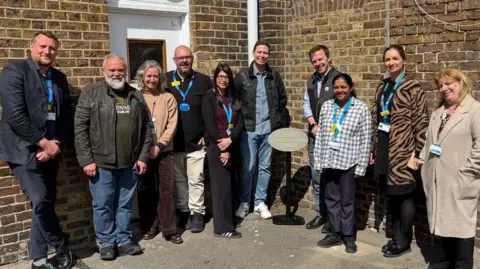
A plaque to mark and help protect the site of a Victorian workhouse located on a hospital site has been unveiled.
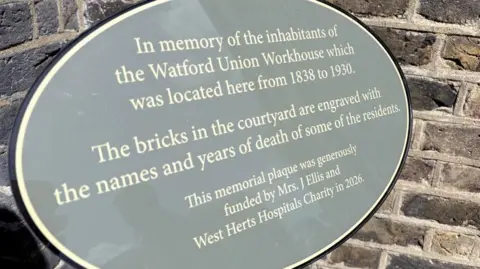
The Watford Union Workhouse opened in 1838, on the south side of Vicarage Road, and shut in 1930.
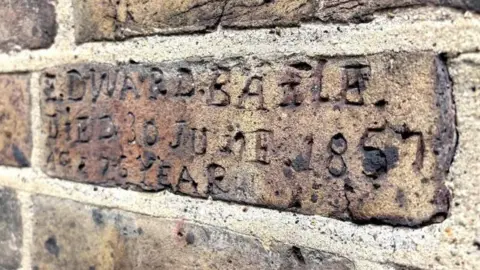
The plaque is located by the wall that once surrounded the exercise yard used by male residents, and refers to engraved bricks in the courtyard that are marked with the names and dates of death of some of the workhouse's former inhabitants.
"New building developments are endangering some of our most important historical sites," said Mrs J Ellis, who partly funded the plaque.
"So I am pleased this plaque will go some way to protecting it."
The Victorian workhouse system was set up to provide housing for people who were too poor, old or ill to support themselves in exchange for their labour.
The engraved bricks at the site, which was designed to accommodate up to 100 people, was part of hundreds of little-known memorials across England nominated for listed status by members of the public in 2018.
Other bricks at the Watford workhouse were engraved with graffiti including one of a horse and a train.
They are probably the only grave markers the former male residents had.
 West Hertfordshire Teaching Hospitals NHS Trust
Construction of the Watford Union Workhouse began in 1837.
In 1838, people from Aldenham's workhouse were moved to Watford and they were later joined by others sent from Watford's old Parish Workhouse.
From 1904, to protect them from disadvantage in later life, the birth certificates of those born in the workhouse gave their address as 60 Vicarage Road.
In 1930 the workhouse was renamed Shrodells Public Assistance Institution, where the elderly, infirm, needy or destitute were cared for and housed.
The building then became part of Watford General Hospital, following the founding of the NHS in 1948.
Toby Hyde, from West Hertfordshire Teaching Hospitals NHS Trust, said: "The memorial plaque reflects a shared commitment to remembering the people who lived and died in the workhouse."
 West Hertfordshire Teaching Hospitals NHS Trust
Workhouses had many prominent critics including the author Charles Dickens.
He frequently depicted workhouses as cruel, prison-like institutions designed to punish the poor, most famously in Oliver Twist.
Some of the workhouse buildings in other parts of the country continued to house families well into the 20th Century.
Do you have a story suggestion for Beds, Herts or Bucks? Contact us below.
Follow Beds, Herts and Bucks news on BBC Sounds, Facebook, Instagram and X.
