Calls for strict dangerous dog laws as attacks rise

 Marie Hay
A woman whose husky was "ripped" open and her daughter attacked by dangerous dogs is calling for stricter rules for pet owners.
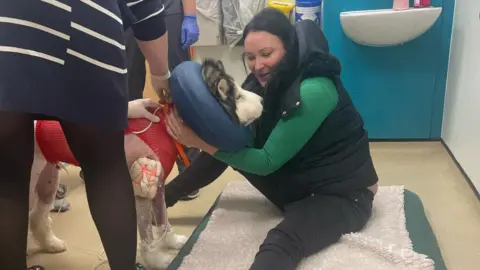
Marie Hay was walking on Redcar beach when her dog, Naevia, was attacked by two bully-type dogs and her daughter was bitten when trying to separate them.
Hay has called for tougher rules for owners and breeders of dogs after new data found attacks had increased across England and Wales, with the highest rates found in the north of England.
Hay said she wanted rules brought in to make sure the "correct people are owning the correct breeds of dogs".
She said the attack happened with "no warning" and she could tell the dogs wanted to kill Naevia.
"They just dived on her and started to pull her shoulders and rip her chest," she said.
While trying to stop the attack, Hay said her daughter was bitten on the arm and several members of the public required hospital treatment after also being injured.
 Marie Hay
Naevia was left unable to walk after the attack but has now fully recovered, along with Hay's daughter.
Hay said when she bought Naevia she was required to prove to the breeder she had owned large dogs before and he then contacted her regularly to make sure she could properly look after the husky.
She wants these checks to be mandatory.
"If other breeders aren't doing those checks, and they're just handing dogs out that are powerful and have got a certain type of trait that might be dangerous, then how are you meant to be know what's going on or if that dog is still in that owner's home?" she said.
Hay also wants rules brought in that would mean all dogs are kept on leads when out in public, to keep "everybody safe".
Dangerous Dogs Act
The UK government attempted to reduce dog attacks by banning XL bullies under the Dangerous Dogs Act and since 31 December 2023 it has been illegal to breed, sell or transfer ownership of this type of dog.
But the RSPCA's head of companion animals, Dr Samantha Gaines, said the rise of dog fatalities and serious bites showed the law "simply isn't working".
"The UK government urgently needs to adopt a different approach; focussed instead on preventing dangerous behaviours rather than focussing on the dog's individual breed," she said.
The RSPCA has called for a return of dog licensing as a means of tracing dogs and monitoring dangerous animals, as well as stronger controls on dog breeding.
Information from Freedom of Information requests sent to the police found the number of reported out-of-control dog offences leading to an injury rose from 18,683 in 2019 to 32,746 last year.
The figures relate to attacks which injured a person or assistance dog but excludes other dog-on-dog attacks.
North-east England had the highest rate of offences in the country, when compared with its population, with 77.8 offences per 100,000 people. The North West had the second highest with 71 per 100,000.
Of the 42 police force areas covered by the FOI data, those in the North East and Cumbria had particularly high rates.
Durham Police had the third highest rate in England and Wales at 87.9 per 100,000, Cumbria Police was fourth with 85.2 and Cleveland Police was sixth with 84.6.
Durham Police said it was the responsibility of owners to ensure their pet did not cause a nuisance or harm to others.
This includes controlling their dog in public and making sure the animal is microchipped and wearing a collar and tag.
Cleveland Police's dog support unit and training manager, Sgt James Grieves, said studies showed communities with "higher levels of poverty, unemployment, and violent crime tend to experience a greater prevalence of dog‑related injuries, which is a pattern followed by Cleveland".
"We have enhanced training for frontline officers, to improve their understanding of dangerous dog legislation, risk assessment and accurate recording of offences," he said.
"This ensures consistency and improves the early identification of risk."
Grieves said the force had implemented a "structured approach" to identifying dog-related risks early and had invested in a sedation gun to humanely capture dogs.
While the Northumbria Police area had a lower offence rate of 70.7 per 100,000, the number of offences reported to it in 2025 jumped 40% to 1,067.
A spokesperson for the force said it had seen an increase in the number of dogs seized under the Dangerous Dogs Act, but this was partly due to more people owning dogs.
They said once a dog was seized an assessment is carried out and specially trained officers provided a recommendation to the courts about whether a control order should be granted, which can include conditions such as being muzzled or walked on a lead.
Cumbria Police did not respond to a request for comment.
Despite the work being carried out by police forces, Hay said she still feared taking Naevia out without tougher laws.
"I'm that terrified that if I leave the house and something goes to attack her, how am I meant to save her twice over?" she said.
