'My great-grandad saved your life' - Aberfan survivor left stunned on school visit

 BBC
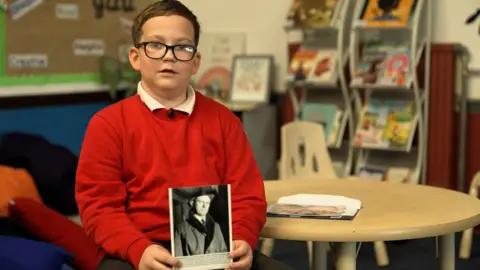
BBCGareth Jones was speaking to children about how he survived the Aberfan disaster when a little boy raised his hand.
Noah, aged 10, held up a photograph and asked a simple question - did he recognise the man in the picture?
"The hairs were standing on the back of my neck," Gareth said.
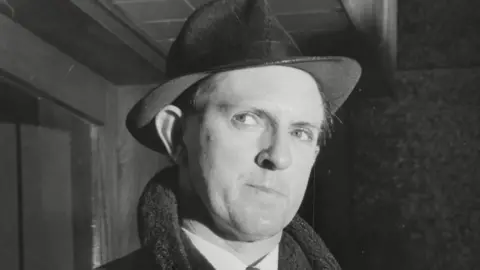
He looked closely - it was of the little boy's great-grandfather, Stephen Andrew, who had pulled Gareth to safety on that fateful day.
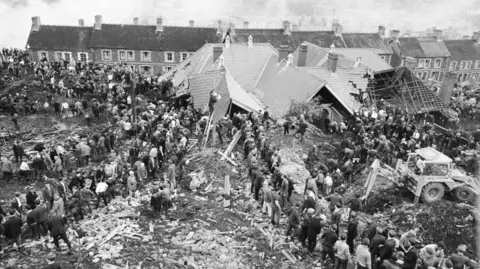
On the morning of 21 October 1966, a colliery spoil tip collapsed on the hillside above Pantglas Junior School, sending tonnes of slurry crashing through the building and nearby houses.
It killed 116 children and 28 adults.
 Getty Images
Recalling how he escaped, Gareth said: "There was a guy at the other side of the window.
"He actually grabbed me and told me to run."
He later learned it was Stephen.
Gareth has always maintained the school caretaker saved his life, pulling him to safety through a shattered classroom window as the disaster unfolded.
But he had never actually seen a photograph of him.
This all changed when he met Noah on a recent visit to Troedyrhiw Primary.
It is near where Pantglas Primary once stood in Merthyr Tydfil county, and the visit came as schools in Wales and around the world prepare to mark 60 years since the Aberfan disaster on 21 October.
"I was absolutely gobsmacked... that bit of the jigsaw has come together," Gareth said.
Noah had grown up hearing about his great-grandfather's heroics.
But his family had also suffered tragic losses on that day.
 Shutterstock
On the morning of the disaster, Stephen started the heating system at the school before returning home to nearby Moy Road.
He had a quick cup of tea with his wife and newborn daughter, before setting off back to work.
Then he watched in disbelief as tonnes of colliery waste poured down the hillside and buried part of the junior school.
Quickly rushing to help, Gareth was among the first of the youngsters he pulled to safety.
But Stephen's two sons at the school, Kelvin and Malcolm, were buried in the rubble and would be among the 116 children who died.
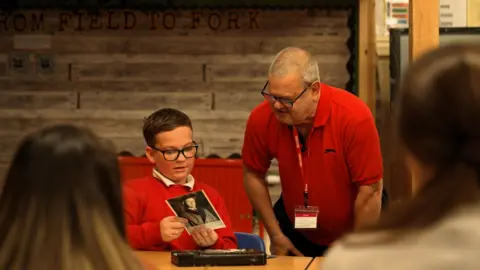
"I'm just happy to hear the story," Noah said, describing his pride in his great-grandfather's efforts.
Around him, his classmates listened intently as Gareth talked about how a seemingly normal school day turned into a catastrophe within seconds.
They asked about the noise, about the moment the walls began to crack, and about what happened afterwards.
"That was really scary," said Caelan, 10, when Gareth explained how his gang of close friends dwindled from 10 to three or four.
"Not having your friends to go out with… I was thinking, what would I do if it happened to me?" he said.
Others reflected on how different it felt to hear the story from someone who had been there, rather than reading about it in a book.
"It made me think how lucky we are that it's not going to happen again," said Aleyah, also 10.
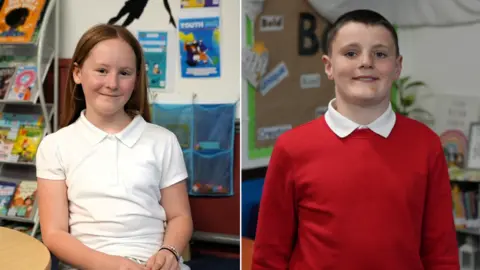
Troedyrhiw is a short distance from Aberfan and teacher Hannah James believes this makes the history feel personal to local children.
"It's part of their identity… part of the community that they live in," she said.
"I think the questions they asked were so mature, and they were able to have real in-depth conversations and show their empathy skills and their understanding of the impact the disaster had for children who were their age.
"It [had been] really hard for them to relate, but I think having Gareth to share his experience has helped them to really understand the impact it had on the community, and their community that they live in."
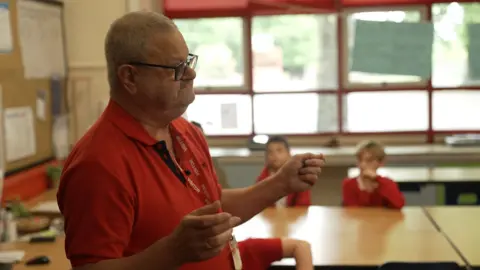
That connection with younger generations is why Gareth continues to tell his story.
"I enjoy speaking about the disaster," he said.
"These children now will have their own children… and they can tell them the story."
While pupils across Wales learn about Aberfan, one school in the US has also been educating its students about it.
This has been with the help of Gaynor Madgwick, another survivor of the disaster.
On a video call from her home near Aberfan, Gaynor spoke to children at Hampstead Middle School in New Hampshire.
Almost 100 pupils, thousands of miles away, had already spent lessons learning about the disaster, and when Gaynor appeared on screen, they greeted her with applause.
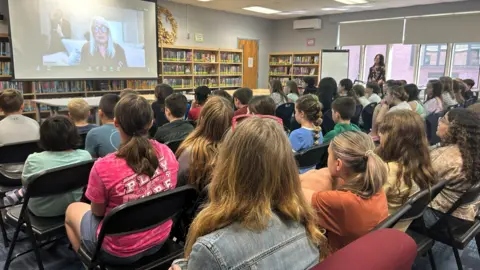 Hampstead Middle School
She was visibly moved by the size of the audience and their knowledge of the disaster, and began by describing the morning of 21 October 1966.
Like Gareth, she had been in class when she heard a "tremendous" roar before a wave of debris crashed into the school.
She told the children how she awoke trapped beneath rubble, with injured legs and surrounded by classmates.
Some were alive, but others were not.
Later, in hospital, she learned her brother, sister and many friends had died.
"We were only eight or nine years of age," she said.
The pupils listened in silence before asking questions about the day itself, and about what came afterwards.
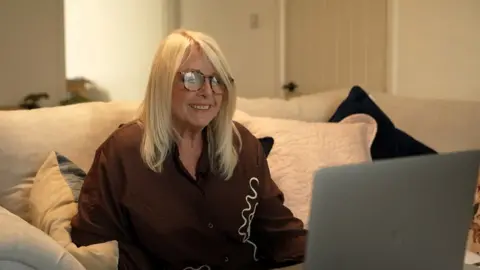
One asked whether she had experienced post-traumatic stress disorder.
"It wasn't until five years ago that I was actually diagnosed," Gaynor said, explaining how anxiety and trauma had stayed with her for decades.
Another asked how she had survived when others had not.
"I feel my life was spared to help others," she told them.
There were questions about the quietness of the village afterwards, and the guilt some children felt playing outside when so many families were grieving.
"We used to go away and hide… not to upset the parents," Gaynor told them.
Their teacher, Jenn Howard, drew parallels with their own community, helping pupils understand how the loss of 116 children in Aberfan would be like losing an entire year group in their school.
For Gaynor, the call was powerful and emotional, saying: "It blew me apart.
"The knowledge was amazing… they wanted to know about PTSD, about everything."
She said moments like this show why sharing survivors' stories matters beyond Wales.
"It's about telling as many people around the world what really happened," she said.
"If there's one thing they take away… it's for children not to suffer in silence.
"To talk, to share their feelings. Not to be afraid."
