Breath test for 'deadliest' cancer trialled in Wrexham

 BBC
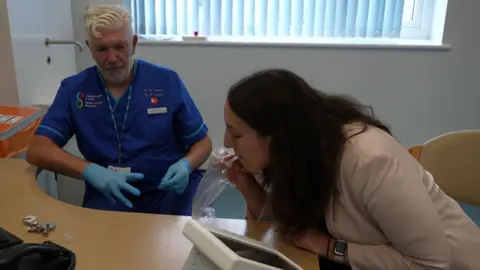
BBCA 30-second breath test that could detect pancreatic cancer is being trialled in Wrexham.
Pancreatic cancer is the deadliest common cancer, with half of people dying within just three months of their diagnosis.
About 530 people are diagnosed with the disease annually in Wales.
Wrexham Maelor Hospital is part of a UK-wide clinical trial involving more than 6,000 patients with an unknown diagnosis.
Pancreatic Cancer UK, which invested more than £1.1m into the test developed at Imperial College London, said it could be "the most significant step toward a lifesaving-breakthrough in 50 years".
 Louise Dale
Pancreatic cancer can have unclear symptoms, like back pain, indigestion and changes to bowel habits, which means that in 80% of cases the cancer goes undetected until after it has spread.
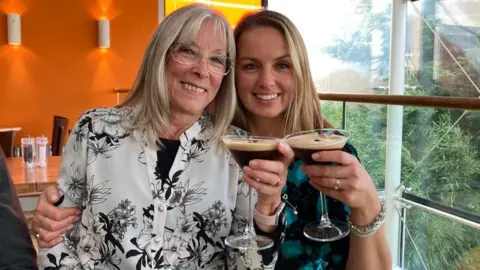
The breath test trial is being welcomed by Louise Dale, from Gresford, whose mum, Carol Purchase, died at the age of 69 - within 12 weeks of being diagnosed with the disease.
Her stomach issues, which began in early 2023 were thought to be due to stress and anxiety, but she was diagnosed with pancreatic cancer about a year later.
Dale says her mum was "taken so quickly" and thinks a test like the one being trialled could have made a difference.
"She may well have got that CT scan earlier... maybe it would have saved her life," she said.
How does it work?
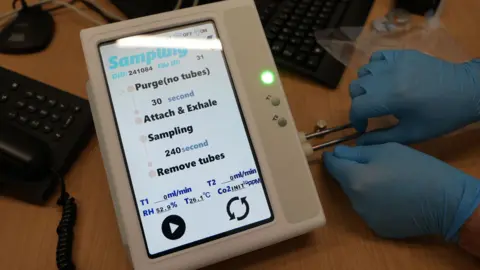
The test involves a patient blowing into a tube which detects volatile organic compounds (VOCs) present in the breath.
Patients with cancer produce different types of compounds, and these changes are detectable in the breath.
By isolating unique combinations of VOCs doctors could be able to quickly identify people likely to have pancreatic cancer.
The breath test is designed to be accurate, non-invasive, and usable in a GP surgery or pharmacy.
It is hoped the test could significantly improve survival rates, while remaining cost-effective.
Breath samples can be taken in as little as 30 seconds, with test results available in a few days.
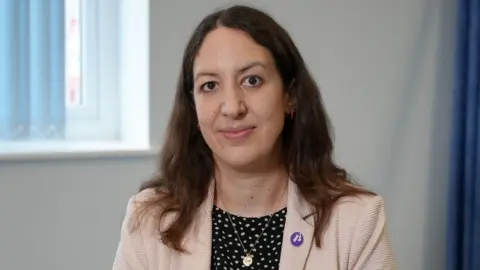
Dr Katherine Free from Pancreatic Cancer UK said following a previous successful trial of the breath test, it was now moving to "an advanced clinical trial".
The test would then be given to thousands of people with an unknown diagnosis - people who have "suspicious symptoms that could be pancreatic cancer, or could be something else".
"This is one of the major challenges of pancreatic cancer," she said.
"The symptoms are very vague. It's things like indigestion, back pain, changes to your poo, weight loss. So they could be pancreatic cancer, but they could also be lots of other different conditions as well."
There is currently no early detection test to help doctors, but Free said if the clinical trial showed it could accurately detect pancreatic cancer, it could be "a game changer" for patients around the UK.
Currently, surgery is the best treatment for pancreatic cancer, but can only be carried out in about 10% of cases because patients often present with the disease at a late stage.
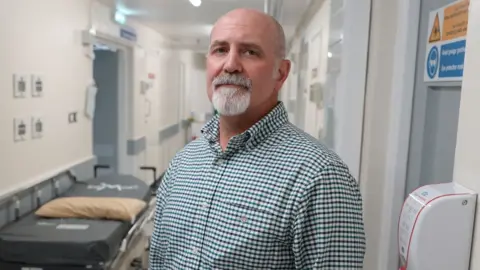
Duncan Stewart, consultant surgeon at Wrexham Maelor, welcomed the clinical trial coming to the hospital, and said the earlier detection the test could bring would be "absolutely key".
"Anything that we can do... to bring that lead time down, so that we can make a diagnosis at an earlier stage, should, hopefully, open up a far greater number of treatment options."
Though the test has come too late for Dale's mum, she said it was "amazing" that the clinical trial had come to north Wales, and she hoped the test would become generally available in the near future.
"Mum would be super pleased that it was happening in Wrexham, and she would be super proud of me advocating for it, because at the end of the day, it could help save lives," she said.
"I don't want other families to have to go through what we've been through as a family."
