What has happened in Plaid Cymru's first 100 days in power?

 PA Media
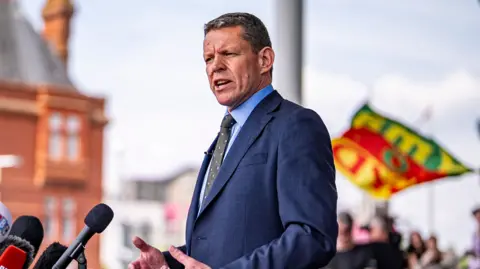
Plaid Cymru claimed victory in celebratory scenes on the steps of the Senedd in May, after it inflicted a heavy and historic defeat on Welsh Labour.
Since then, it has been an occasionally rough ride for Rhun ap Iorwerth's minority administration.
After 100 days in charge, Plaid ministers say they have laid the foundations to improve public services, and have already made a "tangible" impact in areas like childcare.
But the government failed to get over its first significant hurdle in the Senedd, when its supplementary budget was rejected by the entire Senedd opposition.
Meanwhile opposition parties claim little has changed since Plaid took charge.
Plaid Cymru formed the first non-Labour Welsh government in May, with the party six seats short of a majority of 49.
It won the election on a platform of challenging Westminster to give Wales more control over its own affairs, a promise of a major programme to boost childcare, and to cut waiting times.
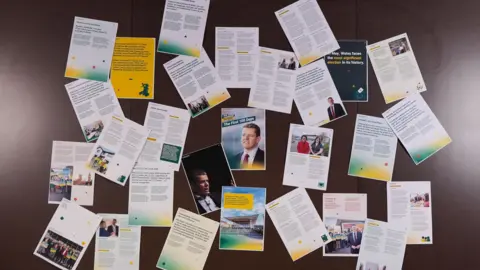
The party set out a plan for the first 100 days ahead of the election, which it said showed how serious it was about governing.
It was criticised at the time as a "plan to have a plan", with the party promising to commission a number of reviews or strategies.
The Welsh government said it had made progress on a number of issues in its first few months, including extending free school meals to more secondary school pupils, a new north-south coach service, and a multi-year funding deal for farmers.
But there's a been a focus on a few big areas over the last few months.
Childcare
Early on, Plaid came under pressure to spell out how it would deliver its landmark childcare policy, which would see free care expanded over a four-year period.
Currently parents in work or training can get up to 30 hours a week for children aged three or four. Plaid want to expand this so at least 20 hours is available from nine months to four years old.
Opposition parties have repeatedly pressured Plaid ministers for answers as to how this will work, demanding costings and a timetable for how the expanded scheme will work - leading a minister to promise more detail.
There were questions from councils, who said the proposal faced serious challenges because of a lack of resources and staff.
The Welsh government now says that all local authorities are on track to provide 12.5 hours of free childcare to two-year-olds via the Flying Start scheme by March 2027.
Plaid ministers want to phase the rest of the scheme over time - but until that is spelled out the party will continue to face scrutiny over how it's achieved.
Waiting times
The length of time that patients have to wait in the NHS was a totemic problem faced by the previous Welsh Labour government.
Plaid Cymru was careful not to raise expectation of an immediate improvement, telling the BBC last February that the public would not expect a difference within the first 100 days.
The party promised to get waiting times "down to pre-pandemic levels" within four years. In June, the Health Minister Mabon ap Gwynfor said he would eradicate two-year waits in a matter of months.
The latest figures saw two-year waits drop slightly - by 3% to just under 4,100 pathways - but for the third month in a row the total numbers waiting for treatment has risen.
Government Efficiency Minister Dafydd Trystan Davies said the government was laying "the foundations for success to bring down waiting lists" - pointing to work on surgical hubs and a workforce plan.
Supplementary budget loss
Plaid is in a minority in the Senedd and the party is vulnerable to defeats if the opposition votes against it.
That happened a few times before the summer recess, including in a crucial vote on an extra £300m in spending to reduce NHS waits and expand childcare.
Labour had demanded £100m extra to be spent on children with additional learning needs - and the two sides had failed to come to an agreement.
It was the first time a Welsh government has lost a vote on a supplementary budget - which is in addition to the main budget exercise that happens in the autumn.
Laura McAllister, professor of politics at Cardiff University, said she thought the government had been a little naive.
"If you're in that position of being a minority government, transactional relationships and goodwill between the parties is absolutely fundamental."
Since then, Welsh Labour leader Ken Skates has indicated that he does want a budget deal with Plaid.
 South Wales Fire and Rescue Service
Wildfires
The Plaid government faced its first major incident over the summer as a devolved government when a number of wildfires broke out in Wales.
The Welsh government came under scrutiny for its crisis management, because unlike the police, fire services are devolved in Wales.
There was criticism from Reform Wales about the time taken in to bring in the army and aerial support.
A minister said lessons needed to be learned with wildfires more likely in the future due to climate change.
Westminster
Plaid Cymru wants powers over policing and justice, rail infrastructure and the Crown Estate to be devolved from Westminster to Cardiff.
It promised negotiations with Westminster to do that, but turmoil in London has made making the case tricky.
Ap Iorwerth tried and failed to get a meeting with the previous prime minister, Sir Keir Starmer, although the man now in charge, Andy Burnham, held his first face-to-face meeting with the first minister in July.
Burnham has promised to put devolution front and centre of his government.
But his Welsh Secretary, Stephen Kinnock, has said he is not yet "entirely convinced" by the case for more responsibilities for the Welsh government.

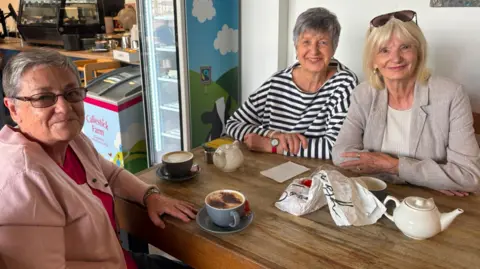
Some at Collier's Adventure Farm in Nelson, Caerphilly, were willing to give the Plaid Cymru government time before rushing to judgement.
Raydean Thomas said: "I think they're finding their feet at the moment. Nothing that they've done has been wrong as far as I can say. I think they're thinking of things in the right way."
Faye Dalgleish-McGee said: "People do rush to have an opinion a bit too quickly - let them get settled in before we start complaining."
Meanwhile, Trish Garner said it was important to wait to see what their plans are.
"But I don't hear an awful lot about what they're going to do and that's my feeling," she added.
Michael Davies said his life had not changed since Plaid had got into power, and that politics was the "same old story" with successive governments blaming each other.
"[They say] it's going to take us x amount of years to put it right and then nothing seems to happen."
Julie Jones, who was also at the coffee morning, said it was too soon to judge ap Iorwerth, but that "he came in all guns blazing".
What does the government say?
Davies said that "the initial work has been completed on the 96 actions" in the party's 100-day plan.
He said that in some areas the administration had "put the foundations for success in place".
"But in others, we've made tangible real progress that people will be able to feel already," he said.
The first minister is on leave until the end of the week and was unavailable for interviews ahead of the completion of 100 days in government.
Asked by BBC Wales whether that meant the government was playing down the milestone, Davies said it was him that was responsible for 100-day programme and that ap Iorwerth would issue a "progress report" next week.
Reform accused Plaid of focusing too much on "reviews, committees and plans".
Dan Thomas, Reform's Welsh leader, told BBC Wales that things have "just got worse" since Plaid won the election, with waiting lists having "gone up".
"The first minister said during the election campaign that two-year waits would be eradicated within a matter of months. We're now three months into a Plaid government and we're nowhere near seeing those waits being eradicated."
Ken Skates, leader of Welsh Labour, said there was "quite a contrast" between Plaid Cymru's first 100 days and the start of Andy Burnham's premiership.
"We've seen plans and processes here, discussion, a lot of talk, very little action. In contrast with Andy Burnham, we've seen some really, really big interventions that are going to make a difference to people's lives."
Darren Millar, Leader of the Welsh Conservatives in the Senedd, said: "Plaid's first 100 days have been a disappointing series of missed opportunities to turn the page on 27 years of Labour rule in Wales."
Additional reporting by Teleri Glyn Jones
