What impact do refugees have on housing in Glasgow?

 Getty Images
Immigration is not directly an issue for the Scottish Parliament, but it has become one of the most contentious elements of the election campaign.
The MSPs elected on 7 May will not have a say over immigration policy, which is decided at Westminster.
But every party has a view on it and a poll for the BBC placed it as one of the most important issues in the minds of voters.
BBC Verify is examining claims made by political leaders about the impact of asylum and migration on housing.
Scotland, like the rest of the UK, has experienced a boom in immigration in recent years.
Official routes such as international student visas account for most of the recent spike in Scotland.
But the far smaller number of people arriving via unofficial routes, such as small boats crossing the English Channel, often dominate the political debate about immigration.
And there has been particular controversy about Glasgow.
Scotland's largest city has a longstanding issue with a lack of housing, and was the first in the country to declare this an emergency in 2023.
And a recent factor has been the interplay between Home Office attempts to clear the backlog of people awaiting asylum decisions, and Scotland's approach to homelessness.
Why are there so many asylum seekers in Glasgow?
 Getty Images
More than 6,500 people are currently in Scotland seeking asylum and receiving Home Office housing support, according to the latest data. This is 6% of the UK total.
These people live in a mixture of hotels and social housing while the UK government decides whether to allow them to remain in the country longer-term.
More than half of them are in Glasgow, with the city hosting the largest number of asylum seekers among all UK local authorities - including 3,683 who are receiving housing support, and another 152 who receive other financial support but not accommodation.
Glasgow signed up to the Home Office's dispersal scheme in 1999, making it a key hub for people being housed after arriving in the UK seeking asylum.
In 2022, Home Office policy shifted to a "full dispersal" model, which meant asylum seekers could be sent to any council area.
Data suggests Glasgow's overall share of Scotland's asylum seeker population (those in receipt of Home Office support) has been gradually falling.
But ultimately a lot of refugees still gravitate to Glasgow even if they were housed elsewhere while awaiting asylum decisions, because there are established communities, charities and faith centres offering support in the city.
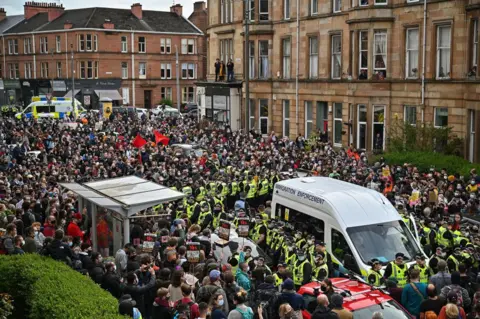
The city is no stranger to protests about the issue of immigration, including a 2021 incident when a Home Office van was surrounded by protesters inKenmure Street to stop it leaving after a dawn raid.
Why are former asylum seekers claiming homelessness?
 Getty Images
Asylum seekers receiving Home Office support in Glasgow are currently all housed in long-term accommodation, rather than former hotels as happens in some other parts of the country.
They get free meals and housing, and an allowance of £1.42 a day to live on - but are not generally permitted to work while their claims are being assessed.
Once that process is complete, people who have been granted permission to remain in the UK have to leave Home Office accommodation.
And at that point many end up claiming homelessness support, which is the responsibility of the city council.
Groups including Shelter Scotland and the Scottish Refugee Council have described the current approach as "homelessness by design" because they say the time provided to find a job or new housing is too short.
Glasgow had 3,895 applications for homelessness support between April and September 2025, of which 43% (1,685) were from people with refugee status or leave to remain (excluding Ukrainian nationals).
This is significantly higher than the overall Scottish figure, of 15% - although other cities are also seeing high rates, such as the 29% in Edinburgh.
A shortage of available housing stock means the council often resorts to renting hotel rooms or bed and breakfasts to house the homeless.
Glasgow City Council said the cost of addressing applications from refugees was £38m in 2025-26.
This has to come from council funds, and officials have forecast that the figure could grow to £56m for the coming year and to £74m in 2027-28.
Do refugees get 'priority' for housing?
During BBC Scotland's election debate, Reform UK's Scottish leader Malcolm Offord claimed that "people arriving immediately to Glasgow, the asylum city of the UK, are given priority, they are jumping the queue" for services like housing.
The Scottish Conservatives have also said that thousands of asylum seekers being attracted to Glasgow means "there is less accommodation available for local people".
The issue here though is not that refugees are given special priority, but that homeless people seeking temporary accommodation can be prioritised over those who are not homeless, but are waiting for permanent accommodation.
Scottish councils have a duty to house everyone who is "unintentionally homeless".
Changes agreed by MSPs back in 2003 gradually stripped out the "hurdles over which applicants had to jump" to get support, in a bid to strengthen the rights of homeless people and compel local authorities to help them.
So if a flat becomes available, the council may need to use it as a temporary home for a homeless family, who as we have seen may be refugees.
This is both because it legally has to, and because this will likely be far cheaper than putting them in a hotel or bed and breakfast.
But Glasgow currently has more than 6,000 live applications awaiting permanent housing and more than 4,200 households in temporary accommodation, with no time limit on waiting lists.
So another family which has been waiting months or years for permanent accommodation may see homeless people moving into that flat and feel they have been overtaken.
What can be done about this?
 PA Media
This is a particular issue at the moment because the Home Office is working through a historic backlog of unresolved asylum claims.
There are hopes that once this has been cleared, the number of people leaving Home Office accommodation will reduce to a more predictable and manageable level.
Glasgow City Council has been calling for more support in the interim, and the Home Office pointed to the fact it has introduced Asylum Move-On Liaison Officers to support people leaving their accommodation.
Changes have also been made to give people granted asylum more time to leave Home Office housing.
It was previously fixed at 28 days, but as of March has been set at 42 days.
Meanwhile both Reform and the Conservatives say they want to restore a "local connection" rule which was removed from the homelessness system in 2022.
It meant that if someone with no links to Glasgow applied for homelessness support in the city, the council could refer them back to some other part of Scotland where they did have connections - like work or family history.
Housing secretary Mairi McAllan told BBC Scotland the rule had been suspended so that, for example, someone fleeing domestic abuse in Inverness could choose where they lived without being sent back to the Highlands for housing support.
However both the Scottish government and Shelter Scotland say restoring a local connection rule would make no difference in terms of refugees, because it never applied to them.
Unlike in England and Wales, people awaiting a Home Office asylum decision in Scotland are not deemed to have a connection to the area where they are housed while waiting, because they have no choice in it.
What some parties are calling for is essentially a system that gives priority to longer-term local residents who are waiting for permanent housing.
Asked about where this would leave homeless refugees, Malcolm Offord told BBC Scotland: "They were allowed into England through the Home Office, they have to go back to England and the Home Office has to work out what to do with them."
Where do the main parties stand on immigration?
A simple summary of where the main parties stand on immigration, and other key campaign issues, has been produced by BBC Scotland.
The guide is based on the promises that parties have made during the campaign.
The SNP want the UK government to deliver a Scottish visa scheme and devolve migration policy to a tailored system that addresses Scotland's workforce needs.
The Scottish Greens also want the UK government to devolve immigration to the Scottish Parliament, and they want to fund councils and registered social landlords to supply asylum housing to end the routine use of hotels and barracks.
The Scottish Conservatives say that no-one who has entered the UK illegally should be allowed to claim asylum, and they plan to withdraw from the European Convention on Human Rights (ECHR) and close all asylum hotels.
Scottish Labour want to see a managed and controlled migration system which ensures Scotland gets the skills and talent it needs, and keeps borders secure across the UK.
The Scottish Liberal Democrats plan to declare the backlog of asylum claims a national emergency, and employ 2,000 more caseworkers to help clear the backlog and close asylum hotels.
Reform UK want to see the removal of immigrants who enter Scotland illegally and break the law, and to scrap Glasgow's status as Scotland's main dispersal city for successful asylum seekers.
What about the wider housing crisis?
Finally, there is the broader issue of the housing crisis in Glasgow and across Scotland.
Every party agrees that the only real solution is to build more houses.
But the latest Scottish government figures showed completions and new starts were down - the 17,336 new homes built in 2025 was down 13% on the previous year, while the 14,999 builds started was down 6%.
Shelter Scotland said the Scottish government is on track to miss its target of building 110,000 new affordable homes by 2032.
And Homes for Scotland, which represents 200 firms in the industry, warned that new starts were on a "catastrophic trajectory" and could fall still further due to a "chronic shortage" of available land for building.
Additional reporting by Rob England

