What does the data tell us about immigration in Wales? Search for your area

 Getty Images
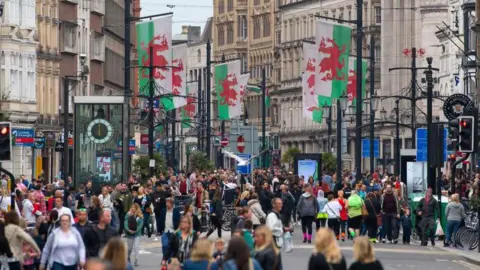
Like many countries, Wales sees a steady flow of people arriving and leaving for other countries each year.
The difference between those arriving and those leaving is known as "net migration".
Focusing on people moving from abroad, latest estimates say Wales' population - which was 3.2 million in June 2024 - had increased by about 23,000 over the previous year as a result of net international migration.
A recent YouGov poll found a quarter of people surveyed in Wales believed that immigration, alongside the economy, should be among the issues prioritised by the Welsh government, even though immigration is controlled by the UK government.
So why do people care so much about it, and what does the data tell us?
How much international migration has there been where you live?
International migration figures include people planning to stay for at least 12 months, such as British nationals returning to Wales from abroad as well as those moving from other countries.
Most people arrive to work or study, while others come to join family members, through humanitarian schemes - such as those for Ukraine and Hong Kong - or to seek asylum.
You can explore international migration in your area using our interactive tool below.
There is often confusion about the common terms used to discuss immigration.
Legal immigrants are those who enter the country with permission such as a visa, while illegal immigrants arrive without it, or stay in the UK after their permission has expired.
Some legal and illegal immigrants make claims for asylum once they have arrived.
Asylum seekers are those asking for sanctuary due to dangers in their home country, and successful applicants are given refugee or protected status.
Apart from the Nation of Sanctuary policy, through which the Welsh government aims to help refugees and asylum seekers placed in Wales to integrate and access public services, the UK government is in charge of immigration.
Home Office data from December 2025 showed that overall across Wales, there were 11 asylum seekers being supported per 10,000 people, the lowest rate across the UK's four nations.
England had the highest, with 16 asylum seekers per 10,000 residents.
The view from Wrexham
The county of Wrexham, in north Wales, is home to 138,245 people, according to the latest ONS estimates from June 2024.
Between 2020 and 2024, it is estimated that international net migration added 2,900 people to Wrexham's population.
But because of other changes in the city of Wrexham and surrounding areas over the same time - like a higher number of deaths than births among people already living there - the area's population went up by less than that overall.
Wrexham has seen recent anti-immigration protests, after Home Office proposals - which were scrapped - to house 70 asylum seekers in a disused care home in the area.
Natalie Wasiuk, 38, who attended the protest, said she believed immigration was a problem in the area.
"The homeless people in town, they're not getting priority over immigrants," she said.
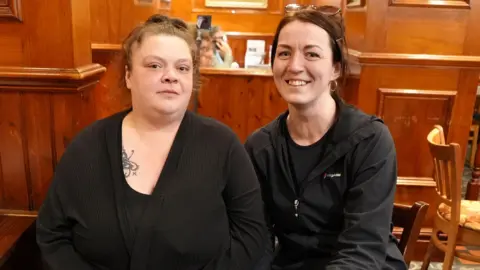
Her friend Kelsey Hesp, 32, felt that people arriving in the city from overseas were given support with services before families like hers.
"Seven years I was homeless for with my two children," she said.
"Yet, there are families coming over here and they get housing.
"No matter what colour you are, or language you speak, we all bleed the same. But, when it comes to taking housing, jobs, being treated differently in your own country, I'm sorry."
The Home Office has a legal responsibility to house asylum seekers while they wait for a decision on their claim.
Local authorities in Wales have legal duties towards those who are homeless, and what help is given depends on circumstances.
Home Office figures showed that, as of the end of December 2025, 128 asylum seekers were being housed in Wrexham while their claims were processed. There is no data on how those individuals entered the UK.
Separately, 333 households in Wrexham were found to be eligible for homelessness support in the year to March 2025. The data does not break down whether these people were British nationals or migrants.

Steven Rees-Davies, 63, said he often talked to friends about immigration.
"Don't get me wrong, the ones in the war I understand, but the ones that are coming over illegally, we're still looking after them. I think that's totally wrong," he said.
Most people who come to the UK from abroad do so legally, having been granted a visa before they travel.
Official estimates suggest about 898,000 people arrived in the UK in the year to June 2025. Around 49,000 entered the country illegally over the same period.
Some of those arriving illegally - including by small boat - go on to claim asylum, which allows them to remain in the UK while their application is considered.
About half of all asylum claims in 2025 were made by people who had entered the country this way.

Anna Buckley, the director of the Polish Integration Support Centre which provides support to Wrexham's Polish community, said it's a welcoming city.
"Every year, we have about 300 people who get in touch with us, maybe they need help with housing, maybe they want to open a business, sometimes we help with the transfer from Poland," she said.
"People who come here legally, they are hardworking people. They pay taxes. They want to feel safe. We are one big international family.
"So if we're talking about legal migration, I'm 100% behind that. But not illegal migration."
She said she had concerns about "illegal immigration leading to crime".
"As an immigrant, you have to apply the rules, you have to apply the law, you have to respect someone's heritage," she said.
'People think we are all illegal immigrants'
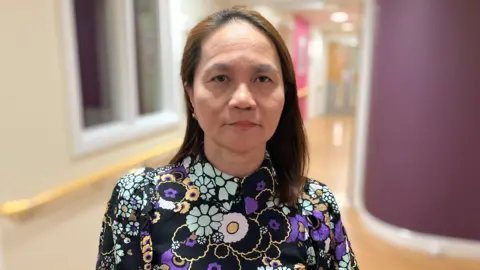
In Pendine Park Care Home on the outskirts of Wrexham, Arlene Elano from the Philippines is one of hundreds of staff members from overseas.
Arlene, who came legally to work in Wales almost 24 years ago, said the recent protests had led to tensions in the community.
"These people think that because of our colour, because of our features, we are all the same, all the same 'illegal immigrants'," she said.
"It threatens the safety of our children. We're worried."
In Wrexham, many people recognised that legal migration was important to sectors such as healthcare and hospitality.
Director of Pendine Park, Mario Kreft, said the sector would be "lost" without migrant workers.
"We have 850 staff. About half of those are from overseas. Philippines, Africa, India, Europe," he said.
"These overseas workers that bring great skills to our country, that bring their families, that actually make a contribution to our country, to our economy, are in fact supporting the national health service."

Prof Ryszard Piotrowicz of Aberystwyth University said political parties might use immigration "as a vote winner" ahead of the Senedd election.
"Parties realise that there are votes to be gained by it," he said.
"I think that parties, in different ways, deliberately play on it, and manipulate it, and I think people fall for it.
"But I think people are genuinely concerned about it. Unless funding is increased to help the extra people who are coming in, who are applying for asylum, then that will have a negative impact on the resource available to the population who are actually living in Wales."
The Home Office, which is the UK government's department responsible for immigration and border control, said "nearly 60,000 illegal migrants and foreign national offenders have been removed since the 2024 election". Though recent figures show the majority of these individuals left voluntarily.
It said it was also "increasing removals of people with no right to remain while moving those in the system out of expensive hotels and into larger, more basic accommodation".
What do the political parties in Wales say?
The Welsh Conservatives and Reform want to scrap Wales' Nation of Sanctuary policy.
A Welsh Conservative spokesperson said: "The Welsh Conservatives believe in a fair system that is firm but controlled - supporting those who contribute, while working with the UK government to stop illegal immigration".
Reform Wales leader Dan Thomas said "immigration is an important issue for voters, and it's easy to see why", adding that "when immigration is too high it puts a strain on our public services and our communities".
Plaid Cymru said it "wants a fair, rules-based system of controlled migration that works for Wales, meets the needs of our communities, reflects Wales' unique challenges, and that upholds our values".
Plaid, along with Welsh Labour, Liberal Democrats and the Green Party, supports the Nation of Sanctuary policy.
Welsh Labour said it was "proud of [its] record supporting those who fled the conflict in Ukraine" and added that the "UK Labour Government vowed to scale up removals of illegal migrants and have done that".
Welsh Liberal Democrat Leader Jane Dodds said the "biggest challenge facing Wales and our public services is the number of young people leaving the country over the last 27 years of Labour control".
A spokesperson for the Wales Green Party said it would "advocate to the UK government for a stronger, more efficient asylum system which includes safe and secure routes".
Additional reporting by Jess Carr, Aidan McNamee and Tony Brown.

