Impact of drought 'can be seen along River Severn'

 BBC
BBCThe impact of this year's drought can be seen along parts of the River Severn, people who use the river have said.
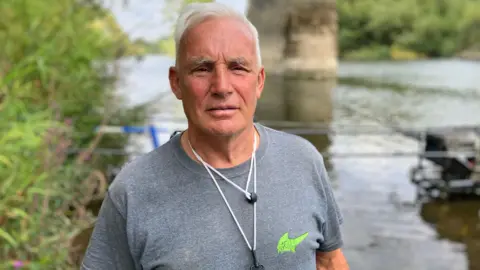
Geoff Maguire from Kidderminster and District Angling Association said water levels were probably the lowest he had seen.
Natural Resources Wales has applied to the Welsh Government for a Drought Order on the river while the Environment Agency (EA) has submitted a matching application for the English stretch.
If approved, the order would temporarily reduce the minimum amount of water legally required in the river.
Currently, water is being released by reservoirs in Wales and pumped from groundwater in Shropshire to help keep the river flowing but the EA says those supplies are under increasing pressure.
Clywedog Reservoir in Powys is currently at about 48% capacity, according to the Environment Agency, and its level has been falling rapidly.
Matt Lawrence, the agency's environment programme manager, said: "We really want to protect that resource or else we potentially can see sections of the upper Severn dry up completely.
"That will have a terrible effect on wildlife, the ecology of the river and the users of the river," he added.
About 200m litres a day are also being pumped into the Severn from a groundwater scheme in Shropshire.
Lawrence said the groundwater was currently in a "good state" but needed to be closely monitored.
"We're having to go out in the river to find enough water to fish, but it's not just us - I think it's the canoes and the boats that are really struggling to get over certain areas," Maguire said.
Fishing conditions have remained good in some areas, but Maguire said anglers were increasingly concerned about what lower levels could mean.
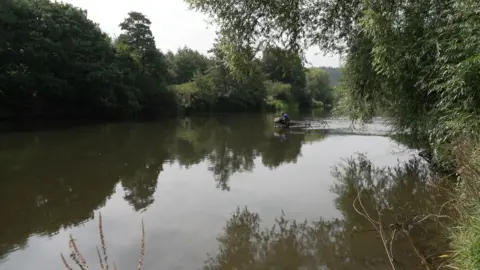
The Severn, which at 224 miles (360km) is longest river in Great Britain, is home to a wide range of wildlife including salmon, eels, otters, brown trout and European bullhead.
Its smaller tributaries and headwaters are particularly important habitats.
Safina Akhtar-Watters, a citizen scientist and first-year environmental science student from Worcestershire, said drought could threaten these ecosystems.
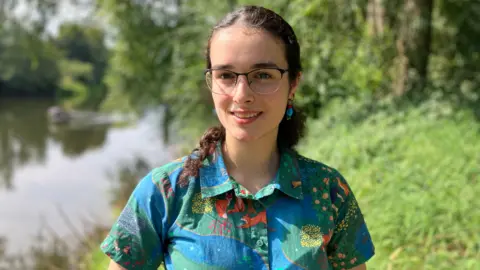
European bullhead, for example, rely on smaller streams to raise their young and shelter from predators. If water levels fall, those habits could disconnect from the river, reduce oxygen levels and mean pollutants become more concentrated.
A sudden change in the river flow could mean species were unable to survive, she said.
"It's not a question of whether the Environment Agency is making the right or wrong decision because they don't necessarily have that choice, but what they should take into account is that these species are adapted to certain variations in river level.
"Will the Environment Agency be able to monitor that sufficiently?"
The agency said the effects of low levels were already being seen in parts of the river and its tributaries.
In south Shropshire, its river team has had to rescue fish from sections of the river.
Lawrence said that although the Severn was important for wildlife, it was also relied on by six million people for drinking water. Farmers also abstract water to irrigate crops.
"That balance for wildlife and people and the use of the river is really important and the drought order is going to help us provide that balance," he said.
Follow BBC Hereford & Worcester on BBC Sounds, Facebook, X and Instagram.
