London paramedics 'first' to use underwater drones
In the Lee Valley White Water Centre, London's specialist paramedics from the Hazardous Area Response Team are training with their new kit.
They recently purchased three unmanned underwater vehicles - known as underwater drones - that can be used in the search and rescue of people who have got into difficulty in water.
"It's the best," said Sam Barton, from the London Ambulance Service (LAS). "[We are] the first ambulance service in the country to have this piece of kit and one of the first emergency services as well."
The drones enter the water and use a mechanical grabber arm to rescue casualties from dangerous water conditions. Previously, paramedics used long-armed poles to try to reach casualties safely.
The Hazardous Area Response Team come to the Lee Valley White Water Centre every year to refresh their skills. They also carry out white-water training in north Wales once a year.
Barton explains how the drone works: "We've got eight motors to keep it nice and stable in the water and move it through the water. We can go up and down, side to side, and we've got two really bright lights to allow us to see underwater."
Barton said the drone also had a camera at the front which sends a live image to the controller, and an arm that can grab hold of a casualty.
It is deployed alongside sonar technology the team have been using for the past few years to locate casualties under the surface.

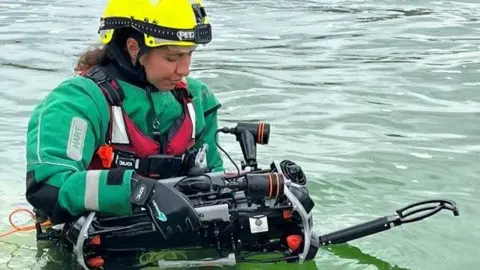
Paramedic Christel Oweis explains how the device uses echo location to identify items in the water.
"I go underwater and it sends out a little ping as I do a scan. If that ping hits anything, it will bounce back and the sonar device will receive an echo," she said.
"It will then use AI to analyse that echo, and if it could be a person it will show an 'X' on the screen."
Once a person and their location are identified, the drone, which is attached to a line on the shore, is deployed.
During the training exercise, it was sent out to retrieve a realistic dummy, which the team had weighed down in the water.
Oweis said the drone allowed them to search for, locate, and rescue casualties "really quickly".
"All our HART (Hazardous Area Response Teams) paramedics are trained to perform rescues in fast-flowing water and still water, however it can be quite dangerous," she said.
"[The drone] can be deployed in less than two minutes."
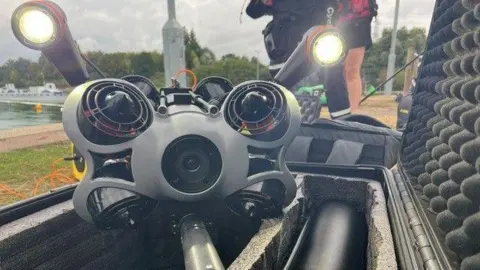
Of the three underwater drones owned by LAS, one is used for training and two are in operation, one in east London and the other in west London.
Barton said the new technology was helping their teams, particularly in the summer when the risks of the capital's waterways increase in hot weather.
The specialist paramedic explained that when water temperatures were higher, crews had less time to rescue someone from drowning, due to the way the body's organs continued to operate when submerged.
Conversely, in water under 6C, the cold water rapidly cools the brain. When cold, the brain requires less oxygen and it can tolerate the lack of blood flow for a much longer period.
Barton said this meant that in cooler water, their team had about 90 minutes to complete a rescue, compared to 30 minutes when the water was warmer.
This time limit refers to complete submersion and not the immediate dangers of cold water shock and hypothermia that can also occur in cold water.
"It's absolutely imperative that we can get this [drone] in the water as quickly as possible to try and rescue as many people as we can," he said.
Listen to the best of BBC Radio London on Sounds and follow BBC London on Facebook, X and Instagram. Send your story ideas to hello.bbclondon@bbc.co.uk
