Patient who harassed paramedic jailed under new law

 BBC
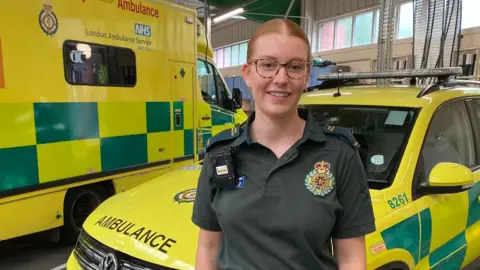
BBCWhen paramedic Ella Johnson responded to a 999 call in April, she rushed to the scene with her female colleague to try to help the patient.
But far from being grateful for their support, the man quickly became abusive towards the two women.
"We literally just arrived on scene, announced that we were here to help, but he just came back with verbal sexual abuse straight away," she said.
The paramedics had been told that the patient had been found unconscious at a bus stop in Shepherd's Bush, west London.
"We tried to help him back up from the floor into the ambulance, but he was kind of like, pushing out his hands, getting quite 'grabby' and continuing with the sort of sexual comments towards me and my colleague."
Johnson said the experience was "frightening."
"The whole time we were saying, you know, 'we're the ambulance, we're here to help, we'd like to get you on the ambulance to do an assessment', but it was just quite difficult to manage because he was grabbing out and saying some quite nasty things."
At this point, Johnson said they called the police for help, who ended up arresting the man and taking him into custody.
Ahmed Sheiki Ahmed was charged under a new law banning harassment motivated by a person's sex, four days after the legislation came into force.
He pleaded guilty to using threatening, abusive or insulting words or behaviour likely to cause harassment, alarm or distress on account of a person's sex, at Westminster Magistrates Court on Wednesday.
Ahmed, who also admitted being drunk and disorderly, was sentenced to 12 weeks in prison and ordered to pay compensation of £150.
 Metropolitan Police
The offence, introduced in April under the Public Order Act 1986, covers intentional harassment directed at someone because of their sex, including where perpetrators target women and girls in public places.
Those found guilty can face up to two years in prison.
In May, David Stroud, 43, from Dartford, was found guilty under the legislation for grabbing a woman's hair and asking if he could kiss her on a train, in what British Transport Police said was the first prosecution it had dealt with.
Officers had arrested him as he got off the train at London Bridge.
Stroud, who was on bail at the time after admitting to a separate 22-month stalking campaign, was sentenced for both offences to a 12-month community order, 150 hours of unpaid work and a 15-day rehabilitation programme.
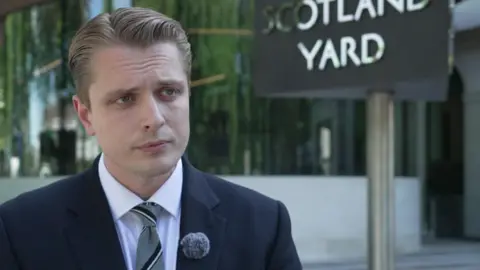
Det Supt Dan Thompson, the Metropolitan Police lead for cases of violence against women and girls, said the law included comments "that could be deemed to be misogynistic, threatening, intimidating towards another person based on their sex".
"Women and girls in London have been telling us for a long time that they feel intimidated in public spaces by some of the behaviour that they encounter on a daily basis," he said.
"And though this legislation protects men and women, it gives us the tools and the powers to disrupt some of that public space behaviour that women are experiencing."
Thompson said 22 people had been charged by the Met in the first three months of the new law being introduced and that it sent a clear message about unacceptable behaviour.
"It names the behaviour, it makes it a criminal offence, and although there are other bits of legislation we've worked with in the past around this, I think by naming it it gives victims that confidence to report it to us. "
'Saddening experience'
Johnson, who started her career as a paramedic for London Ambulance Service two years ago, said she was glad the law had been introduced.
"I think it feels like something's being done and that people can't get away with talking to us, talking to women and girls in a certain way, and getting away with it."
She said it was "unfortunately quite common" to experience abuse from members of the public and believes such incidents have been getting worse.
"We want to look after people, we want to help people, but unfortunately there are some circumstances where we do get abuse, verbal abuse, sexual abuse, even physical abuse as well."
She said she decided to begin using a body-worn camera at work, which is voluntary for London Ambulance paramedics, after a previous incident.
"It can be quite a saddening experience because we are just wanting to do our jobs. I love my job. I really enjoy it, but sometimes we can encounter people who don't respect us."
The law was introduced following calls from campaigners who wanted to tackle the problem of girls and women being catcalled and harassed in the street.
Like many women, Johnson can relate to this.
"I haven't just experienced [harassment] in my job. I've also experienced it in my personal life as well. And I feel you've just been kind of told to accept it and just brush it off."
She hopes the new law will send a message to others that such behaviour will not be tolerated, and also "empower" more victims to come forward to report it.
Listen to the best of BBC Radio London on Sounds and follow BBC London on Facebook, X and Instagram. Send your story ideas to hello.bbclondon@bbc.co.uk
