Drone network part of Met's London-wide tech push
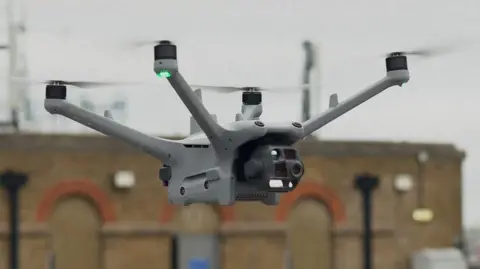
Drones will be part of some 999 call responses across London as part of a major expansion in technology use by the Metropolitan Police.
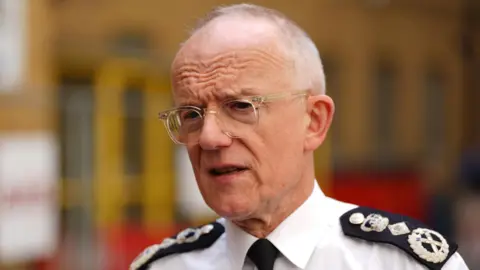
In a wide-ranging speech on Wednesday, Met Commissioner Sir Mark Rowley will lay out plans to expand an existing programme into a "city-wide drone network".
The use of drones in to respond to emergencies, which Big Brother Watch described as "alarming", is an expansion of an existing pilot scheme in Islington.
Among other reforms, Sir Mark will also call for more freedom in using new technology - like facial recognition and AI - without waiting on new laws to keep up, and allow forces to focus their spending on technology over officer recruitment.

 Metropolitan Police
The force said that the new drones were quicker, quieter, cheaper and more environmentally friendly than police helicopters, while delivering the same operational results.
Under a pilot in Islington, drones have been launched only as a response to a 999 call, the Met said, and have been piloted by trained operators remotely from the force control room.
The technology allows officers to send drones directly to incidents, providing live aerial footage, tracking suspects and supplying critical intelligence before officers arrive.
'Intrusive surveillance'
Eight months into the pilot, the force said the programme has grown significantly. It is now operating three drone bases across London, with nine drones attending around 200 incidents each week.
Sir Mark will say: "Drones are already transforming how we respond to incidents - getting visuals from the scene in minutes, giving officers critical intelligence and helping us act faster and more safely.
"Now we are scaling that capability across London and working with partners to create a truly integrated, city-wide drone network."
Jake Hurfurt from Big Brother Watch said drones may have a role in providing quicker updates to evolving emergencies - but the Met "must not use them as constant flying surveillance cameras".
He said the force had "point blank refused to disclose to the public any documents outlining how, why or when it uses these drones.
"It is alarming that potentially intrusive surveillance is being rolled out with such little scrutiny."
On Tuesday, the force announced the expansion its use of static live facial recognition cameras to London's West End and Soho.
Human rights organisation Liberty said the force should pause its use of the technology until a legal framework is put in place to govern its use.
 PA Media
The Met commissioner will use his speech to call for a move away from creating new legislation for the use of each new technology as it emerges.
"Policing by consent is key to the British policing model and is something we must treasure," he will say.
"However, when it comes to new technologies, as we saw with Live Facial Recognition, some campaign groups call for new legislation and restrictions every time a new capability emerges.
"While that comes from a legitimate place, it risks slowing progress to the point where policing cannot keep pace with the threats we face."
Speaking on Tuesday about the expansion of facial recognition, Akiko Hart, director at Liberty, told the BBC that "robust safeguards, oversight and transparency" were needed in its adoption by police forces.
"Until this is in place the Metropolitan Police should pause their use of the technology, not expand it," he added.
Sir Mark will also argue that police budgets for technology have fallen to half the level of other public bodies amid too much political focus on officer numbers.
"For decades, political debate has focused heavily on police officer numbers, with far less attention given to whether policing has the tools it needs to do the job effectively," he will say.
There were commitments to boost officer numbers in England and Wales in the Labour, Conservative and Reform UK manifestos at the 2024 general election.
A Home Office spokesperson said the biggest reforms in more than 200 years were being made to policing: "Too many officers have been stuck behind desks doing admin. Our reforms will get more police back into local areas tackling the epidemic of local crime.
"We've already put over 3,100 more neighbourhood officers into roles in less than a year. Record investment into technology will free up officers' time and our National Police Service will lift national responsibilities away from local forces – so they are no longer distracted from their job of serving their communities."
'Too slow and restrictive'
London's deputy mayor for policing and crime, Kaya Comer-Schwartz, said: "We are proud to have backed the Met with record funding for the very latest technology to drive efficiencies and improve the performance and accountability of the police."
Among the technologies Scotland Yard wants to use was the AI data processing provided by controversial US-tech giant Palantir.
The force was blocked from signing a contract worth up to £50m with the firm after Comer-Schwarts refused to approve the deal after she raised concerns over the procurement process.
Sir Mark, who previously warned front line policing faces cuts without the deal, on say on Wednesday: "Right now, policing is trying to keep up using systems that are too slow and too restrictive. If that does not change, we won't succeed."
Palantir said it intends to challenge the deputy mayor's decision in court.
Listen to the best of BBC Radio London on Sounds and follow BBC London on Facebook, X and Instagram. Send your story ideas to hello.bbclondon@bbc.co.uk
