People walk along motorway towards Dublin Airport as fuel protests continue

 PA Media
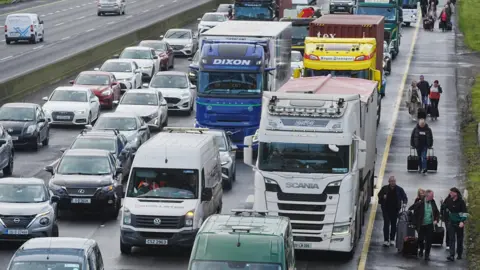
People have been seen walking with their luggage along Dublin's M50 towards the airport as vehicles block roads during fuel protests in the Republic of Ireland.
The army was called in on Thursday to help remove vehicles blocking roads, with the Irish police treating protests at fuel depots as "blockades".
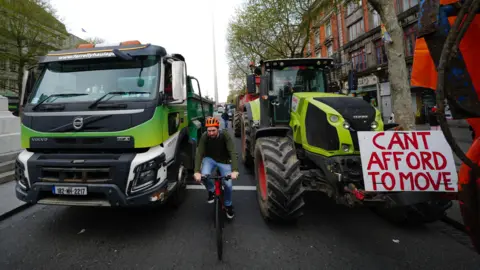
Travel in parts of the country has been affected for the third day in a row, with slow-moving convoys protesting against high fuel prices caused by the US and Israeli war against Iran.
It is understood Irish Minister for Agriculture Martin Heydon and Minister of State Timmy Dooley will meet with representative bodies on Friday.
Speaking to Irish broadcaster RTÉ, Dooley said it was his understanding that invitations had been extended to representative bodies "to continue the dialogue that started last week", but that the government would not be meeting with representatives from the protesters.
Earlier, the Irish Minister for Justice, Jim O'Callaghan, said there would be "legal consequences" for the protests.
"It might not arise today or tomorrow but people have licences to drive vehicles, those licences will be affected."
O'Callaghan added that he expected insurance coverage to become "void as a result of the owner of the equipment deciding to voluntarily get involved in such illegal activity".
Gardaí (Irish police) can request the assistance of the Irish army in "aid to the civil power... when required".
In a statement on Thursday, a gardaí spokesperson said the force was "moving to an enforcement phase" unless those blocking access to critical infrastructure "desist and disperse".
They said blockades were putting food, fuel, clean water and animal feed supplies at risk.
'Significant disruption'
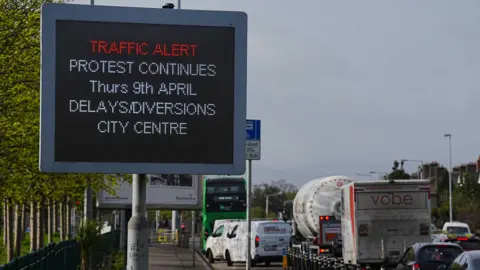
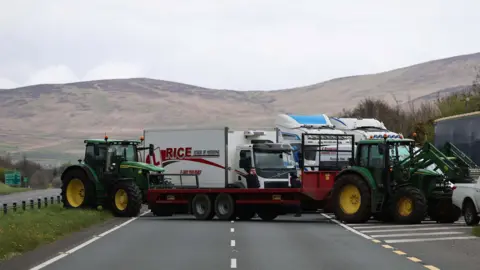
A number of motorways and roads across the country have been blocked by protesters.
Protesters also blockaded fuel sites in Cork, Limerick and Galway.
Fuels for Ireland has said that 100 garage forecourts have run out of fuel, mainly in Munster and the west of Ireland.
Its chief executive Kevin McPartlin told RTÉ that the number could be five times that by Friday night, adding that 50% of the country's new supply was being kept behind barricade lines.
The National Emergency Coordination Group (NECG), which brings together government departments and state agencies to coordinate emergency response, met on Thursday.
The group said while the blockades were causing "significant disruption", Ireland's fuel supplies overall remained "robust and resilient".
However it also highlighted a "serious concern regarding access to fuel for emergency service vehicles" and that transport disruption was "causing people to miss scheduled medical appointments".
The NECG was also briefed on the impacts being felt by the agriculture sector and the threats to provision of animal feed supplies.
 PA Media
The Irish Health Service Executive called for all approaches to medical facilities to be kept clear for users to access treatment.
Taoiseach (Irish prime minister) Micheál Martin said people who were not protesting "want this resolved".
"We're going to do everything we can to keep the economy going," he added.
Earlier, Martin told RTÉ that the blocking of roads and infrastructure was "not a fair form of protest".
He said it was "unacceptable" that people would be denied access to fuel and clear water.
"For people who said they were concerned about the price of fuel, to now be denying people access to fuel is beyond any logical comprehension."
Martin said that the government did not anticipate violence.
However Irish Defence Minister Helen McEntee claimed the actions of some protesters was "now crossing into criminal behaviour".
"There are genuine people there with genuine concerns…but those involved in protests who are actively blocking and preventing people from accessing fuel…they have to stop."
Sinn Féin leader Mary Lou McDonald called for the taoiseach (Irish prime minister) and tánaiste (deputy PM) to "pick up the phone" to protesters.
McDonald also said she did not want to see "disruption" or protesters "sleeping in tractors" on O'Connell Street, adding "people should engage respectfully".
'We can't afford to stop'
 Liam McBurney/PA Wire
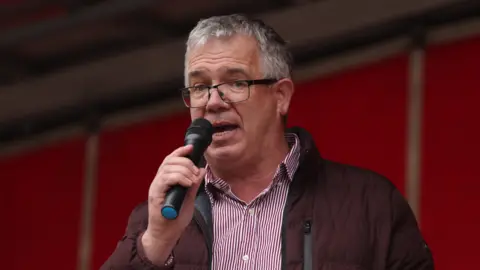
James Geoghegan, a spokesperson for the protesters, said his fuel bill would go up to €70,000 (£60,939) this year if prices didn't change.
"We simply can't afford that," he told BBC Radio Ulster's Evening Extra, adding: "We're only a small business. We can't pass that on to the farmers."
He said the protesters "just have to get help" and "can't afford to stop" the protests.
Geoghegan added that protesters were letting through ambulances and anyone with a medical appointment.
Allow X content?
The M50 and the M1 on either side of Dublin Airport were both closed for periods on Thursday and long delays remain.
The traffic tailbacks also extended onto the N7 westbound from the M50.
Details of traffic disruption across Ireland can be found on the TII website.
Dublin Airport advised passengers to allow extra time for their journey on while Translink said cross-border services were subject to delays and disruption.
The justice minister said the protesters need to know about "the damage that their actions are having on Irish people and Irish society".
"This damage is going to continue unless it ceases or it's stopped by An Garda Síochána and the defence forces," he added.
He added that protestors were being "manipulated" by "outside actors", some from the far-right.
 PA Media
On Thursday afternoon, a small number of new trucks joined the blockade of O'Connell Street in Dublin.
Road closures around O'Connell Street extend along the north and south quays of the Liffey, and to Westmoreland Street and O'Connell Bridge.
Protests have also taken place at various locations on main roads leading to the city, as well as near other large urban areas.
Why are the protests taking place?
 Brian Lawless/PA Wire
The conflict in the Middle East has caused rapid price rises for both petrol and diesel.
Some 20% of the world's oil trade, the raw ingredient for producing both petrol and diesel, has been halted by the closure of the Strait of Hormuz.
Diesel in the Republic of Ireland has risen from about €1.70 (£1.48) a litre to €2.17 (£1.89) on many forecourts in recent weeks and petrol is now up to 25 cents more per litre at many pumps, RTÉ reports.
The protests started on Tuesday morning.
