Bone gaming dice discovered during Roman dig

 The Vindolanda Trust
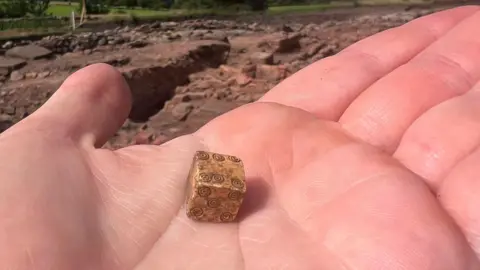
A dice made of bone has been unearthed during an archaeological dig, the first of its kind to be discovered at the Roman site.
The dice - or die - was discovered during excavations at the Magna Roman Fort in Northumberland, and offers "an immediate connection" into how those who lived there spent their leisure time more than 2,000 years ago.
"Holding something so familiar, yet so ancient, really brings that human story of Magna to life," said Sonya Galloway of The Vindolanda Trust.
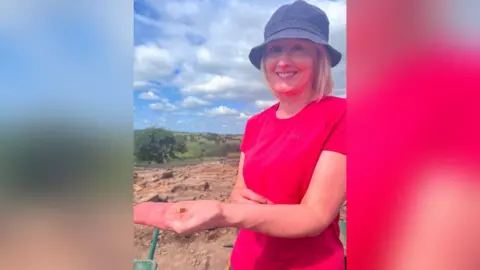
Excavator Sue Mingay, who made the find, said she was "over the moon" with the discovery.
 The Vindolanda Trust
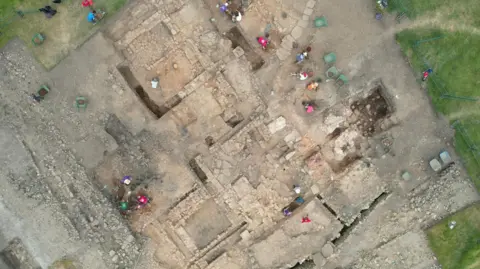
The Magna Excavations are part of a five-year project funded by the National Lottery Heritage Fund.
The bone gaming dice was found beside the furnaces of the praetorium bathhouse during Period 8 excavations at the site.
"When I saw it, and the shape of it, I hoped it would be a die," said Mingay.
"When I looked more closely, I was over the moon to see how delicate the markings were."
Excavators have previously unearthed 4th century paving stones and remains of a Hadrianic hypocaust system, a form of underfloor heating used in the commander's private bathhouse.
Other notable finds have included a copper alloy Roman belt buckle and spearhead.
 The Vindolanda Trust
Galloway, communications manager for The Vindolanda Trust, who manage the site, said the discovery had made a big impact on social media.
"It's easy to see why this little bone die has captured so many people's imaginations.
"It is a wonderfully relatable object - almost everyone will have rolled a die while playing a game, so there's an immediate connection to the people who lived at Magna nearly 2,000 years ago.
"Now we need to find the game board!"
