Artemis II mission was a triumph. Now comes the hard part

 NASA via Getty Images
Nasa's Artemis II mission has successfully sent four astronauts sweeping around the far side of the Moon and landed them safely back home.
The Orion spacecraft performed admirably and the images the astronauts captured have delighted a whole new generation about the possibilities of space travel.
But does this mean that the children enthralled by the mission will be able to live and work on the Moon in their lifetimes? Perhaps even go to Mars, as the Artemis programme promises?
It seems churlish to say, but looping the Moon was relatively easy. The really hard part lies ahead, so the answer is "maybe, maybe not".
 NASA
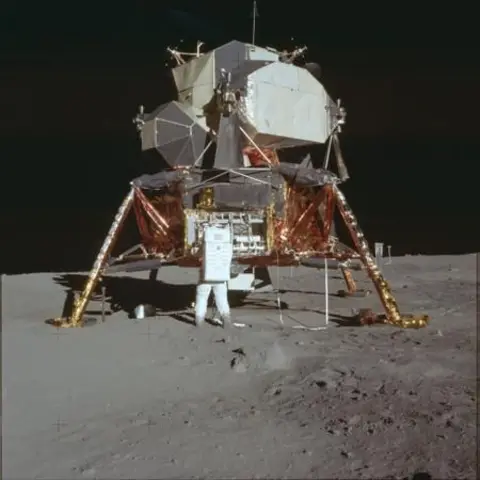
NASAWhen Neil Armstrong and Buzz Aldrin became the first humans to land on the Moon in July 1969, many assumed it was only the beginning and that people would soon be living and working in space.
That didn't happen because the Apollo programme was born not from a love of exploration, but from the Cold War, to demonstrate US superiority over the Soviet Union. That feat was achieved by Armstrong's "one small step" off his lunar lander - job done.
Just a few years after he planted the American flag on the lunar surface, the TV audience figures for subsequent missions plummeted and future Apollo missions were scrapped.
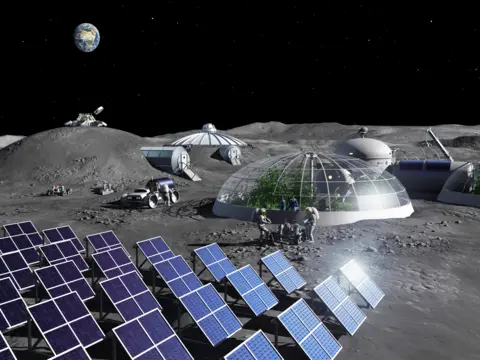
This time, Nasa's stated ambition is different. Administrator Jared Isaacman has set out plans for one crewed lunar landing per year, beginning in 2028, with the fifth Artemis mission - planned for later that same year - marking the start of what the agency calls its Moon base.
 ESA/P. Carril
It sounds like science fiction, but here are the words of a serious space player dealing in science fact: "The Moon economy will develop," Josef Aschbacher, Director General of the European Space Agency (ESA), tells me.
"It will take time to set up the various elements, but it will develop."
But as the commander of Apollo 13 famously said when his spacecraft malfunctioned on the way to the Moon: "Houston, we've had a problem..."
The lander problem
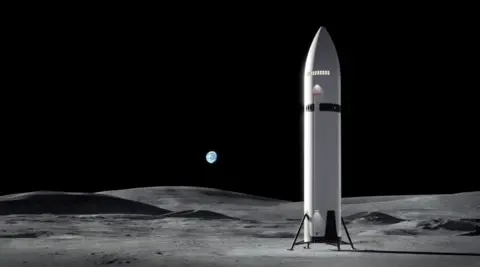
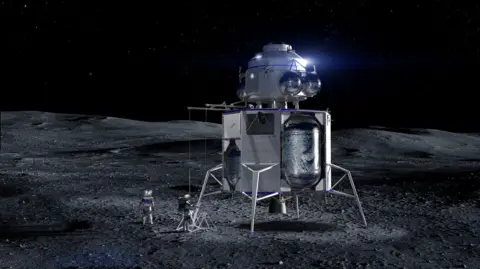
To get boots on the lunar surface, Nasa needs a lander. The US space agency has contracted two private companies to build them: Elon Musk's SpaceX, whose lunar version of its Starship rocket will stand 35 metres tall, and Jeff Bezos's Blue Origin, whose Blue Moon Mark 2 craft is more compact but just as ambitious.
Both are well behind schedule.
Nasa's own Office of Inspector General laid out the picture starkly in a report published on 10 March. SpaceX's lunar Starship is at least two years behind its original delivery date, with further delays expected. Blue Origin's Blue Moon is at least eight months late, with nearly half the issues flagged at a 2024 design review still unresolved more than a year later.
These landers are very different to the compact Eagle module that carried Armstrong and Aldrin to the surface in 1969 and which was just big enough to transport two men to collect some rocks and return.
The new landers must carry very significant amounts of infrastructure - equipment, pressurised rovers, the early components of a base. And carrying that amount of mass requires enormous amounts of propellant, far more than can be launched in a single rocket.
 SpaceX
 Blue Origin
The Artemis programme intends to store all this propellant in a depot, which will orbit around the Earth and will be topped up by more than 10 separate tanker flights, all launched at regular intervals over months. The plan looks elegant but is fiendishly difficult.
Keeping super-cold liquid oxygen and methane stable in the vacuum of space, then transferring them between spacecraft, is one of the most demanding engineering challenges in the programme.
"From a physics point of view it makes sense," says Dr Simeon Barber, a space scientist from the Open University. But he points out that the launch of Artemis II was delayed twice this year, before it eventually took off because of fuelling issues.
"If it's difficult to do in the launch pad, it's going to be much more difficult to do in orbit," he says.
The next Artemis mission - Artemis III - is designed to test how the Orion crew capsule docks in Earth orbit with one or both landers. It is scheduled for mid-2027. Given that Starship has not yet completed a successful orbital flight and Blue Origin's New Glenn rocket has managed just two launches, this target looks, as Barber puts it, "a very steep ask".
The new space race
Nasa has kept its 2028 target for a first Artemis Moon landing in part for political reasons - it now aligns with President Trump's renewed space policy, which calls for Americans to be back on the lunar surface by 2028 – a deadline that falls within his current term of office, due to end that year.
Independent analysts don't believe the target is realistic. But Congress has backed the date with billions of dollars of taxpayers' money, partly because there is a new competitor on the horizon.
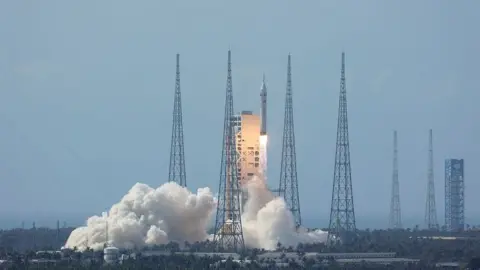 VCG / China Manned Space Agency
China's emergence this century as an economic and military superpower has also seen its space capabilities accelerate rapidly, and it now has a stated aim of landing an astronaut on the Moon by around 2030.
If the Artemis timetable slips, as many experts believe it will, China could get to the Moon first. Its approach is simpler. It uses two rockets, a separate crew module and lander, and avoids the in-orbit refuelling complexity of the American plan.
Mars - the distant dream
Beyond the Moon lies Mars.
Musk has spoken of getting humans to the Red Planet before the end of this decade.
Many experts believe it is far more likely to be the 2040s at the earliest. The journey alone - seven to nine months, through intense radiation, and with no possibility of rescue - presents challenges that dwarf anything involved in getting to the Moon.
Mars's thin atmosphere makes landing a full-sized, crewed spacecraft - and then launching it again - a problem of staggering complexity.
 NASA
NASAArtemis II has put human spaceflight back on the agenda. Private companies are building rockets and landers with genuine urgency. Europe is actively debating how deeply to engage.
As I drove around the Kennedy Space Centre after the launch of the Artemis mission, I was struck by the new buildings put up by Blue Origin and others in construction by SpaceX: private sector infrastructure nestling close to a government agency that once sent astronauts to the Moon.
Even if the timetables slip, this new partnership feels like something special is happening on the Florida coast - and Nasa has already got some of its old mojo back.
ESA astronaut Alexander Gerst once told Aschbacher, after returning from the International Space Station, that the view from space changes everything.
Gerst told the ESA boss that he wishes all eight billion people on Earth could go to space just once and see what he saw - a small, fragile, beautiful planet, cared for not nearly well enough by the species lucky enough to live on it.
"That," says Aschbacher, "would create a very different life on planet Earth."
