Voters shown fake 20mph claims and a bogus manifesto on social media

 Getty Images
Claims about the real cost of the 20mph policy and a fake political party manifesto are among the misinformation about Welsh politics being shared online by prominent accounts in the build-up to the Senedd election, the BBC has found.
The examples come from pages seen by BBC Wales' undercover voters and include one account which brands itself as a "trusted news source for Welsh communities" while actually acting as an unofficial party support page.
The project tracks what a group of fictional voters are seeing online; their profiles are based on data from the National Centre for Social Research (Natcen).
It only gives us a broad indication of what might be out there but has already shown that information being widely shared online is not always what it appears to be.

One page, Wales Network News, describes itself as a "trusted news source for Welsh communities".
This page appeared on the Facebook feed of Claire, one of the six undercover voters whose feed mostly consists of local groups in her home constituency of Afan Ogwr Rhondda.
At first glance, it looked like a conventional news source; it often shares more than a dozen posts a day, almost all of them about Welsh politics and many in local community Facebook groups like Claire's.
The post which appeared on Claire's feed was a genuine news story about former UKIP Senedd leader Caroline Jones quitting Reform UK.
But when the BBC clicked through to the Wales Network News Facebook page, it found the account had also posted misinformation, including repeatedly sharing a fake Reform UK manifesto claiming the party would abolish the Senedd, get rid of Welsh sports teams, and promote "one anthem" and "one language" for Great Britain, as well as removing free prescriptions and bus passes.
None of these policies appear in Reform UK's real Senedd manifesto. Coverage of Senedd election manifestos can be found on the BBC News website.

On closer inspection, the page is not a neutral news source but largely contains content explicitly endorsing Plaid Cymru, sharing stories that are critical of the party's opponents and often directly copying posts from official Plaid social media channels.
Using a transparency tool, it is possible to see that, between July 2020 and November 2025, the page was called The Party of Wales Plaid Cymru Carmarthenshire & Pembrokeshire Supporters.
Prior to this, from when it was created in September 2019, it was a pro-Brexit Party page, based in the same area.
Wales Network News has been approached for comment.
Plaid Cymru said the page had no connection to the party.
The exact origin of the fake manifesto is not known, but the BBC found a page that had shared it months before it appeared on Wales Network News.
That page did not reply when asked for comment.
A different page, Doge Wales (also known as Senedd Waste) appeared on the X (formerly Twitter) timeline of Siân, another of the fictional undercover voters.
On her feed we saw a post from Doge Wales, which often criticises what it describes as "the millions of pounds wasted by the Senedd and Welsh government".
A closer look brings up some potentially misleading claims about Plaid's role in successive Welsh governments and the cost of the 20mph speed limit.
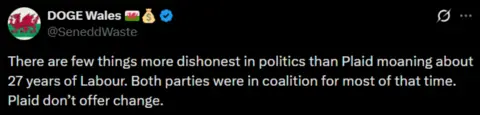
In one post, the page said Plaid Cymru and Welsh Labour had been in coalition for "most of" the latter's 27-year run in government.
A coalition usually means all parties involved have ministers in the cabinet.
Plaid and Labour have only been in coalition once in Cardiff Bay, for four years from 2007.
The parties also entered into cooperation agreements from 2016 to 2017 and from 2021 to 2024, in which Plaid remained in opposition but worked together with Welsh Labour on certain policies.
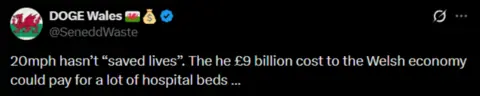
The page also claimed the default 20mph speed limit in Wales came at a "£9bn cost to the Welsh economy".
The change to 20mph cost £34m to implement. There has since been a reduction in casualties on Welsh roads, but the policy has not been universally popular.
The £9bn figure appears to be an upper estimate of the policy's cost to the economy over the course of 30 years, made in a 2022 Welsh government document.
It concluded the increase in journey times could create an economic "disbenefit" of £6.4bn between 2023 and 2052 – with £8.9bn being a worst-case scenario.
But it estimated, when potential economic savings from improved road safety were also taken into account, the policy would cost £4.54bn over 30 years to the Welsh economy.
Savings on police, ambulance and medical costs, the report said, will outweigh the direct cost of implementing the policy (the £34m spent in 2023).
The truth is, we do not know exactly what the longer-term costs or benefits will be, but it is inaccurate to say outright that the policy has cost, or is projected to cost, £9bn.
Doge Wales said: "All BBC Wales coverage in this election should be viewed in the context of its decision to appoint the former chief executive of Plaid Cymru to a senior editorial role.
"Plaid's cooperation agreement with Labour was a coalition in all but name and we make no apologies for drawing attention to the party's role in propping Labour up."
A BBC spokesperson said: "Rhuanedd Richards is currently the interim director of BBC Nations. Rhuanedd was appointed as a leader within the BBC in 2018 and was director of BBC Wales from 2021 to 2025.
"Rhuanedd has always been open about her career history and is wholly committed to upholding the impartiality of the BBC."
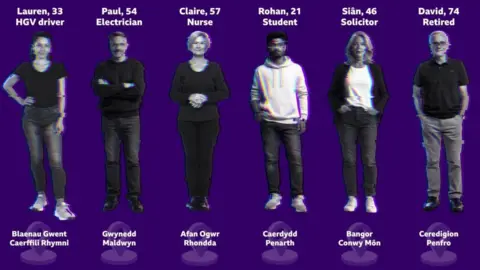
What our undercover voters are served by the algorithm is not a complete picture of what real Welsh voters are seeing online.
But their profiles have been designed to reflect a range of views and backgrounds in the electorate and we will keep monitoring their feeds until the election to get a sense of how the campaign plays out on social media and sharing what we find.

