What went wrong for Scottish Labour?

 PA Media
About midday on Sunday, Labour MSPs and Scottish MPs jumped onto an online meeting to conduct a post-mortem of last week's election defeat.
I'm told around 25 logged on. Defeated candidates did not take part.
There was a lot to talk about.
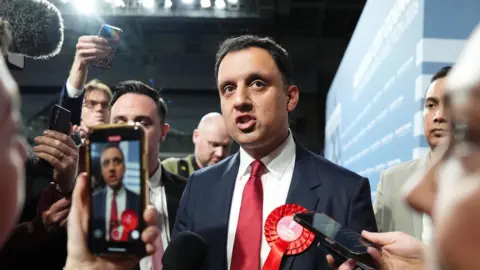
The party's Scottish leader, Anas Sarwar, had spent the election campaign insisting that he could emerge as the next first minister.
Instead, he led his colleagues to their worst ever Holyrood result.
They returned 17 MSPs. That sees them tied with Reform UK in second place.
There's disappointment, anger and exasperation within the party.
So what went wrong?
Sarwar led the discussion but there were contributions from the two figures who ran the election campaign - Scottish Secretary Douglas Alexander and the deputy leader in Scotland, Dame Jackie Baillie.
One person present described the mood as "defensive".
Earlier in the day, speaking on BBC Scotland's The Sunday Show, Sarwar suggested the party's strategy wasn't entirely to blame for the result.
He put it down to "a big national wave, and a general vibe that we couldn't change".
That's a polite way of directing at least some of the blame towards Sir Keir Starmer, a man Sarwar maintains should resign from this role.
But don't Scottish Labour have to take some of the blame themselves?
Their approach to the campaign had its roots in the Hamilton, Larkhall and Stonehouse by-election last year.
Then, the party scored a surprising victory, narrowly defeating both the SNP and Reform UK.
They hoped to recreate that victory in more than 30 constituencies across the central belt, the sort of seats that were historically Labour but have swung towards the SNP in recent years.
But that by-election win in 2025 was resource heavy. Activists pounded the streets in huge numbers. Members from across the nations came to knock doors.
And it appears that the party simply wasn't able to replicate that effort in dozens of seats simultaneously, especially while Labour fought elections elsewhere in the UK.
One senior party figure told me it was naively optimistic to think that this could be replicated across so many seats.
And the same person said Sarwar's claims that he could become first minister is making it difficult to "style it out" after such bad results.
 PA Media
Over the weekend, some in Scottish Labour were questioning why there hadn't been more focus on the regional ballot – sometimes called the "peach ballot" – in the election.
A number of other parties focussed on picking up seats this way, which sees MSPs elected in wider electoral regions.
The Conservatives and Liberal Democrats both hammered home the message that they wanted our "peach vote". They knew this was the secret to maximising their representation.
But Labour focussed on talking about constituency head-to-heads with the SNP. They lost almost all of them.
They did pick up regional seats, but some believe there would have been more Labour MSPs if the focus had been on that peach ballot paper.
One insider told me the party put "very little thought" into this part of the election.
So what do they do now? And what happens to the man Scottish Labour put front and centre of their campaign – Anas Sarwar?
He's indicated he plans to stay in place. At least for the foreseeable future.
There are council elections in Scotland next year, and it's possible that other party figures who fancy the top job would like to let Sarwar own those results before taking over.
After all, if things continue as they are, you'd be expecting Labour losses in those local polls.
One party figure told me they wanted to see Sarwar oversee "an orderly process of post-mortem" before standing down.
They added that they would also want to see Jackie Baillie standing down as deputy leader at that point too.
 PA Media
And it's no secret that there's not a lot of love among Scottish Labour MSPs for Sir Keir. That feeling has, perhaps, intensified in these past few days.
The same party figure who told me they had been too optimistic in their strategy said that it was time for MPs to "show some gumption or they're going to go off a cliff in 2029".
In other words, they should move to get rid of the prime minister. But he plans to try and reset his premiership in a major speech on Monday.
Many in Scottish Labour will not be happy about that.
Paul Sweeney, an MSP who narrowly got back into Holyrood on Friday, said dislike of the prime minister on the doors in Scotland was "kind of visceral", and that his unpopularity had doomed the campaign from the start.
Speaking to BBC Scotland's Scotcast, he said voters saw Starmer as "weak" and "indecisive", adding: "There's lots of people who have a very, very emotional dislike when you speak to them about the prime minister".
There's a lot of despondency in Scottish Labour, and perhaps that shouldn't be too surprising.
The 2024 general election suggested the party was on the up in Scotland. But they've come crashing back down to earth.
A silver lining may be a (joint) second place in Holyrood.
But that's small comfort to a party that used to simply dominate Scottish politics.
And at this point, it feels like any return to those days is a long way off. Or perhaps destined to remain a thing of the past.
