Scottish election 2026: Results in maps and charts

 Getty Images
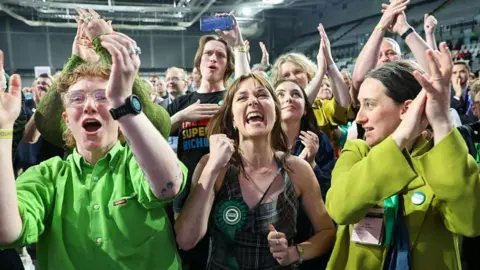
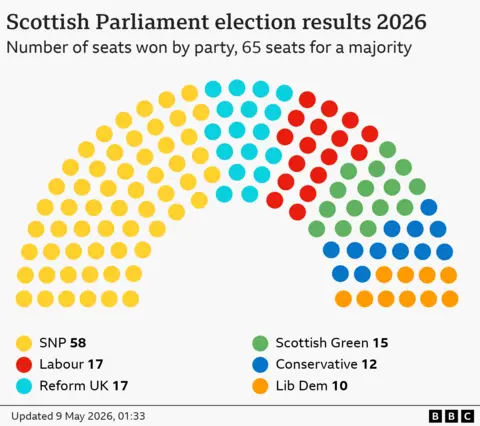
The SNP is the biggest winner in the Scottish Parliament election but its tally of 58 seats is short of a majority.
Party leader John Swinney said his party had won the Holyrood election "hands down" and the SNP is now expected to return to government.
Elsewhere Labour and Reform were tied for second and the Scottish Greens won their first constituency seats.
We look at the picture across Scotland and the shape of the new Scottish Parliament.
The SNP has won the election by a considerable distance, with the vote splintered between their opponents.
Labour continued their record of losing seats at every Scottish Parliament election since 1999, and ended up in a tie for second place with the surging Reform UK.
The Conservatives collapsed from second place in 2016 and 2021 to record their worst ever Holyrood result, winning just 12 seats.
Meanwhile there have been significant gains for the Greens, who hit a record 15 seats, and for the Lib Dems, who won 10.
The constituency map remains a sea of yellow, with a major addition right at the top of the map - Shetland has gone to the SNP, the first time a party other than the Liberals have won a national election there since 1945.
However there have been some standout results in Lib Dem orange and Scottish Green, er, green.
You have to zoom in a bit to see them, but the Greens have taken their first ever constituency seats, in Glasgow Southside and Edinburgh Central.
The Lib Dems conquered the northern part of the mainland with wins in two vast constituencies - Caithness, Sutherland and Ross, and Skye, Lochaber and Badenoch. They also captured urban seats in Edinburgh Northern and Strathkelvin and Bearsden.
Even Labour managed to make one gain, in Na h-Eileanan an Iar (Western Isles).
And all of that meant that despite the SNP making some gains - like capturing Eastwood from the Tories - they still fell well short of the majority John Swinney had targeted.
Constituency vote share across Scotland for the main parties
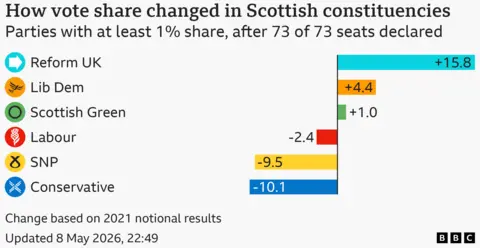
The distribution of party support around the country is notable, as seen in these maps.
The SNP remains strong pretty much everywhere - but has finished third in a constituency for the first time since 2011, with Angus Robertson slipping behind the Greens and Labour.
The Lib Dems have built a number of powerful strongholds at different ends of the country, but continue to be uncompetitive in other seats, losing their deposit (by recording under 5% of the vote) in 27 constituencies.
The Greens only stood in six constituencies, and finished in first or second place in four of them. Will they opt to branch out more in future?
Reform UK meanwhile built a pretty broad base of support - they didn't lose a single deposit, in contrast to the Tories who lost 22.
Labour meanwhile seems to continue its retreat into central belt heartlands - that Western Isles triumph aside - and has a serious shortage of viable target seats as Anas Sarwar scratches his head about where to start another rebuild.
Regional results crucial for most parties
With constituencies delivering the SNP to power, the regional vote ended up being key in deciding the makeup of the rest of the parliament.
One of the most notable winners was Reform UK - which despite coming close in Banffshire and Buchan Coast, has gained all of its representation from the regional list.
After a campaign full of fiery rhetoric between leaders, the party may have an equally explosive impact on the coming term at Holyrood.
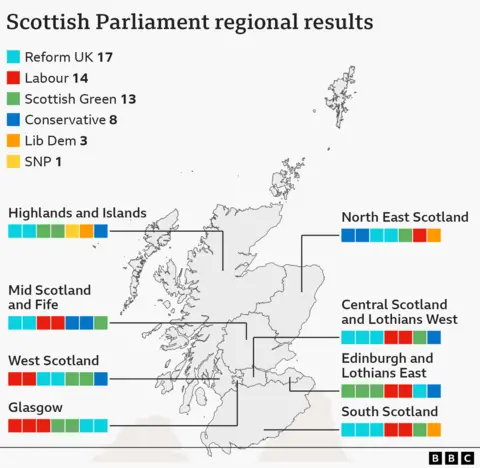
The other big winners were the Scottish Greens, who now have an MSP in every region of Scotland for the first time.
With Labour and the Tories both losing out, it raises real questions about how the opposition will operate at Holyrood.
The Lib Dems will feel their influence has increased, and may compete with the Greens to do budget deals with the SNP.
Turnout is down on the last Holyrood election
Participation was down almost across the board, from the record high of 63% in 2021 to 53% in this election.
There was just one seat where turnout increased - in Glasgow Kelvin and Maryhill, it inched up by 0.4%.
In a total of 18 seats, less than half of the population turned up to cast a ballot.
This is actually fairly well in line with the sort of turnout we saw at Holyrood from 2007 through to 2016.
But all parties will still need to do a bit of soul-searching about how to combat the oft-cited "scunner factor" and try to win the public back over to politics.

