Brighton Pride: From small protests to one of UK's biggest LGBTQ+ events

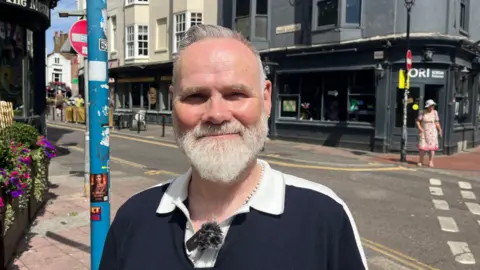 Sara Smith / BBC
As Brighton Pride marks 35 years, those who were there in 1991 have been reflecting on how a small demonstration became one of the UK's biggest annual LGBTQ+ events.
The first marches protested against Section 28, a controversial law introduced by Margaret Thatcher's Conservative government that banned councils and schools from promoting homosexuality.
Campaigners later transformed their demonstrations into Pride marches which not only challenged the law but also celebrated identity.
But some members of the LGBTQ+ community have claimed Brighton Pride has become too commercial and lost its meaning in recent years.
One man previously told the BBC that Pride had become a "massive money-making exercise" and that its "expensive" ticketed events excluded those on low incomes.
Organisers said at the time there were "practical realities of the cost of putting on a safe, accessible event".
Tickets range from about £45 to £345, although the parade is still free to watch.
 Alf Le Flohic
Alf Le Flohic, an independent researcher into LGBTQ+ history in the South East, said he was "proud" to have been involved in that first Pride march.
He said he arrived in Brighton in 1987 and saw an advert by an LGBTQ+ group to join discussions about how to respond to Section 28.
"Hundreds came to the meetings, there was a sense of community power," he told the BBC.
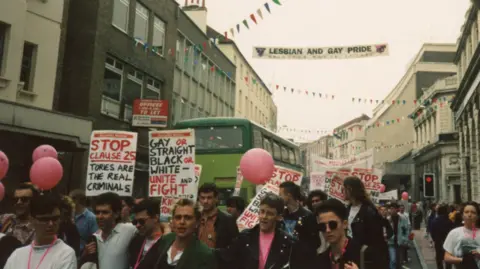
Section 28 marches began in Brighton and Hove in 1988, walking in protest between the then two town halls.
The movement became Pride in 1991, Le Flohic explained.
"Section 28 was to make us feel ashamed of who we are, but the opposite of shame is pride. We chose to be proud of who we are," he said.
"The reaction on the streets was often hostile, with some swearing and spitting at us.
"But when I looked back at the 1991 Brighton Pride banner and the crowd behind it, I thought 'wow, we did this as a community'. I felt proud and empowered."
The Pride followed earlier events in the city, organised by the Sussex Gay Liberation Front in 1972 and 1973.
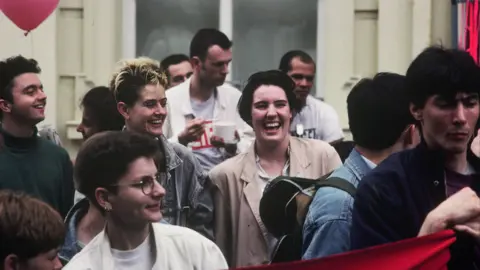 Abigail Dombey
Abigail Dombey recalled there were a few hundred people who took part in the 1991 Pride march.
"It was exciting but nerve-racking, we felt vulnerable and there was verbal abuse," Dombey said.
"However, it was important to be visible, to be seen and heard."
She said she once had an egg thrown at her from onlookers at a separate protest.
'Pink washing'
Dombey said that after years of demonstrations, activists realised Brighton needed a march that celebrated LGBTQ+ identity, not just protest.
Many people argue that the event has retained its political edge.
Organisers last year said political party participation had been suspended at Pride events in support of trans rights.
Meanwhile, others have claimed Pride has lost its "radical spirit in favour of corporate interests" over the years.
One woman added companies now used the event for "pink-washing", a practice of superficially supporting LGBTQ+ causes to boost their image despite having discriminatory practices or poor human rights records.
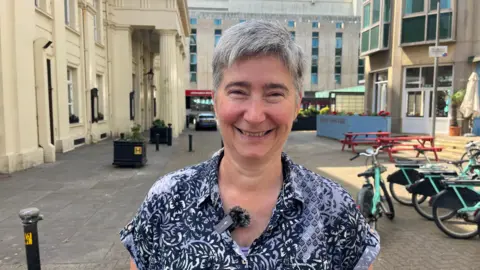 Abigail Dombey/BBC
Melita Dennett, who now presents BBC Introducing - Sussex and Surrey, said that despite some hostility the first marchers also received a lot of support.
"People stopped to wave at us," she said. "It was really heart-warming.
"I remember there were lots like 'we're here, we're queer and we're not going shopping'."
The campaigner said the early Prides helped cement Brighton's reputation as a welcoming place where people could be themselves.
"I think the message for younger generations is to remember the struggles that made today's freedoms possible," she said.
This year's Pride is due to take place on 1-2 August, with headline acts including Raye and Diana Ross.
- Join Allison Ferns this Saturday on BBC Radio Sussex from 10:00 BST where she will be live from the heart of Brighton Pride, bringing you the colour, the music, the emotion and the stories behind one of the city's biggest weekends.
Follow BBC Sussex on Facebook, X, and Instagram and listen to BBC Radio Sussex on Sounds. Send your story ideas to southeasttoday@bbc.co.uk or WhatsApp us on 08081 002250.
