Assembly debating bill aimed at banning conversion practices

 Getty Images
A bill aimed at banning sexuality and gender conversion practices is being debated by assembly members for the first time at Stormont.
It contains provisions that could see a two-year jail sentence imposed on people who conduct conversion practices.
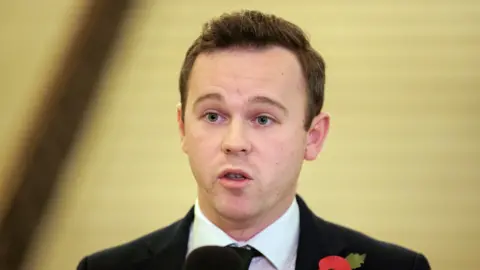
Alliance's deputy leader Eóin Tennyson proposed the private member's legislation, but it has been criticised by the Democratic Unionist Party (DUP) which said the bill "presents a real threat to freedom".
Unionist parties are expected to oppose the bill, but it is believed to have support from Sinn Féin and the Social Democratic and Labour Party (SDLP).
Advocates say the legislation is about protecting LGBT people from harmful attempts to change or suppress who they are.
Critics contend it is a legislative overreach which limits freedom of choice for gay and trans people, and risks criminalising important conversations around sexual orientation and gender.
Opening the debate, Tennyson said conversion practices were not a "relic of some distant past" but a "cruel" act that persists in society today.
He became emotional as he read testimony from an anonymised account of someone who had gone through conversion therapy.
Tennyson insisted that the ban he was proposing would be "comprehensive" and was seeking to ensure people would not be "shamed and humiliated simply because of who they are or who they love".
Ahead of the debate, Tennyson said Northern Ireland had lagged behind on equality for too long.
But DUP leader Gavin Robinson said the legislation was vague and that Northern Ireland already has laws to deal with abuse and coercive behaviour.
"We can protect people from mistreatment without creating vague new offences that reach into homes, churches and private conversations," he added.

LGBT campaign groups in support of the bill protested outside Stormont.
Alexa Moore from the Rainbow Project urged Stormont to pass the bill, saying it would make Northern Ireland the first part of the UK to bring such laws in.
She said campaigners would work with Stormont parties to make the bill the best it could be.
MLAs from Alliance, Sinn Féin, the SDLP and People Before Profit also joined the event.
What are conversion practices?
Conversion practices - sometimes called "reparative therapy" or "gay cure therapy" - try to change someone's sexual orientation or gender identity, according to the British Psychological Society (BPS).
In practice, it means trying to stop or suppress someone from being gay or from identifying as a different gender to their sex recorded at birth.
It often includes talking therapies and prayer but more extreme forms can exist.
The BPS and other professional bodies, including NHS England and the Royal College of Psychiatrists, said all types of conversion practices were "unethical and potentially harmful".
The bill would make it a criminal offence to provide conversion therapy, or to engage in coercive conversion behaviour, with the goal of changing a person's sexual orientation or gender identity.
It would also make it an offence to remove a person from Northern Ireland for the purposes of subjecting them to conversion practices.
The definition for coercive behaviour is borrowed from the Domestic Abuse and Civil Proceedings Act (Northern Ireland) 2021.
It includes violent or threatening behaviour, humiliating the victim, or controlling their day-to-day activities.
'Fundamentally illiberal'
In a summary of legal advice, the Christian Institute - a nondenominational charity that states that it is opposed to abortion, homosexuality and "transgender ideology" - said Aidan O'Neill KC's critique of Tennyson's bill was "devastating".
"O'Neill argues that the proposals are fundamentally illiberal, poorly drafted, and pose a severe threat to basic civil liberties," the charity said.
"He ultimately concludes that the bill likely exceeds the legislative competence of the Northern Ireland Assembly."
James Kennedy, the Christian Institute's Northern Ireland policy officer, said that "existing law offers strong safeguards against coercion in the home and verbal or physical abuse anywhere else, too".
He called on assembly members (MLAs) to oppose the bill.
'LGBT people do not need fixing'
Meanwhile, the Ban Conversion Practices Coalition has urged MLAs to take a "historic opportunity" to pass the bill and become "the first jurisdiction on these islands to pass a ban on these harmful, abusive practices".
Scott Cuthbertson, CEO of The Rainbow Project, said "politicians have the opportunity to buck that unfortunate trend, and deliver real protections for LGBTQIA+ people in Northern Ireland".

Patrick Corrigan, head of nations and regions at Amnesty UK, said the draft bill "sends a clear message that everyone has the right to be safe and live openly and fully".
"LGBT+ people are not broken and do not need fixing - protection from harm is long overdue."
Adam Murray, from Cara-Friend, encouraged people to read the bill, which he described as "very thoughtful".
He said significant work had gone into it from LGBT charities and academics, and that legislation introduced elsewhere had also been considered.
"This is not an attempt to overreach," he said. "Serious thought has been put in."
How did we get here?
Stormont politicians have debated the issue of gay conversion practices before.
In 2021, MLAs passed an Ulster Unionist Party (UUP) motion calling for it to be banned in all forms, however it was not binding.
However the UUP has now changed its position under new leader Jon Burrows and has said it would vote against the bill, saying it was "excessively broad, legally uncertain and potentially damaging".
The Traditional Unionist Voice (TUV) is also expected to vote against the legislation.
 PA Media
When Sinn Féin held the communities brief in the executive, several of its ministers advocated banning the practice - with Deirdre Hargey at the time saying her officials were drafting a bill, but a subsequent collapse of power-sharing meant this got no further.
Speaking to reporters at Stormont, First Minister Michelle O'Neill said that Sinn Féin "very much" supports legislation to ban conversion practices.
She described the practice as "really horrible and ugly", but said the detail of the bill was important and protections for families must be included.
O'Neill said it would be wrong for unionist parties to use a petition of concern to block the legislation.
 PA Media
During the debate at Stormont, DUP assembly member Gordon Lyons said there needed to be an "intention to suppress" and evidence that harm had been suffered.
"I have read the whole bill and I understand how it all connects together," he said.
"There is nothing in this bill that rules out legitimate conversations between individuals, or conversations between a parent and a child. It's simply not there."
Unionist parties cannot use a veto mechanism known as a petition of concern at this stage but they could seek to use it in future, if the bill passes its second stage on Tuesday.
In England, the government has published its own plans to legislate to ban the practice there, which could carry jail time and fines for those found to have carried out "abusive acts" aiming to change someone's sexual orientation or transgender identity.
