Dog walkers urged to help protect rare birds

 Getty Images
Walkers and dog owners are being urged to help protect a rare ground-nesting bird.
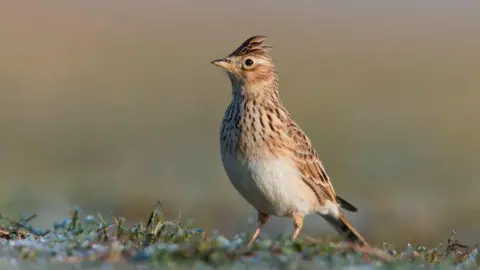
Visitors to Selsley Common near Stroud in Gloucestershire are being encouraged to keep an eye out for skylarks by Stroud District Council, which manages the land.
The birds, which lay their eggs directly into the grass in the spring and summer, are classified as 'red' on the British Birds of Conservation Concern list, meaning the UK population is in steep decline.
Martin Pearcy, chair of the council's environment committee, said: "A few small actions from all of us - staying on marked paths and keeping dogs on short leads - go a long way to helping these threatened birds raise their chicks safely."
In England, dogs being walked on open access land between 1 March and 31 July must be on a short lead of no more than 2m (about 6.5ft).
This rule is part of the Countryside and Rights of Way Act 2000.
Along with skylarks, Selsley Common, which is part of the Cotswolds National Landscape, is home to other ground-nesting birds such as meadow pipits.
It is a designated Site of Special Scientific Interest (SSSI), with wildflowers such as rock rose, wild thyme, and several species of orchid growing on the unimproved limestone grassland.
"We're lucky to have such a special place on our doorstep, and the sound of skylarks singing overhead is part of what makes Selsley Common so magical," Pearcy added.

The UK population of skylarks halved in the 1990s and continues to fall, according to conversation organisations.
Rebecca Charley, Stroud District Council's strategic lead for nature recovery and biodiversity, said: "Everyone who uses the common has a part to play in keeping it thriving.
"When people stick to paths, keep dogs on short leads and clean up after them, it helps protect this delicate ecosystem.
"We really appreciate the community working with us to look after such a precious place."
Follow BBC Gloucestershire on Facebook, X and Instagram. Send your story ideas to us on email or via WhatsApp on 0800 313 4630.
