Oswestry: The English town that belongs in Wales

 Richard Collett
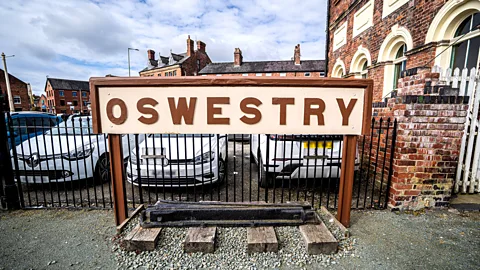
In the border town of Oswestry, Welsh is heard in shops, on signs and in daily life – despite the town being firmly in England.
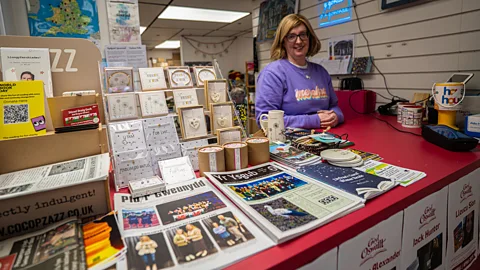
"You're the first person I've spoken English with today," Sian Vaughan Jones said, with sudden realisation as I stepped into Siop Cwlwm, a Welsh-themed shop in the Shropshire market town of Oswestry.
"You'll hear Welsh all over town," she added, as I browsed shelves lined with Welsh-language books, CDs, calendars and greetings cards. "There are some days when I don't speak any English at all."
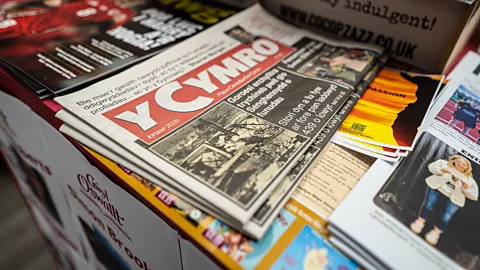
A Welsh business staffed by Cymraeg (Welsh) speaking locals like Jones, should not be a curiosity in the United Kingdom, where more than 500,000 people speak the Celtic language. But this one is, because, as Jones proudly told me, Siop Cwlwm – which means the "Knot Shop" in Welsh and promotes Welsh language, culture and heritage – is one of the few Welsh shops in England. "Because Oswestry is right on the border," said Jones. "We're so connected to Wales."
"Connected" is a diplomatic description of Oswestry's relationship with Wales. Some might say it's on the "wrong" side of the border entirely. Look at a map, and you'll see the border between England and Wales lies no more than six miles away – to the north, south and west – enclosing Oswestry within a small wedge of "English" land protruding unnaturally into Wales. Tourist information signs across town say Croeso (Welcome); flyers advertise a Siop Siarad (a Welsh language get-together); and the local football team, The New Saints, is the most successful club in the Cymru Premier, the Welsh national league.
 Richard Collett
"When you look at a map, the border goes around Oswestry," said local curator Mark Hignett, whom I met later at Oswestry Town Museum. "One story I've heard says the cartographer had a hiccup. Another, that it was drawn to punish Oswestry by placing the town in England," he half-joked. "In reality, it was likely drawn where it is because Offa's Dyke is to our west."
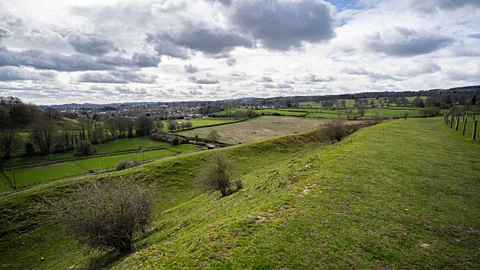
Hignett explained how the Cornovii – a Celtic tribe who spoke a Brythonic language, from which modern Welsh descends – once dominated this part of Britain. It's thought they constructed Old Oswestry Hill Fort around 800 BCE, and a short walk from town, its Iron Age ramparts still rise above the countryside.
After the fall of the Roman Empire in the 5th Century CE, however, Anglo-Saxon invaders, who spoke dialects of Old English, began displacing native Brythonic speakers. Around the 7th Century, a defensive boundary known as Wat's Dyke was formed to Oswestry's east, dividing the Anglo-Saxons from their Celtic counterparts. In the 8th Century, an Anglo-Saxon king named Offa built another dyke, a vast earthwork of ditches and parapets, to the west of Oswestry. Stretching for some 80 miles, Offa's Dyke still marks much of the modern border between England and Wales.
To the Welsh, Oswestry became part of "The Lost Lands" – places where Cymraeg was once spoken. Yet being so close to this ancient boundary also left the town in the midst of a hazy and often bloody borderland. "We were either trading with the Welsh, or we were fighting the Welsh," said Hignett, summarising Oswestry's medieval history.
Next to Oswestry's Town Hall lie the ruins of an 11th-Century Norman castle, from which English kings attacked Welsh princes who refused to bend the knee. In 1216, however, England's King John burned Oswestry to the ground as punishment for siding with the Welsh. Six miles west, on the Welsh side of the border, are the remains of Sycharth Castle, the ancestral home of Welsh national hero Owain Glyndŵr. In 1400, Glyndŵr led the last great Welsh rebellion against the English, and in 1404 convened the last Welsh Parliament until the modern Senedd Cymru opened in 1999. During the rebellion, Glyndŵr also burned Oswestry to the ground – this time, presumably, for siding with the English.
 Richard Collett
Throughout this medieval violence, Oswestry constantly changed hands. Yet it also endured as a trading hub, where bilingualism thrived out of necessity. Oswestry's Town Markets – held on Wednesdays, Fridays and Saturdays – trace their origins to 1262 and continue to attract people from both sides of the border.
"Oswestry is recognised unofficially as the capital of Mid Wales," said Rob Williams, chairman of Cambrian Heritage Railways, when I met him at the town's restored station. "Historically, the natural flow of people from Wales was to markets here. All the roads lead to Oswestry."
The Cambrian Railway, a 230-mile-long Victorian-era network, also led to Oswestry. The vast majority of its lines, however, ran through Mid Wales, connecting the town to the Welsh coast at Aberystwyth. Williams described it as a "Welsh Railway", even though it was headquartered in Oswestry.
Like many of Britain's railways, the Cambrian fell victim to the Beeching cuts in the 1960s. In 2022, Cambrian Heritage Railways reopened a 1.7-mile (2.7 km) stretch from Oswestry Station to Weston Wharf as a tourist attraction. The aim is to eventually extend the line towards Llanymynech, where the English-Welsh border runs down the high street. Williams hopes the heritage railway can become a gateway to Oswestry's other tourist attractions, including Old Oswestry Hill Fort, the town's markets and the long-distance Offa's Dyke Path and Wat's Dyke Way, both of which weave through town.
"We've always had this Jekyll and Hyde relationship with Wales," Williams added, highlighting the town's ambiguous identity.
 Richard Collett
Somewhat unusually, the Ordnance Survey marks both the town's English name, Oswestry, and its Welsh one, Croesowallt, on its maps. A street called Welsh Walls runs alongside Maes Chwarae Bryn Hafod (Maes Chwarae means "recreation ground" in Welsh); while another street named English Walls runs onto Salop Street, Salop being an old Anglo-Saxon name for Shropshire.
English and Welsh have co-existed here for centuries, and for Lowri Roberts, Siop Cwlwm's founder, that dual identity is the town's strength.
"From my perspective, I would say Oswestry is a Welsh town in England," she told me back in the shop. "I'm a Welsh Oswestrian. I speak Welsh here. I live a Welsh life. Look at what makes a Welsh town, be that a Welsh shop or a Welsh chapel, and we have it all here. But ask an English Oswestrian, and they'll say something different."
While Jones, the shop's assistant, grew up speaking Welsh in North Wales, Roberts grew up speaking it as her first language here in Oswestry. She described the number of Welsh speakers as "ebbing and flowing" over the centuries – not just in Oswestry, but in Wales itself, where the language was marginalised for centuries after Henry VIII's Acts of Union in 1536 forcibly annexed Wales to England and established the modern border.
The language is now experiencing a resurgence, with the Welsh government aiming for one million speakers by 2050. Because Oswestry is in England, however, Roberts said no one knows exactly how many Welsh speakers live here, since official census figures count speakers in Wales but not in border towns like this one.
 Richard Collett
"We're not a diaspora here. We're an overspill," she said, explaining that because Oswestry lies on the "wrong" side of the border, local Welsh-language initiatives cannot always access Welsh government funding. "The line on the map doesn't reflect the culture. People don't stick to borders. We don't want to be defined by a border Henry VIII drew five centuries ago."
When Roberts founded Siop Cwlwm with her late mother in 2010, she knew she was filling a gap in the market. Anecdotally, she believes the number of Welsh speakers in Oswestry is growing. Indeed, I first met Roberts in 2022 when I started researching a book about the United Kingdom's borders. Back then, Siop Cwlwm occupied a smaller space on the second floor of Oswestry's indoor market.
With business booming, it has since moved to a prominent high-street location, where they hold a Welsh-language Siop Siarad twice a month. Oswestry Library also hosts conversational Welsh groups and language-learning courses, and in April 2026, Siop Cwlwm organised Gwŷl Oswallt, the town's first Welsh-language book festival.
More like this:
Roberts, who has spent her whole life in a border town, knows Welshness can thrive peacefully alongside Englishness, and she's pleased to see the language, culture and heritage spilling over the border.
"The Welsh language is older than English," she said proudly. "We never want to force it upon people, but it's a language everyone on our island can share."
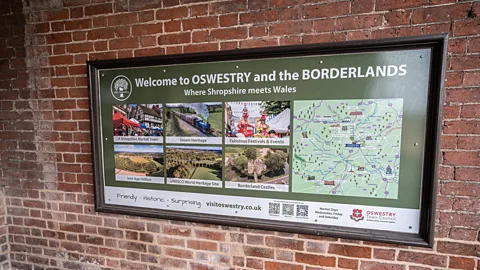
"Welcome to Oswestry and the Borderlands" reads a sign I'd spotted earlier outside the red-brick train station. While Oswestry's Welsh identity is strengthening, it's not so much a Welsh town on the wrong side of the border, but a place in between. Oswestry is a border town at heart, a town where you can choose to be English or Welsh, or something else entirely.
* Richard Collett is the author of Along the Borders: In Search of What Divides and Unites the British Isles.
--
If you liked this story, sign up for The Essential List newsletter – a handpicked selection of features, videos and can't-miss news, delivered to your inbox twice a week.
