How much sunscreen do you need to protect your skin?

 Getty Images
Sunscreen protects your skin from the damaging effects of UV radiation, and can help prevent skin cancer.
But experts warn that many people do not use enough, or apply it correctly.
How does the sun damage your skin?
Sunburn is a clear sign that your skin has been damaged, but you do not actually need to burn to sustain skin damage.
The cause is UV (ultraviolet) radiation emitted by the Sun.
Some exposure to UV radiation is beneficial, because it enables our skin to produce essential vitamin D. This is important for the function of bones, blood cells and our immune system.
But too much can cause premature ageing and lead to skin cancer.
The number of new melanoma skin cancer cases diagnosed in the UK in a year has risen above 20,000 for the first time.
The charity Cancer Research UK says too much exposure to UV - from sitting in the sun and sunbeds - is part of the cause, with an estimated nine in every 10 cases thought to be avoidable.
Too much sun can also damage your eyes.
What is the UV Index and how does it work?
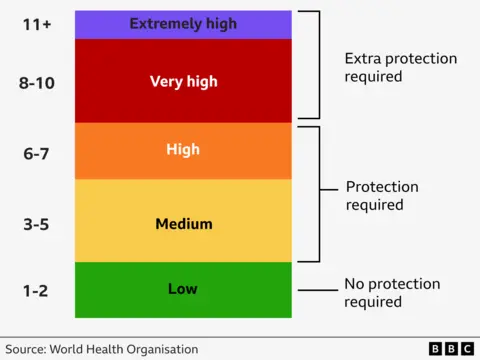
The UV Index is a measure of UV radiation used around the world. It starts at zero and can rise above 10.
According to Cancer Research UK, if the UV index is three or above, you should consider using sunscreen and covering up. Higher readings require more protection.
Levels of UV radiation vary throughout the day, with the highest readings over a four-hour period when the sun is at its highest - usually from late morning to early afternoon.
UV levels are part of many weather forecasts, including those from BBC Weather and the Met Office.
How much sunscreen do you need?
The NHS says most people do not apply enough sunscreen.
It recommends that adults use around six to eight teaspoons of sunscreen if they are covering their entire body.
Sunscreen should be applied to all exposed skin, including the face, neck and ears - and head if you have thinning or no hair - ideally 30 minutes before you go out into the sun.
It should be reapplied every two hours, or sooner if you sweat a lot, have been in water, or after drying yourself with a towel.
This is the case even if the sunscreen says it is water resistant, or describes itself as long-lasting.
However, no sunscreen provides absolute protection from UV radiation.
So, you should wear trousers or skirts with a fabric that does not allow sunlight through, a top with long sleeves, a sun hat and sunglasses.
Spend time in the shade during the hottest part of the day.
 Getty Images
How can children be protected from the sun?
You should take extra care to protect babies and children as their skin is much more sensitive to sun damage.
The NHS says children younger than six months should not spend any time in direct sunlight. Sunscreen is not recommended for this age group.
Once they are six months old, the NHS recommends using a sunscreen rated at least 50 SPF which offers high levels of protection from both UVA and UVB.
Sunscreen should be applied to all exposed areas, and regularly reapplied.
Children wearing sunscreen should still avoid direct sunlight during the middle of the day, and wear a wide-brimmed hat and sunglasses.
What do the SPF numbers on sunscreen bottles mean?
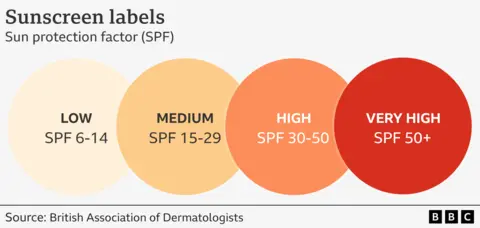
The most visible number on sunscreen bottles is the sun protection factor or SPF. The higher the number, the greater the protection.
According to the British Skin Foundation, the SPF rating tells you how much protection your sunscreen provides from UVB.
Correctly applying sunscreen with an SPF of 30 it means that it would take your skin 30 times longer to go red than if you used none.
The British Skin Foundation says an SPF of 30 allows about 3% of UVB to penetrate the skin and SPF 50 about 2%.
It and the NHS both recommend using sunscreen with an SPF of at least 30.
What do the star ratings on sunscreen mean?
Many sunscreen brands also carry a star rating from one to five.
The NHS says the star rating measures the amount of UVA protection, with more stars denoting increased protection. The NHS recommends using sunscreen with at least four stars.
If the letters "UVA" appear inside a circle on the sunscreen bottle, the product meets EU safety standards.
Ideally, your sunscreen should have both a high SPF rating and a high star rating.
Can I use an old bottle of sunscreen?
Sunscreen should be kept in a cool, dry place, out of direct sunlight, according to the British Association of Dermatologists.
It says unopened sunscreen stored correctly typically lasts around 30 months.
You should not use sunscreen which is past its expiry date as it may be less effective.
Some sunscreen does not have an expiry date but displays a "period after opening (PAO)" symbol. This is an open container next to a number indicating how long the product remains effective once in use - with "12M" meaning 12 months.
What should you do if you get sunburned?
Sunburn results in hot and sore skin which may peel after a few days. In extreme cases, skin can blister.
It usually gets better within a week or so, but there are things you can do to ease the symptoms.
The NHS recommends getting out of the sun as soon as possible, and keeping burned skin covered to protect it from the sun until it has fully healed.
A cool shower or a damp towel can help, as can moisturising aftersun products, painkillers and drinking plenty of water. Ask your pharmacist for advice.
You should not put petroleum jelly or ice on sunburned skin. You should resist scratching the burned areas and avoid tight-fitting clothes.
Contact your GP or NHS 111 if your skin is blistered or swollen or you have other symptoms of heat exhaustion or heatstroke.
Regularly getting sunburned can increase the risk of skin cancer.

