'Swanky little' Saxon belt strap end found in dig

 Cotswold Archaeology
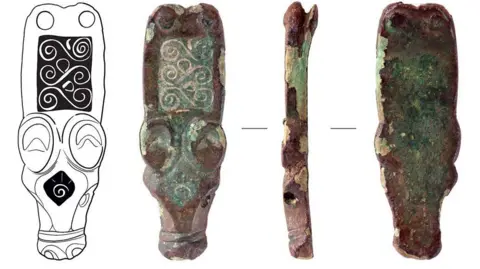
A "swanky little" 9th Century Anglo-Saxon belt strap end is the star find of an excavation on the outskirts of a market town, say archaeologists.
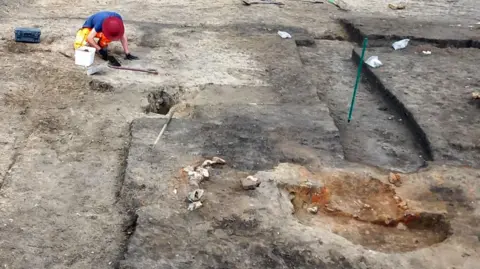
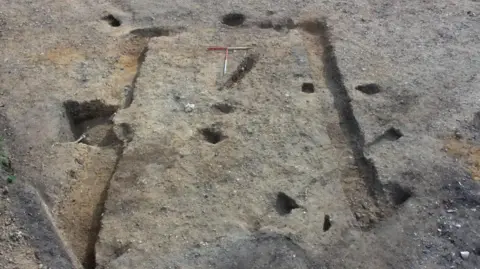
The discovery was made in 2024 at Halesworth, Suffolk, alongside the remains of Saxon burials and at least four buildings, one of which might be a chapel.
The copper-alloy find was decorated with silver and a stylised animal head. It would have been fixed to the end of a leather or textile belt to prevent it fraying.
Archaeologist Jezz Meredith said the "high-status item" would have been worn "by a lesser lord or thegn, a wealthy merchant or a reeve [public official]".
"So it's quite a swanky little thing," the Cotswold Archaeology senior publications officer added.
 Cotswold Archaeology
The more usual finds were made in the same area of the excavation, which was undertaken ahead of a development by McCarthy & Stone.
A small cemetery was unearthed containing the poorly preserved remains of seven people, including an adolescent and at least two men and two women.
"The other interesting area is there is an extensive industrial theme to the finds - what we're potentially seeing is a suburb of Halesworth forming away from the church and historic core," said Meredith.
"It's known from Sudbury and Ipswich that kilns and animal processing was getting pushed out of the towns at this time, pushing noxious fumes into the suburbs."
The finds included fired clay, quern stones [for grinding grain], a spindle whorl, furniture fittings, nails, knives and a heckle tooth [used to card wool before spinning] and three of the buildings had large hearths associated with them.
At the same time there was a possible fifth building, which could have been a chapel associated with the burials.
 Cotswold Archaeology
The animal bone finds have particularly puzzled the experts.
Meredith said: "52% was pig - including 15 pig heads - that's the biggest proportion of pork finds in East Anglia in this period of any site and it's quite bonkers, we don't know why.
"And 4% was red deer, yet during this period it's lords who eat it, and the only place in East Anglia with a high proportion of deer bone [remains] is Castle Rising castle in Norfolk.
"We're thinking maybe the workers who were working around the hearths were being fed by scraps of high status food."
A great deal of melted down lead from window glass was also unearthed, but not close enough to the potential chapel to belong to it.
So, the archaeologists speculated there was "a high status building somewhere near the location".
"All the finds throw up more questions than they answer," Meredith said.
"By a lucky accident in the 10th Century, the suburb started to wind down and return to agriculture so that's why it's quite well preserved."
The archaeological investigation was undertaken as a requirement of conditions secured on the planning consent, in accordance with the National Planning Policy Framework.
The work is supported by Suffolk County Council Archaeological Service, and based on archaeological potential indicated by information on the Suffolk Historic Environment Records.
Do you have a story suggestion for Suffolk? Contact us below.
Follow Suffolk news on BBC Sounds, Facebook, Instagram and X.
