'Out': Retracing Reading's gay liberation movement
In June 1972, a handful of students gathered at a pub for what would turn out to be the first meeting of Reading's Gay Alliance.
One of the founders of the movement was Martin Kaufman, then a student at the University of Reading.
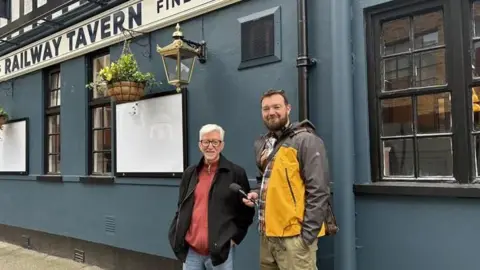
The meeting at The Railway Tavern, on Greyfriars Road, marked a turning point in the town's social history.
Radio Berkshire's Phil Mercer met Kaufman at the historic pub to retrace the birth of Reading's gay liberation movement.
"Here, in this very spot, was the first location for a publicly-accessible gay and lesbian - and that's what we called them - gay and lesbian meeting place," said Kaufman.
"It wasn't until about August [1972] that we had a regular venue - a meeting on a Wednesday night, a social gathering and then a disco on a Saturday."
It had been about five years since the partial decriminalisation of male homosexuality, "because lesbianism was never illegal", said the activist.
"We were in a period of still great repression and the great feelings of 'can I do anything to actually be who I am?', which is why the Gay Liberation Front (GLF) came along."
The GLF was a radical organisation, founded in New York after the Stonewall riots in 1969, with the London branch formed in 1970. It aimed to transform society and end what it saw as oppression of the gay community.
The Reading Gay Alliance was actually two groups of activists, Kaufman explained.
"One are what I call the reformers, the campaign for homosexuality and the other, the rebels, of which I was one, in the Gay Liberation Front.
"I would go to London and come back and inject, I think, some of the rebelliousness of the Gay Liberation Front into the Reading Gay Alliance."

From the early 1970s onwards, Reading became part of a larger network in the gay and lesbian world, which included Basingstoke, Slough, Maidenhead, Windsor, High Wycombe and London, he said.
It was at another of the town's pubs where the first publicised meeting would be held.
At the Coopers Arms in the Market Place, Gough Sergeant and his now husband David Thompson organised the Reading University Group for Homosexuals, Kaufman explained.
Arriving to find "five people sitting around a table with half pints of beer", Kaufman said he remembered thinking "this is not what gay liberation needs to be".
"I thought 'we need to do more, we need to publicise, we need to be more visible'," he said.
At St Andrews Hall on Redlands Road, now the Museum of English Rural Life, Kaufman and others organised a festival called People Together later in 1972.
It included the "first public selling of a gay newspaper in Friar Street and Broad Street", a Saturday morning workshop and a gay and lesbian dance in the evening, he said.
"That might sound 'so what?'," said Kaufman, adding: "But, when you've never had one, it's a big thing.
A month or so later, a regular disco started at The Railway Tavern.
'So energised'
They also began holding meetings on the university's Whiteknights Campus, "about sexuality, homosexuality, heterosexuality, bisexuality or question mark", said Kaufman.
"Suddenly, we found there were people outside the university who'd come to that.
"We realised there was a greater meeting place, a greater interest in talking about these things than just a few students."
"I was so energised, as were my fellow colleagues, whether from the reformist wing or the long-haired rebellious ring, to actually get things done," he said.
"The week after the dance was the very first Gay Pride March, which I went on.
"To my absolute amazement, in Time Out magazine, the one photograph of the Gay Pride March, the very first one, included me.
"I was actually quite embarrassed because my family didn't know that I was gay at the time.
"Now I think how amazing, how fantastic that they actually, first of all, publicised it and that I have a record of being on the first Gay Pride March."
At a time when there were risks involved, Kaufman said he was determined to be part of it all.
"It's part of my own make-up that you just have to put into practice what you believe in," he said.
"It's not good enough just to believe something, you actually have to do something.
"It was that spirit of 'we will not take this anymore, we're going to stand up for our rights' that inspired me."
