How worrying is the Ebola outbreak in DR Congo?

 Getty Images
The outbreak of Ebola in the Democratic Republic of Congo is concerning.
It has been spreading for weeks undetected in a part of the world where civil war makes getting on top of the virus difficult, and the species of Ebola involved is rare, so there are fewer tools to stop a virus that kills around a third of people infected.
This is a critical moment in an outbreak where there is uncertainty about how far it has spread, but there are already almost 250 suspected cases and 80 deaths.
Most Ebola outbreaks tend to be small, but specialists are haunted by the 2014-16 outbreak. Then, 28,600 people in West Africa were infected in the largest ever outbreak of the disease.
The declaration of a public health emergency of international concern by the World Health Organization (WHO) does not mean we are in the early stages of a Covid-style pandemic.
The risk Ebola poses to the whole world remains tiny.Even in the 2014-16 outbreak, there were only three cases in the UK and all were healthcare workers who had volunteered to help.
"But it does reflect that the situation is complex enough to require international coordination," says Dr Amanda Rojek, from the Pandemic Sciences Institute at the University of Oxford.
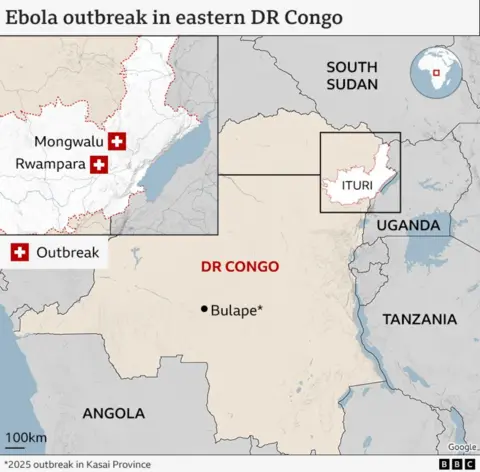
After all, there is still a significant threat to neighbouring countries like Uganda, South Sudan and Rwanda, considered high risk because of close trade and travel links.
Two people have already been confirmed to have the virus in Uganda, of whom one has died.
Ebola is a severe and deadly disease, although it is thankfully rare. Ebola viruses naturally infect animals – mainly fruit bats – but people can become infected if they come into close contact.
This outbreak is being caused by the Bundibugyo species of Ebola – it is one of three species known to cause outbreaks but is relatively unfamiliar.
Bundibugyo has caused only two outbreaks before – in 2007 and 2012 – where it killed around 30% of people infected.
Bundibugyo poses a series of challenges. There are no approved vaccines or drug treatments for Bundibugyo, although there are some experimental ones, unlike other species of Ebola virus.
And tests to determine whether somebody has the infection do not appear to work well. Initial results in the outbreak were negative for Ebola virus, and more sophisticated laboratory tools were required to confirm Bundibugyo was involved.
Dealing with Bundibugyo is "one of the most significant concerns" in this outbreak, says Prof Trudie Lang from the University of Oxford.
Symptoms are thought to appear between two and 21 days after somebody is infected.
Initially they are like developing the flu - fever, headache and tiredness. But as Ebola progresses, it leads to vomiting, diarrhoea, and the body's organs not working. Some patients develop internal and external bleeding.
With no approved drugs designed to target Bundibugyo virus, treatment relies on "optimised supportive care" including managing pain, other infections, fluids and nutrition. Early care improves the odds of surviving.
Ebola spreads through infected bodily fluids such as blood and vomit, although this does not normally occur until symptoms have appeared.
The first known case was a nurse who developed symptoms on April 24. It has since taken three weeks to confirm an outbreak is happening.
"Ongoing transmission has occurred for several weeks, and the outbreak has been detected very late, which is concerning," said Dr Anne Cori from Imperial College London.
It means health officials are behind where they would like to be in stopping the outbreak, which the WHO says points towards a "potentially much larger outbreak than what is currently being detected and reported".
The main method will be rapidly identifying who is infected, and to whom they may have passed the virus.
There will also be efforts to prevent Ebola spreading through hospitals and other treatment centres, which will be dealing with patients when they are most infectious. And to ensure anyone who dies and whose body remains infectious has a safe burial.
This will be a challenge due to the number already infected, and made worse as it is taking place in a conflict-torn part of DR Congo that has more than 250,000 people displaced from their homes.
"Many of the affected areas are mining towns with highly mobile and transient populations. This mobility increases risk as people move between communities and across borders," says Lang.
However, DR Congo does have extensive experience in dealing with Ebola outbreaks and the response is "significantly stronger today than it was a decade ago", says Dr Daniela Manno from the London School of Hygiene & Tropical Medicine.
Whether this outbreak can be quickly contained or spirals into a repeat of what happened just over a decade ago will be determined by the response now.
