WHO declares Ebola outbreak in DR Congo an international emergency

 AFP via Getty Images
The World Health Organization (WHO) has declared an Ebola outbreak in the Democratic Republic of Congo a public health emergency of international concern.
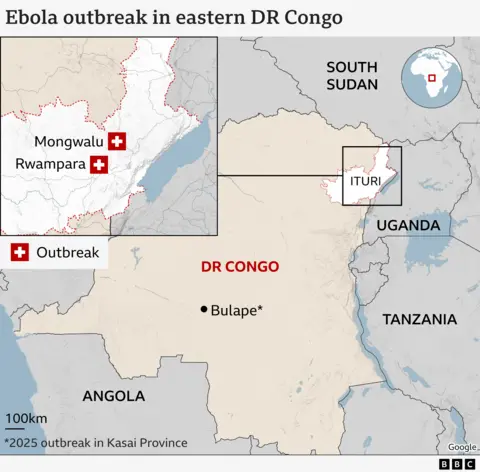
The agency said the outbreak in DR Congo's eastern Ituri province, which has seen around 246 suspected cases and 80 deaths reported, does not meet the criteria of a pandemic emergency.
But it warned it could potentially be "a much larger outbreak" than what is currently being detected and reported, with significant risk of local and regional spread.
The current strain of Ebola is caused by the Bundibugyo virus, the health agency said, for which there are no approved drugs or vaccines.
Early symptoms include fever, muscle pain, fatigue, headache and sore throat, and are followed by vomiting, diarrhoea, a rash and bleeding.
The WHO saidthere were now eight laboratory-confirmed cases of the virus, with other suspected cases and deaths across three health zones including Bunia, the capital of Ituri province, and the gold-mining towns of Mongwalu and Rwampara.
One case of the virus has been confirmed in the capital Kinshasa, believed to be in a patient returning from Ituri.
The WHO said that the virus had spread beyond DR Congo, with two confirmed cases reported in neighbouring Uganda. Ugandan officials said a 59-year-old man who died on Thursday had tested positive.
In a statement, the Ugandan government said the patient who died was a Congolese citizen whose body had already been returned to DR Congo.
A laboratory has also confirmed an Ebola case in the eastern city of Goma, currently controlled by the M23 rebels, the AFP news agency reported on Sunday.
At least six Americans have been exposed to Ebola in DR Congo, and one has displayed symptoms but none have been confirmed to have been infected, the BBC's US partner CBS reports, citing sources.
The US government was reportedly trying to transport them out of the country, possibly to a military base in Germany, STAT News reports.
The US Centers for Disease Control and Prevention (CDC) said it planned to send more staff to DR Congo and Uganda, while the US Embassy in DR Congo issued a health alert reminding citizens not to travel to Ituri province.
The BBC has contacted the CDC for comment.
Jean Kaseya, director general of Africa Centres for Disease Control and Prevention, warned that in the absence of vaccines and effective medicines people should follow public health measures, including the guidance about handling the funerals of those who have died from the disease.
"We don't want people infected because of funerals," he told the BBC World Service's Newsday programme.
Community funerals, where people helped wash the bodies of their loved ones, contributed to many people becoming infected in the earlier stages of the big outbreak more than a decade ago.
The WHO said the ongoing security situation and humanitarian crisis in DR Congo, combined with high population mobility, the urban location of the hotspot, and the large number of informal healthcare facilities in the region increased the risk of spread.
Countries bordering the DR Congo are considered high risk due to trade and travel.
Rwanda said it would be tightening screening along the country's border with DR Congo as a "precautionary measure".
Its health ministry said surveillance systems had been strengthened and health teams were on alert to "ensure early detection and rapid response if needed".
 Reuters
The WHO advised that DR Congo and Uganda establish emergency operation centres to monitor, trace, and implement infection-prevention measures.
To minimise spread, it said confirmed cases should be immediately isolated and treated until two Bundibugyo virus-specific tests conducted at least 48 hours apart are negative.
For countries bordering regions with confirmed cases, governments should enhance surveillance and health reporting.
The WHO added that countries outside the affected region should not close their borders or restrict travel and trade as "such measures are usually implemented out of fear and have no basis in science".
WHO director general Dr Tedros Adhanom Ghebreyesus warned there are currently "significant uncertainties to the true number of infected persons and geographic spread" of the outbreak.
What is Ebola and how does it spread?
- What is causing this outbreak? Ebola is a disease caused by a virus – it is rare, but severe and often deadly. There are three species of Ebola virus that cause outbreaks, and this one is known as Bundibugyo
- How is Ebola transmitted? It spreads between people through infected bodily fluids, such as blood and vomit
- How deadly is it? Around 30% of people have died in previous outbreaks of Bundibugyo Ebola virus
- What is the incubation time? Symptoms appear between two and 21 days after being infected
- What are the symptoms? The initial symptoms appear suddenly and are flu-like, such as a fever, headache and tiredness. As the disease progresses, vomiting and diarrhoea develop and the body's organs do not work as well. Some patients may develop internal and external bleeding
- Where does Ebola come from? Outbreaks start when somebody catches Ebola from infected animals, such as fruit bats
- Is there a vaccine? There are vaccines for the Zaire species of Ebola, but not for Bundibugyo
Ebola was first discovered in 1976 in what is now DR Congo, and is thought to have spread from bats. This is the 17th outbreak of the deadly viral disease in the country.
There is no proven cure for Ebola, with the average fatality rate is around 50%, according to the WHO.
Africa CDC previously said it was concerned by the high risk of further spread due to the urban settings of Rwampara and Bunia, and mining activities in Mongwalu.
The health agency's executive director Dr Jean Kaseya added that "significant population movement" between the affected areas and neighbouring countries also meant regional co-ordination was essential.
Around 15,000 people have died from the virus in African countries over the past 50 years.
DR Congo's deadliest outbreak was between 2018 and 2020, during which nearly 2,300 people died.
Last year, 45 people died after an outbreak in a remote region.
Additional reporting by James Gallagher
