Stormont officials told how to spend without a budget

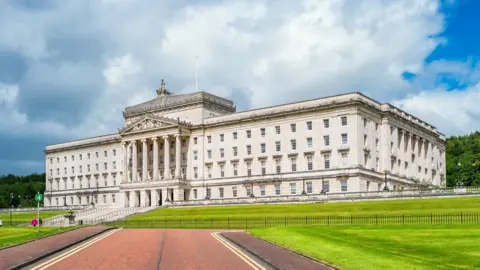 Getty Images
Stormont officials have been given new guidance on how to manage departmental finances in the absence of a budget.
The executive has failed to reach a final agreement on the draft budget which was published in January.
That means all government departments started the financial year in April without being certain how much they would have to spend.
The senior official in the Department of Finance has now sent advice to his civil service colleagues which effectively says that the safest type of spending is on commitments with specific funding from the UK government and areas where the executive has previously committed to spending.
Examples of previous commitments include spending on welfare reform mitigations.
The advice to departments reflects the amount of money that the Department of Finance could authorise if a Budget Act is not passed before the end of July, which is based on 95% of the total authorised in the Budget Act for last year.
They have also been told that they should not have less than that amount once the executive finally reaches agreement.
These sort of temporary procedures have already been used on other occasions when a budget has not been in place at the start of the financial year.
The Finance Minister, Sinn Féin's John O'Dowd, sent his budget proposals to executive colleagues on Christmas Eve before releasing them for public consultation in early January.
The hope was that Stormont could agree a multi-year budget for the first time in more than 10 years.
O'Dowd said: "A multi-year budget provides the opportunity to give departments the certainty they need for long-term planning and create the conditions to drive transformational change."
However, the draft was rejected by other parties with the Deputy First Minister, the Demoratic Unionist Party's (DUP) Emma Little Pengelly, describing it as "deeply flawed".
O'Dowd has been continuing to talk to the UK government in the hope of securing more funding, outside the usual allocation process.
A recent "open book" analysis of Stormont's finances by the UK Treasury suggests it is sceptical about the case for more funding.
The SDLP opposition has been highly critical of the failure to agree a budget describing it as a "shambles" which is "demeaning devolution".
