Postal workers to FA Cup, a history of Albion Women

 Brighton & Hove Albion FC
Brighton & Hove Albion Women are playing the biggest game in the club's history on Sunday. They're off to Wembley, and the FA Cup is at stake.
Win against Manchester City, and they go home with their first major trophy. They will surely become Sussex legends.
This is a huge moment for Albion Women, who are also set to be the first club in Europe with a purpose built women's football stadium.
So as the team stands on the edge of greatness, we are going back to find out how a group of Post Office telephonists started it all.
A team is born
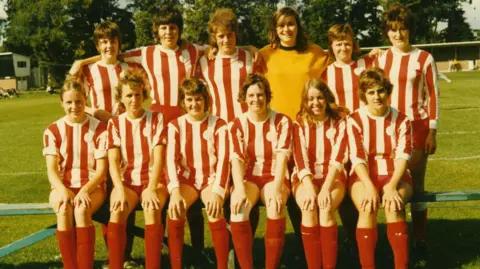
It was 1967. The England men's team had won the World Cup the year before, and football fever was still consuming the country, right down to the social club at the Brighton General Post Office.
A group of telephonists there got together and played in charity matches. They were the original Albion Women - known as Brighton GPO.
Among them is a 17-year-old, Eileen Bourne. Now, Eileen recalls those early days, including her first match, where she played in goal against a team of over-50s postmen.
"At that time, there was no organised women's football at all... so getting a team to join, for me, was manna from heaven," Bourne said.
"We played against the postmen, that was my first game, I don't remember the score. Probably in my scrapbook.
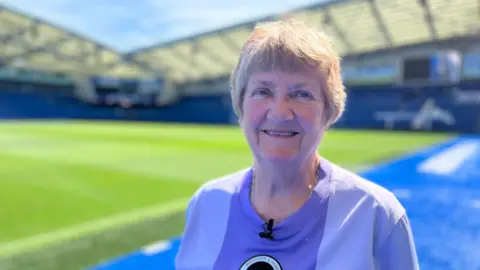
"After the World Cup, women's teams were forming organically. Shops, stores, and various organisations started getting women's teams up. We played friendlies against them."
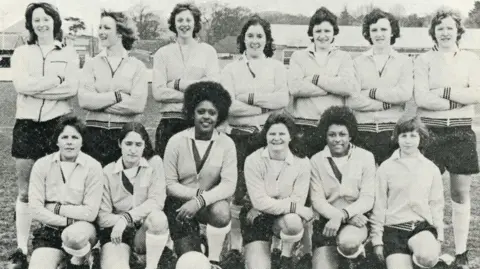
The local clubs formed a league, and this was happening around the country. Eventually, the leagues united to create the Women's Football Association.
"I can't remember how many founder members there were, but we were one of them," Bourne said.
 Brighton & Hove Albion FC
All this was happening while the Football Association's ban on the women's game was in place.
"I'm not sure I thought about it that much; I was just glad to be out on the pitch and going to training sessions," Bourne recalled.
"By that time, I worked for a bank. They had two pay scales, one for men and one for women. The women's was always less. You got used to not being thought that much of."
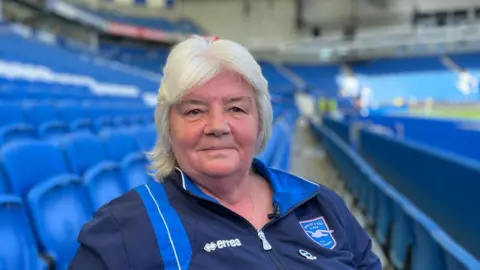
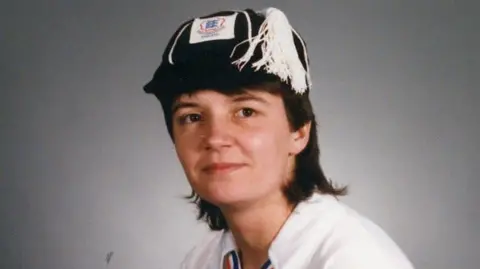
Another member of the original Brighton GPO team was Julie Hemsley. She joined them at 14 years old.
"I was spotted in the street playing with the boys, kicking a ball at a hedge, which we got told off for," Hemsley said.
"I was a kid playing with adults. We just wanted to play. The pitches weren't that good, we started at Buckingham Park... there was some grass, a few holes, we had this old shed that we had to change in.
"They bought a kit... it was knitted. But we were wearing the badge, playing for a proper football club."
 Brighton & Hove Albion FC
But Hemsley's contribution did not stop on the pitch; she secured the deal for the team to become affiliated with the Albion. In 1990, Brighton & Hove Albion Women & Girls' FC was born.
She even managed to get the team two games at the legendary Goldstone Ground in Hove and later became their coach. She would go on to coach England and was a Lioness herself.
Of Brighton, she said: "We won the treble in the Home Counties league, then we went to the National League... we went on to the [Women's Super League].
"It's quite an amazing story really, with a lot of help and a lot of allies in the men's game. To get into the FA Cup final, it's amazing."
It has been a long journey for Albion Women. From a shed at the side of a field to plans for a 10,000-seat stadium in Falmer by 2030.
Right now, though, they are off to Wembley.
You can watch a special live stream in the build-up to the match, from Wembley Way on Sunday. Head to the BBC Sussex Facebook page and bbc.co.uk/sussex from 13:00 BST.
Follow BBC Sussex on Facebook, on X, and on Instagram. Send your story ideas to southeasttoday@bbc.co.uk or WhatsApp us on 08081 002250.
