Why experts are urging caution on DIY rape test kits

 Getty Images
Young people are being warned about the validity of so-called self-test rape kits being promoted to individuals who may not want to contact police or health services in the aftermath of an attack.
At ease and believed – that is how staff at Exeter's sexual assault referral centre (SARC) want every patient to feel when they arrive.
But the reality is only a small proportion of survivors make it this far - most never attend a police station or specialist service.
It is with these people in mind that a non-profit organisation has been promoting home self-swab kits aimed at collecting DNA which it argues can help preserve evidence that might otherwise be lost.
However, the National Police Chiefs Council (NPCC) has issued a stark warning against their use, saying they can create "false expectations", lead to re‑traumatisation and undermine trust in the services designed to help victims.
Devon and Cornwall-based sexual violence charity, First Light, which contributed to the NPCC's working group on the kits, is backing its concerns.
CEO Lyn Gooding says: "Some of those promoting these kits are presenting them as a way to prevent rape. We have to be honest: a swab kit does not prevent rape. Rape is prevented by tackling perpetrator behaviour, by education, by properly resourced specialist services and by a justice system that holds offenders to account."
Katie White, the co-founder of Enough, which launched the kits, says self-testing is not putting survivors at risk - "doing nothing is".
"In those first critical hours, evidence is often lost completely. For many, this isn't about choosing between different options, it's about having any option in that moment. Ignoring that reality means accepting a system that works for a minority while leaving the majority behind," she says.

Exeter's purpose-built SARC was opened by Queen Camilla in February 2025 and is one of the first in the UK to meet new forensic regulations and accreditation standards that came into force in October.
Harriet Crawford-Turner, services manager for sexual assault referral centres in Devon and Cornwall, says this means patient suites are kept sterile and require the installation of a custom air filtration system.
"We are being measured currently against lab conditions," she says. "You couldn't recreate that at home."
But she added that attending a SARC is about more than the forensic integrity of evidence collected.
Patients get to choose at every step of the process and do not have to undergo a forensic examination or report to the police just because they attend.
"We are here to let you know that you're not alone," she says. "There is a free NHS service that is provided for you... it's not just about DNA, it's not just about evidence – it's about caring for the person."
Patients can contact the service 24 hours a day and speak to crisis workers, who can then mobilise within 90 minutes.
"The only thing I can say is, you don't have to be alone," she adds. "Just call and speak to the crisis workers... then you can make the choice that's right for you."
Data from the Crime Survey for England and Wales shows only about one in six victims of rape or sexual assault report it to a health professional, while fewer still report to police - at about one in seven.
Enough says it has distributed 9,000 self swab kits since its launch in 2024, primarily to university students, including on Bristol campuses and at a pop-up event at Kings College London.
The community interest company says the reality is "most survivors are currently left with no support and no evidence captured at all".
It says the kits are not designed to replace SARCs or the police and instead "exists only for those who have already decided they do not want to go down those routes".
But despite the company's laudable aims, they have quickly become the focus of growing concern, including from the Advertising Standards Authority (ASA) which ruled on Wednesday the company had made misleading claims in a series of online posts about how evidence from their kits could be used in court and how many women were raped in the UK each year.
Enough says it "respects" the ASA's ruling and has updated its wording to ensure greater clarity.
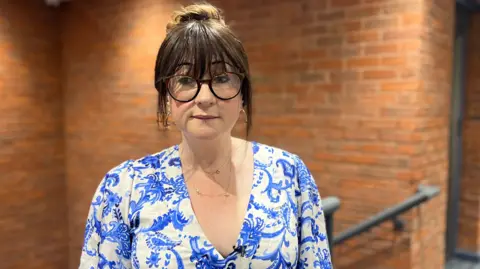
First Light says it has been raising these concerns since November 2024, working with universities, colleges and employers "to ensure they had the information they needed before these products could gain a foothold in Devon and Cornwall".
Gooding says the concern is what happens when evidence collected outside a regulated environment is later relied on in court.
"[If] that case falls apart as a consequence of their [the victim's] own actions, that that will do untold damage to that individual," she says.
Gooding adds victims should not carry the burden of proving their own case.
"The most important thing for a victim of rape is the fact that they can have access to help and support when they need it.
"It's not their responsibility to stop rape."
The NPCC has issued a national position statement warning that evidence collected through self-swabbing kits in unregulated environments could be challenged or ruled unusable in court.
The policing body says that while self-swabbing outside regulated environments is "not recommended", officers would still gather material presented to them "without judgement" as part of a wider investigation.
Chief Constable Sarah Crew, NPCC lead for adult sexual offences, says victims should instead be supported through regulated forensic and medical pathways.
"These kits can create false expectations, lead to re‑traumatisation and reduce trust in statutory services," she says.
"Our priority is always to put victims' needs first, while relentlessly focusing on identifying, disrupting and prosecuting perpetrators and anything that undermines that, risks allowing offenders to continue their behaviour."
Devon and Cornwall Police, NHS England, the Faculty of Forensic and Legal Medicine, Rape Crisis England & Wales and the Association of Forensic Science Providers have all warned self-swabbing outside clinical settings risks contamination and evidential weakness in court.
 Enough
But Devon and Cornwall's Police and Crime Commissioner Alison Hernandez supports exploring the idea, despite the position taken by her own force and national policing leaders.
She says she is "committed to identifying radical and disruptive ideas to combat" violence against women and girls and "will not discount any idea put forward, no matter how controversial, without due consideration".
She says her office is considering funding an independent evaluation of a pilot programme of self-swab kits Enough is proposing, dependent on the company securing funding for the pilot.
Hernandez adds: "I am keen to listen to any organisation that is interested in reducing sexual violence and addressing its aftermath.
"With long waits for justice and very low conviction rates the current system is failing victims of rape and all opportunities to improve this need to be considered."
White says Enough has always presented self-swabbing as the "third option" after sexual assault referral centres and the police.
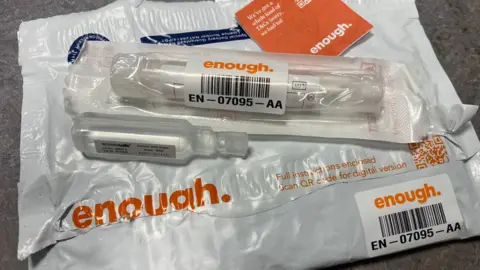
She says the kits contain a DNA swab to be posted to a laboratory for testing, with half the sample frozen which can be kept for up to 20 years.
Enough's claim the kits could deter rape has drawn fierce criticism.
"The physical presence of this on a campus and students being aware of what it does, that creates a threat - it makes a rapist think twice," White adds.
"The second is that the existence of these starts conversations... about consent... so it's a combination of criminal and cultural threats."
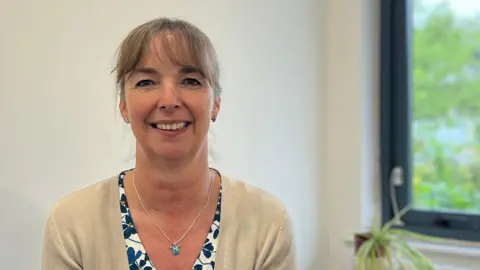
But Gooding, from domestic abuse and sexual violence charity, First Light, says preventing rape cannot be achieved with a swab kit.
"It's about society challenging those abusive behaviours," she says.
"And it's everybody's responsibility to do that.
"Why should it fall upon a rape victim to prove themselves that they are a victim?
"It's not their responsibility at all."
If you have been affected by any of the issues raised in this report, help and information is available via the BBC Action Line.
Follow BBC Devon on X, Facebook and Instagram. Send your story ideas to spotlight@bbc.co.uk.
