Mother and baby home dig uncovers remains of another 36 children

 ODAIT
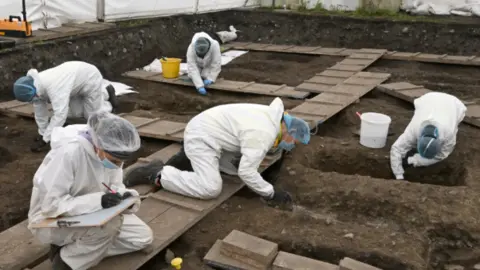
ODAITThe experts tasked with excavating the site of a former mother and baby home in western Ireland have uncovered the remains of another 36 infants.
The latest update in the ongoing search in Tuam, County Galway, brings the total number of infant remains found, so far, to 69.
The dig was commissioned by the Irish government, following widespread shock over revelations that babies and young children had been buried in a mass grave.
The scandal came to light in 2014 when an amateur historian, Catherine Corless, revealed 796 children died as residents of the home, but had no burial records.
Who ran the home?
The mother and baby home, which housed unmarried mothers and their children, was operational for 36 years between 1925 and 1961.
It was run by an order of Catholic nuns, the Bon Secours Sisters, and during their tenure many children in their care died from malnutrition and disease.
The order has since apologised, acknowledging that children were "buried in a disrespectful and unacceptable way" within the grounds of their institution.
 ODAIT
ODAITChildren 'buried in white coffins'
In 2017, a test dig confirmed evidence of a mass, unmarked grave in a large underground structure thought to be related to a sewerage storage system.
As a result the government ordered a full forensic excavation of the site.
That operation began last summer and the team releases information on its findings on a monthly or bi-monthly basis.
In its latest update, they said the results indicate that the infants they found "were buried in coffins which have since decayed".
"The evidence indicates that the majority of coffins were single shouldered with mounts and had been painted white," the report stated.
It added that in a small number of cases "two or three individuals were buried in the same coffin".
The Tuam home was demolished a few years after it closed and the area around the site was developed into a housing estate in the early 1970s.
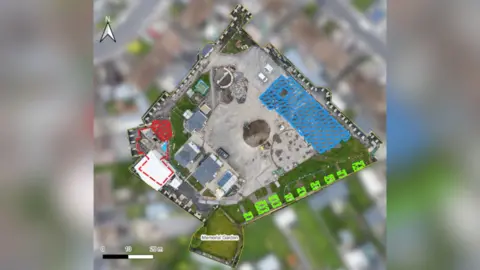
The latest remains were found in an area of the site which was identified in historical documents as a "burial ground".
The team said the evidence they have recovered "is consistent with the location being a burial ground" from the period during which the home was in operation.
However, the report also said there were no surface markers in that location which would have indicated the presence of graves.
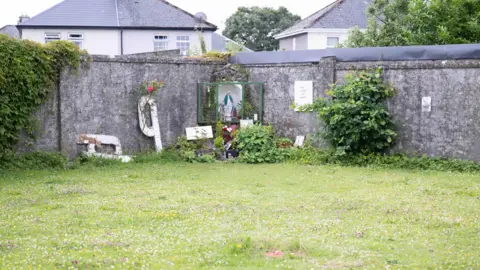
That area (marked red in the aerial image above) is to the north west of a grassed courtyard which residents have tended to as a memorial garden since 1975.
Human remains were uncovered shortly after residents moved in to the new estate, but at the time it was believed the bones were from a famine-era grave.
 Andrew Downes/ODAIT/PA Wire
Remains to be identified through DNA
All infant remains uncovered during the current forensic excavation are being exhumed in the hope they can be identified through DNA analysis.
The plan is to return them to their loved ones for a proper burial or cremation, according to their family's wishes.
The team's latest information release is the sixth update since the operation began and covers the period from 29 January to 31 March 2026.
During that period, five more DNA samples have been taken from people who believe they may have relatives buried at the site.
It brings the total number of DNA samples submitted to 33.
The dig team has again appealed to anyone who believes they may have a family member buried at the Tuam site to contact them.
What is the aim of the excavation?
The team involved in the excavation includes archaeologists, anthropologists, construction workers, a specialist photographer and an evidence manager.
Their mission is to exhume, analyse and where possible identify human remains which were "buried in a manifestly inappropriate manner" at the Tuam site.
They will also attempt to establish the cause of death of each infant, and the circumstances in which they died.
However, that task will be extremely challenging, due to the passage of time and the co-mingling of remains as a result of the nature of their burial in a mass grave.
The dig team's work is overseen by the Office of the Director of Authorised Intervention, Tuam (ODAIT) which was established by law in October 2022.
Any sets of remains which cannot be identified following tests will be "buried with dignity and respect" according to ODAIT's website.
